

VW P0108 Code Manifold Air Pressure (MAP) Barometric Pressure Sensor
Reviewed/Verified by:

A P0108 fault code indicates an issue with the circuit for the Intake Manifold Air Pressure (MAP) sensor. P0108 code will trigger the check engine light if there is a problem with the intake manifold pressure sensor, faulty connector, or damaged wires.
At a Glance
- Meaning: P0108 is a high signal from the manifold absolute pressure (MAP) sensor circuit.
- Most common causes: a failed MAP sensor or damaged wiring and connector.
- The sensor runs on a 5 volt reference, not 12 volts; check reference, ground and signal with a meter.
- A wire shorted to the 5 volt reference can set this code with a good sensor.
- On some engines the same unit also measures charge air temperature (P007D).
The two most common problems that trigger the check engine light with code P0108 are a bad MAP sensor or wiring issue.
This sensor can set more than one fault code:

🔧 Find out what is actually wrong before you pay someone to guess
Dealer level diagnostics at home with the YOUCANIC UCAN-II Pro.
- ✔ Covers most makes and models, including many luxury brands. Send us your VIN and we will confirm your car before you order
- ✔ Reads every module, not just the engine, so you find the faults a basic reader says are not there
- ✔ Commands the car: test a fan or pump, bleed ABS, retract an electronic parking brake, register a battery
- ✔ No subscriptions. Free lifetime updates, so the price you pay is the whole price
- ✔ Backed by real mechanics in the USA you can email before and after you buy
Featured in The Wall Street Journal
- P0108: Manifold absolute pressure (MAP) sensor/barometric pressure (BARO) sensor: high input
- P007D: Charge Air Cooler Temperature Sensor Circuit High, Bank 1 (on engines where the intake air temperature sensor is built into the same unit)

Possible Causes

- Faulty manifold pressure sensor
- Damaged connector for manifold pressure sensor
- Damaged wires that connect to the manifold pressure sensor
- Faulty Engine Control Unit (ECU): Rare
MAP sensor communicates with the ECU. It operates in a 5-volt range and not 12 volts.
Symptoms

A fault MAP sensor can cause several issues, including:
- Check engine light on
- Rough idle
- Acceleration problems
- Poor fuel economy
How to fix code P0108
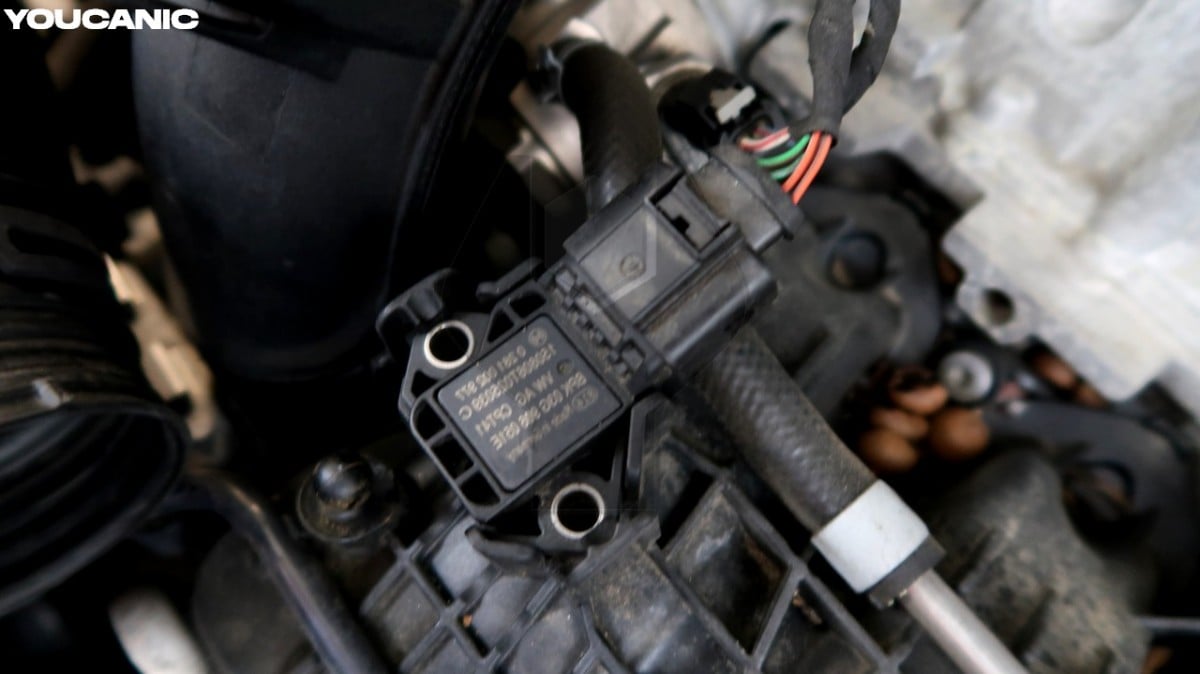
The video above shows you how to diagnose fault code P0108. Even though we diagnosed the problem on a 2016 Volkswagen Jetta, the procedure is the same for all cars since P0108 is a generic code.
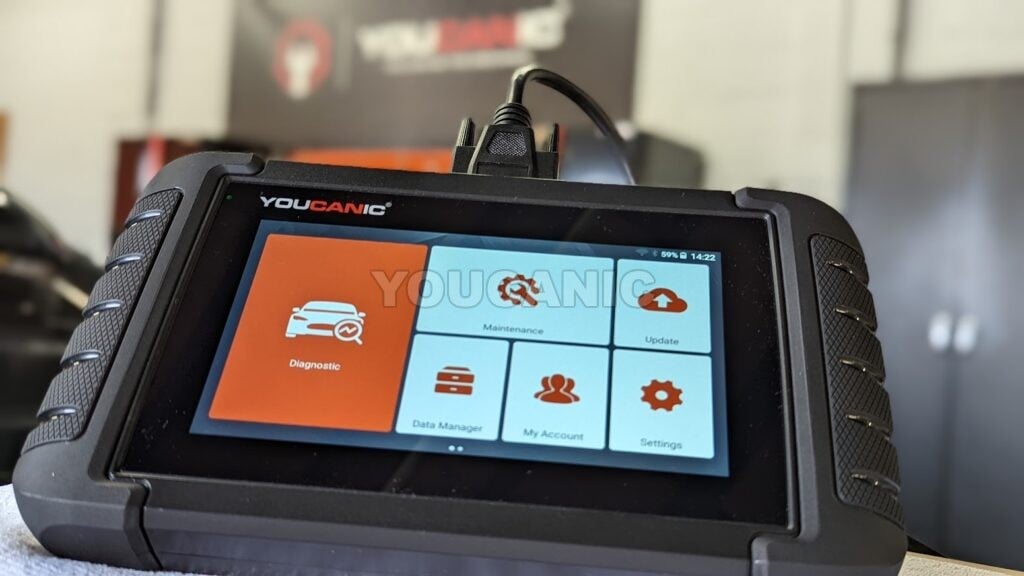
The YOUCANIC UCAN-II Pro can read and clear fault codes in the engine and other control modules on supported vehicles.
The location of the MAP sensor will vary, but the sensor is usually installed on the intake manifold.
First, start reading the fault codes using an OBD-II scanner. Connect the scanner to the diagnostic port under the dashboard and read codes from the Engine Control Module (ECM).

Next, locate the connector to the MAP sensor. Unplug it and check it for corrosion. If no corrosion is present, use a digital multimeter to check the voltage to the sensor. With the ignition on, you should read around 5 volts. If you get 0 volts, there is a wiring or ECU problem. If you have 5 volts, also check the ground pin, then plug the sensor back in and back probe the signal wire: its voltage should change when you start the engine and again when you open the throttle. P0108 means the computer sees too high a signal, and an open ground or a broken signal wire causes that just as often as a failed sensor, so rule out the wiring before buying a new one.
How to replace a MAP sensor

Replacing the MAP sensor is a very simple job that usually takes less than one hour.
- Park the vehicle on level ground.
- Allow the engine to cool down.
- Open the hood and secure it open.
- Locate the engine intake manifold.
- Remove the air filter housing or other covers on the MAP sensor.
- Unplug the MAP sensor’s electrical connector by pressing it and pulling it away.
- Remove the bolts that hold the MAP sensor in place. On a Volkswagen, you don’t need to remove any screws. Simply press on the locking tabs, then pull the sensor.
- Install the new MAP sensor in reverse order.
Can I drive with a bad MAP sensor?
While the car will still run with a bad MAP, we do not recommend driving. Fuel consumption will increase significantly; in some cases, the engine computer may limit power (limp mode), and on some cars the transmission will stay in a low gear gears.
Can a bad MAP sensor throw a code?
Yes, a bad MAP sensor can throw more than one code. Here are a couple of common fault codes triggered by a bad MAP sensor:
- P0108: Manifold absolute pressure (MAP) sensor/barometric pressure (BARO) sensor: high input
- P007D: Charge Air Cooler Temperature Sensor Circuit High, Bank 1 (on engines where the intake air temperature sensor is built into the same unit)
Can you clean a MAP sensor?
You can clean a MAP sensor with an electric parts cleaner. Cleaning the MAP sensor does not always work.
The two reading test that settles it in a minute
You do not need to guess whether this sensor is lying. Watch its live reading at two known conditions and compare them against what physics says they should be.
With the ignition on and the engine not running, the manifold is open to the atmosphere, so the sensor should read barometric pressure. At sea level that is roughly 100 kilopascals, or about 29 to 30 inches of mercury, falling with altitude. Now start the engine and let it idle. A healthy engine pulls a strong vacuum, and the reading should drop sharply to somewhere around 30 to 40 kilopascals.
A sensor that reads correctly at key on but does not fall at idle is either faulty or is not seeing manifold vacuum at all. A sensor that reads wildly high at key on, higher than local barometric pressure can possibly be, is faulty or has a wiring problem. That single comparison separates a bad sensor from everything else, and a full system scanner with live data will show it in under a minute.
Why a high reading often means a leak, not a sensor
P0108 is specifically a high input fault, and understanding what that means saves money. The module expects to see low pressure in the manifold at idle because the engine is pulling vacuum. Anything that lets air into the manifold without passing the throttle weakens that vacuum and pushes the reading up toward atmospheric, which is exactly the condition the code describes. The sensor may be reporting the truth perfectly accurately.
On Volkswagen engines the usual suspects are the crankcase breather and positive crankcase ventilation assembly, whose diaphragm splits and is a well known failure on the 2.0 TSI, along with cracked or perished vacuum lines, a split intake boot or charge pipe, a leaking intake manifold gasket and a stuck open purge valve. Before buying a sensor, look and listen for leaks with the engine idling, and check whether the fuel trims are running heavily positive, which is the signature of unmetered air getting in.
The reverse case is worth knowing too. If the small vacuum passage or hose that feeds the sensor is blocked with carbon, the sensor is sealed off from the manifold and will sit near atmospheric pressure whatever the engine is doing. Clearing that passage costs nothing.
Check the connector and the 5 volt supply
As noted above, this sensor runs on a 5 volt reference rather than battery voltage. With the connector unplugged and the ignition on, you should find close to 5 volts on the reference pin and a good ground on another. If the reference is missing, the problem lies between the sensor and the engine control module, and no replacement sensor will fix it.
Check the pins for corrosion and for oil, since oil wicking along the harness from a leaking breather system will contaminate this connector and produce intermittent faults. Flex the harness by hand while watching the live reading, because a broken conductor inside intact insulation reads normally until it moves.
Finally, do not clear the code and walk away. Fix the cause, clear it, then drive the car through a mix of idle, light cruise and acceleration and confirm the reading tracks sensibly throughout. A code that returns immediately with a new sensor fitted is telling you the sensor was never the problem.


