2004 to 2013 BMW 3-Series Check and Add Coolant
Reviewed/Verified by:

Use BMW blue coolant, the G48 type, mixed 50/50 with distilled water, and do not top up with orange or green coolant from a parts store. Mixing types is what turns a top up into a flush. The expansion tank is in the engine compartment on the passenger side, and the system needs bleeding properly afterwards rather than simply filling.
At a Glance
- Fits: 2004 to 2013 BMW 3-Series (E46 late and E90, E91, E92, E93).
- Check only with the engine cool; a hot system can spray scalding coolant.
- The expansion tank is in the engine bay; many have a float that shows the level.
- Use BMW blue coolant (G48 type), mixed 50/50 with distilled water; do not mix with orange or green coolant.
- Low coolant warnings that keep returning mean a leak, often the expansion tank, hoses or water pump.
If your BMW 3-series engine overheats, it is wise to halt driving. Pull over and allow the engine to cool off. Opening the cooling system while it is hot can spray scalding coolant and cause severe burns. Once the engine has cooled down, proper checks on the coolant level should be done.
Symptoms
- Check Coolant Warning,
- Low Engine Coolant Message
- Engine Overheating
What you will need
- BMW antifreeze coolant, either premixed 50/50 or concentrate mixed 50/50 with distilled water
Procedure
- Allow the engine to cool down.
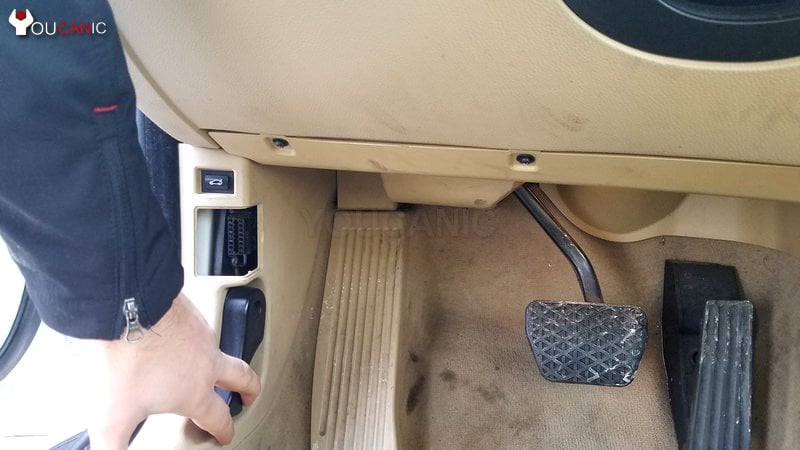
- Open Hood. In the 3-Series, the hood release is underneath the dashboard. Pull the lever until you hear the BMW hood pop open.

- Then, you will need to release the hood safety latch behind the front grille. Raise the hood and secure it in the open position.
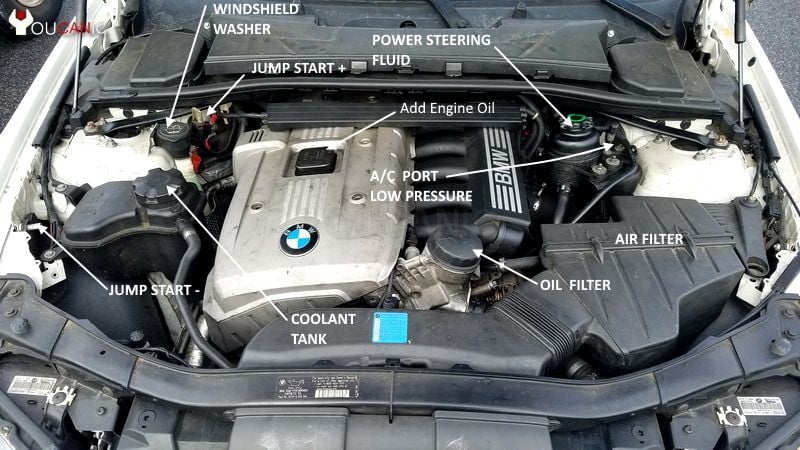
- Next, Find the Coolant Expansion Tank. The tank is located in the engine compartment in front of the passenger side. Check the coolant level and add when it is low. Open the Cap slowly. Remove the Cap only when the engine has cooled down.
- When the Cap has been Removed, check the coolant level of your BMW 3-Series. Observe the coolant reservoir tank and note the low and high levels. If the level is below the minimum mark, you will need to add coolant, or your 3-Series may overheat. BMW 3-series uses the floating device to determine the coolant level.
- Add engine coolant/antifreeze. Only add the coolant type recommended by BMW.


This guide applies to the following BMW models

🔧 Find out what is actually wrong before you pay someone to guess
Dealer level diagnostics at home with the YOUCANIC UCAN-II Pro.
- ✔ Covers most makes and models, including many luxury brands. Send us your VIN and we will confirm your car before you order
- ✔ Reads every module, not just the engine, so you find the faults a basic reader says are not there
- ✔ Commands the car: test a fan or pump, bleed ABS, retract an electronic parking brake, register a battery
- ✔ No subscriptions. Free lifetime updates, so the price you pay is the whole price
- ✔ Backed by real mechanics in the USA you can email before and after you buy
Featured in The Wall Street Journal
- 316i
- 318i
- 320i
- 323i
- 325i
- 325xi
- 328i
- 328xi
- 330i
- 330xi
- 335i
- 335is
- 335xi
- 320d
- 320xd
- 325d
- 330d
- 330xd
- 335d
- M3 and M3 GTS
Use BMW coolant, and mix it with distilled water
BMW specifies its own blue coolant, commonly referred to as G48, which is free of nitrites, amines and phosphates. That chemistry is chosen for the aluminum and plastic components used throughout the cooling system on these cars, and the orange extended life coolants sold for American vehicles are a different formulation that should not be mixed with it. Nor should the traditional green type.
Most BMW coolant is sold as a concentrate rather than ready mixed, which catches people out. It needs diluting fifty fifty, and it must be diluted with distilled or deionized water rather than tap water. The minerals in tap water deposit as scale in the radiator and heater core, and on a system with passages as fine as these that matters more than it would on an older engine.
Topping up with a small amount of plain distilled water in an emergency is acceptable to get you home. Topping up repeatedly with water is not, because it progressively dilutes the corrosion protection.
The system needs bleeding properly
This is the part specific to this generation and the step most often skipped. Gasoline models of this era use an electric water pump rather than one driven by a belt, and the cooling system does not purge air by itself simply because you have refilled it. Air trapped in the system produces an engine that overheats while the heater blows cold, which is the classic signature of a bleed that was never done.
These cars have a built in bleeding routine that runs the electric pump without starting the engine. The usual method is to fill the expansion tank, leave the cap off or loose as specified for your model, switch the ignition on without starting the engine, and then hold the accelerator pedal fully down for around ten seconds to trigger the routine. The pump runs for several minutes while air works its way out, and the level in the tank will drop as it does, so keep topping it up.
Check your own model’s procedure before relying on that, since details vary across the range, and run it more than once if the level keeps falling. Some scan tools can command the bleed directly, which is more reliable than the pedal method.
Where the coolant is going
A sealed system does not consume coolant, so a level that keeps dropping means a leak. On this generation of 3-Series the usual suspects are predictable and worth checking in order. The expansion tank itself cracks along its seams and around the level sensor, and it is one of the most common failures on the car. The thermostat housing, the radiator end tanks and the various plastic coolant pipes all become brittle with heat cycling and split. The electric water pump fails too, sometimes leaking and sometimes simply stopping.
Check the cap as well. It maintains system pressure, which raises the boiling point, and a cap that no longer seals allows coolant to be pushed out and lost as steam long before it looks worn. Caps are inexpensive and are worth replacing on age alone.
If coolant is disappearing with no visible leak, no puddle and no smell, look harder before adding more. White smoke from the exhaust, a creamy deposit under the oil filler cap or a sweet smell and damp carpet in the passenger footwell all point somewhere more serious. And if a warning appears while the level is correct, the level sensor in the tank or the coolant temperature sensor is the more likely culprit than the coolant. A full system scanner will read the stored code and show live coolant temperature, which separates a sensor fault from genuine overheating.
Frequently Asked Questions
What coolant does a 2004 to 2013 BMW 3 Series use?
BMW blue coolant (a phosphate free, nitrite free type) mixed 50/50 with distilled water, or a coolant that carries the BMW approval. Avoid generic green coolant.
Why does my BMW keep losing coolant?
Common leak points on these cars are the expansion tank, the radiator end tanks, hoses and the water pump. A sweet smell or white crust near a part shows where it is leaking.
Can I open the coolant cap when the engine is hot?
No. The system is under pressure and hot coolant can spray out. Wait until the engine is cold, then open the cap slowly.
Related Guides
- 2004 to 2013 BMW 3-Series Add Windshield Washer Fluid
- 2004 to 2013 BMW 3-Series Check or Add Brake Fluid
- 2004 to 2013 BMW 3-Series Check or Add Power Steering Fluid