
Kia Forte Rear Brake Pads & Rotor Replacement Guide
Reviewed/Verified by:

The rear caliper pistons on a Kia Forte have to be wound in, not pushed. Push them like a front caliper and you damage the parking brake mechanism inside. The rest is straightforward: two 14 mm bolts hold the carrier, and the pads are due when they are down to about 3 mm or when the wear indicator starts squealing.
At a Glance
- Fits: 2018 to 2022 Kia Forte with rear disc brakes.
- The rear caliper piston must be wound back (turned while pushed), not just pressed in, because the parking brake works through it.
- Release the parking brake and support the car on jack stands before removing the wheels.
- Watch the brake fluid reservoir as the pistons go back so it does not overflow.
- Pump the pedal several times before driving to bring the pads into contact.

What you will need
- Kia Forte Rear Brake Pads
- Kia Forte Rear Rotor
- Lug Nut Wrench
- Floor Jack
- Jack Stands
- Phillips screwdriver
- Hammer
- Mechanic Toolset
- 14mm socket
Procedure
- Park the vehicle on a flat-level ground surface.
- Loosen the lug nuts using a breaker bar or a lug nut wrench.
- Jack up the vehicle’s back and support it with jack stands.
- Pull the rear wheel out of the vehicle.

- Remove the two set screws on the rotor using a large Phillips screwdriver.


- Release the parking brakes and disconnect the cable at the back of the brake caliper.
- Remove the two 14mm bolts holding the brake caliper using a 14mm wrench.
 If the guide pins are spinning when loosening the 14mm bolt, use another 14mm wrench to hold the guide pins.

- Pull the caliper out from the carrier and set it aside.

- Pull the two metal clips out from the brake pads.

- Remove the two 14mm bolts behind the rotor holding the carrier using a 14mm wrench.

- Pull the carrier out from the rotor.

- Push the brake pads to the middle to pop them out from the carrier.
- Clean the carrier using a wire brush.
- Pull the rotor out from the vehicle. If the rotor doesn’t come off easily, use a hammer to tap the back. Do not hit the dust shield.

- Push the piston on the caliper using a rear brake piston compressor tool and turn it clockwise.
- Check on the guide pins by moving them in and out. If the guide pins are not moving efficiently, wipe them clean and add some caliper grease.
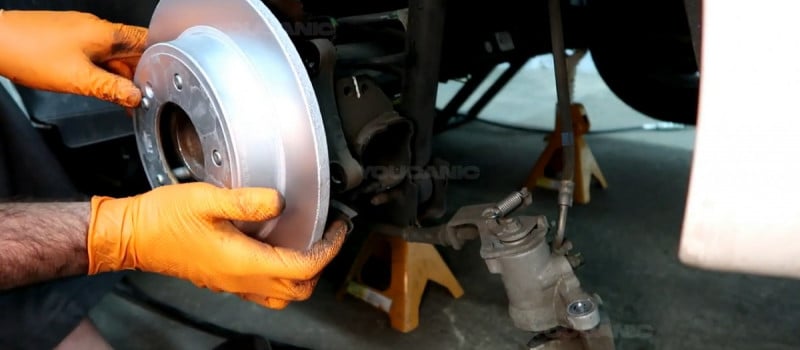
- Place the new rotor in the vehicle and reinstall the set screws. If set screws got damaged, reinstall at least one set screw.

- Line up the new brake pads into the carrier and push them to set them into place. Make sure that the brake pads are in their correct position.
- Place the carrier back to the knuckle and reinstall the two bolts. Torque to specification. See below.
- Reinstall the two metal clips on the brake pads.

- Line the caliper back to the carrier and reinstall the two 14mm guide pin bolts.

- Reinstall the rear wheel back to the vehicle.
- Start the engine and press the brake pedal a few times to set the pressure back to the brake caliper.


 If the guide pins are spinning when loosening the 14mm bolt, use another 14mm wrench to hold the guide pins.


Torque Specifications
- Rear lug nuts: 88.3 ~ 107.9 N.m (9.0 ~ 11.0 kgf.m, 65.1 ~ 79.6 lb-ft)
- Brake caliper guide pin bolts: 21.6 ~ 31.4 N.m (2.2 ~ 3.2 kgf.m, 15.9 ~ 23.1 lb-ft)
- Caliper assembly to knuckle: 63.7 ~ 73.5 N.m (6.5 ~ 7.5 kgf.m, 47.0 ~ 54.2 lb-ft)
Wind the rear piston in, do not push it
This is the mistake that turns a brake job into a caliper purchase, and it only applies to the rear. Front caliper pistons are pushed straight back with a clamp. Many rear calipers, including those on cars with a cable operated parking brake acting through the caliper, use a screw mechanism instead, and the piston has to be rotated clockwise as it is wound in using a cube or a wind back tool.
Force a screw type piston back with a C-clamp and you strip the internal threads and the parking brake adjuster with it. The caliper is then scrap. If the piston does not move with gentle pressure, stop and establish which type you have before applying more force.

🔧 Find out what is actually wrong before you pay someone to guess
Dealer level diagnostics at home with the YOUCANIC UCAN-II Pro.
- ✔ Covers most makes and models, including many luxury brands. Send us your VIN and we will confirm your car before you order
- ✔ Reads every module, not just the engine, so you find the faults a basic reader says are not there
- ✔ Commands the car: test a fan or pump, bleed ABS, retract an electronic parking brake, register a battery
- ✔ No subscriptions. Free lifetime updates, so the price you pay is the whole price
- ✔ Backed by real mechanics in the USA you can email before and after you buy
Featured in The Wall Street Journal
If your Forte has an electronic parking brake instead, the rear pistons are driven by small motors and cannot be wound back by hand at all. The system has to be put into service or maintenance mode with a scan tool first, the pistons retracted electronically, and the system reactivated afterwards. Forcing those destroys the actuator, which is considerably more expensive than the pads.
Watch the brake fluid level while you work
Retracting the pistons pushes fluid back up into the reservoir, and if someone has topped the reservoir to maximum on worn pads, it overflows. Brake fluid strips paint within minutes, and the master cylinder sits directly above painted metal. Open the reservoir cap before you start, keep an eye on the level as the pistons go back, and remove some fluid with a syringe if it climbs toward the top. Flush any spill with plenty of water rather than wiping it.
Do not press the brake pedal while a caliper is off the car or while the pads are out. Without the pads in place the piston has nothing to stop it, and it will come out of its bore, which empties the system and turns the job into a rebuild and a full bleed.
Finish the job properly
Before you drive anywhere, pump the brake pedal several times with the car stationary until it feels firm. The pistons have been wound back and the first pedal press only brings the pads into contact with the rotors. Drive off without doing this and the first time you need to stop there will be almost no braking at all.
Replace pads in axle sets rather than individually, so both sides have matching friction material and wear evenly. Clean the caliper slide pins and regrease them with a proper high temperature brake grease while everything is apart; seized slide pins are the most common reason one pad wears out long before the other and the main cause of premature rotor wear.
If you have fitted new rotors as well, bed the pads in. The usual method is a series of moderate stops from around 35 miles per hour, allowing the brakes to cool between them, avoiding both hard stops and sitting stationary with your foot on the pedal while they are hot. That last point matters: holding new hot pads against a new rotor at a traffic light transfers material unevenly and is the cause of most “warped rotor” vibration complaints, which are usually deposits rather than warping.
Torque the wheel nuts to specification with a torque wrench in a star pattern rather than running them up with an impact gun. Over tightened wheel nuts distort the rotor hat and produce exactly the pulsing under braking that people then blame on cheap rotors. Finally, if a warning light appeared alongside the worn pads, read the codes afterwards, since a full system scanner such as the YOUCANIC UCAN-II Pro will clear the stored fault and, on cars with an electronic parking brake, handle the service mode as well.
Frequently Asked Questions
How do I know the rear pads on my Forte are worn?
Squealing from the wear indicator, a grinding noise, a longer pedal, or pads thinner than about 3 mm when you look through the wheel. Rear pads usually last longer than the fronts.
Do I need a special tool to retract the rear piston?
Yes, a caliper wind back tool that turns the piston clockwise while pushing it in. Forcing it straight back can damage the parking brake mechanism inside the caliper.
Should I replace the rotors too?
If the rotors are scored, have a lip at the edge, or are below the minimum thickness stamped on them, replace them with the pads for even braking and less noise.
Related Guides
- 2018+ Kia Forte Front Brake Pads Rotor Replacement
- 2018+ Kia Forte Rear Turn Signal Light Bulb Replacement
- 2018+ Kia Forte Brake Light (Center) Trunk Replacement


