
Kia Engine Control Unit (ECU) Replacement
Reviewed/Verified by:

A Kia ECU may fail due to hardware failure caused by water damage, corrosion, or when jumper cables get connected backward. In some cases, a Kia ECU may fail due to software issues. Software issues can sometimes be fixed by running the latest software update, which the dealer can complete for a fee.
At a Glance
- Shown on: 2018 Kia Forte; similar on other Kia models
- Symptoms: Stalling, no spark or injector pulse, no start, engine will not shut off, codes that will not clear
- Common causes: Water damage, corrosion, reversed jumper cables, software
- Important: A replacement ECU normally needs programming and immobilizer pairing
- Check first: Fuses, main relay, grounds and battery voltage
This guide is a step-by-step on how to replace the engine control unit on a 2018 Kia Forte. The procedure is similar for other Kia vehicles as well.

Symptoms
Common symptoms of a faulty Engine Control Unit (ECU) include:

🔧 Find out what is actually wrong before you pay someone to guess
Dealer level diagnostics at home with the YOUCANIC UCAN-II Pro.
- ✔ Covers most makes and models, including many luxury brands. Send us your VIN and we will confirm your car before you order
- ✔ Reads every module, not just the engine, so you find the faults a basic reader says are not there
- ✔ Commands the car: test a fan or pump, bleed ABS, retract an electronic parking brake, register a battery
- ✔ No subscriptions. Free lifetime updates, so the price you pay is the whole price
- ✔ Backed by real mechanics in the USA you can email before and after you buy
Featured in The Wall Street Journal
- Check Engine Light stays on after fixing a problem.
- The engine shuts off for no reason.
- The engine keeps running after the key is turned off
- No spark.
- Loss of injection pulse or fuel pump.
- Intermittent starting problems.
Before You Buy a New ECU
- Confirm the diagnosis: codes such as P0606 (control module processor fault) or a total loss of communication with the engine computer point to the ECU. Many other no start faults look similar.
- Check power and grounds first: blown fuses, a bad main relay, corroded grounds or a weak battery can make a good ECU act dead.
- Plan for programming: a replacement ECU, new or used, usually has to be programmed to your VIN and paired with the immobilizer and keys. Without that, the engine will crank but not start.
- Consider repair: repairing the original unit can avoid programming because it keeps your car’s data.
A scan tool such as the YOUCANIC UCAN-II Pro can read engine codes and check whether the engine computer is communicating on supported models, which helps confirm the ECU is really at fault.
What you will need
- Kia Forte Engine Control Unit
- Mechanic Metric Toolset
- 10mm Socket
Procedure
- Open the hood. Pull the hood release under the dashboard.


- Locate the hood latch on the vehicle’s front and press the tab to the left to unlock the hood latch.
- Pull the hood up and set the hood strut to hold the hood open.

- Disconnect the battery’s terminals by loosening the 10mm bolt and pulling the cables out. Use a 10mm socket and turn it counterclockwise to loosen the bolt. Disconnecting just the negative battery terminal is enough.

- Locate the Engine Control Unit (ECU) on the driver’s side of the engine compartment near the vehicle’s firewall.
- Unlock the clips on the ECU’s electrical connectors by pulling the clips up.


- Disconnect the electrical connectors by pulling them out of the ECU.


- Remove the 10mm bolt on the right side of the ECU’s metal plate. Use a 10mm socket and turn it counterclockwise to remove the bolt.

- Remove the two 10mm bolt below the ECU’s metal plate. Use a 10mm socket and turn it counterclockwise to remove the bolt.
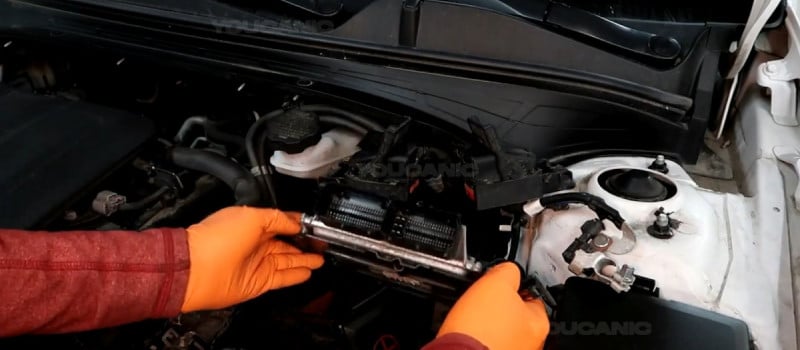
- Pull the bracket and ECU out of the vehicle.

- To remove the ECU from the bracket, remove the four 10mm bolts of the ECU attached to the frame. Use a 10mm socket and turn the bolts counterclockwise to remove them.

- Line up the new Engine Control Unit into the metal plate and reinstall its four 10mm bolts by turning them clockwise.
- Place the ECU and metal plate back in the vehicle. Then reinstall the two 10mm bolts below, and one 10mm bolt on the left of the bracket.

- Reconnect the two electrical connectors of the ECU and push the clips down to set them into place.

- Reconnect the battery terminals and tighten the 10mm bolts to set them into place.


The new ECU will need to be codded before starting the engine. If the ECU is used, data of the previous vehicle will need to be cleared; then, it can be coded and programmed to work on your Kia. Kia dealerships will only install a new ECU. A Kia dealership will not install or program a used ECU.
Independent repair shops that specialize in ECU programming and coding will be able to flash a used ECU and code it to work on your vehicle.
Check these troubleshooting and repair guides for more help on your Kia.
Frequently Asked Questions
What are the symptoms of a bad Kia ECU?
Stalling for no reason, no spark or fuel injector pulse, intermittent no start, an engine that keeps running after shut off, and codes that return after repairs.
Does a replacement Kia ECU need programming?
Usually yes. It must be programmed to the car and paired with the immobilizer and keys, or the engine will not start.
What can damage a Kia ECU?
Water intrusion, corrosion and connecting jumper cables backward are common causes.
Can a software update fix ECU problems?
Some ECU issues are software related and can be fixed with the latest update from a dealer.
Related Guides
- Kia ABS Module Pump ESC Control Unit Replacement
- 2015 to 2021 Kia Sedona Check + Add Engine Oil
- 2015 to 2021 Kia Sedona Engine Air Filter Replacement
- Kia Forte Engine Air Filter Replacement Guide


