When the air conditioner on your Volvo is not putting out cold air, it means there is an issue with the A/C system that requires attention. While this problem will not affect your driving or safety, it can lead to a very uncomfortable driving experience during the hot summer months.
What Does A/C Is Not Cooling Issue Mean?
The heat and ventilation air conditioning system (HVAC) is responsible for keeping the vehicle at a comfortable temperature. When the A/C malfunctions, the most noticeable problem is the car not cooling. This must be fixed immediately to prevent an uncomfortable driving experience.
⚠️ Why You Should Fix It ASAP:
Performance Issues – The A/C not cooling may lead to a hot driving experience and reduced fuel efficiency if you decide to drive with the windows down.
Costly Repairs if Ignored – The issue may cause more damage if ignored. The estimated cost of repair starts from $200 – $1500
Common Causes
There are many systems and A/C components that could be malfunctioning, leading to a faulty A/C. These include:
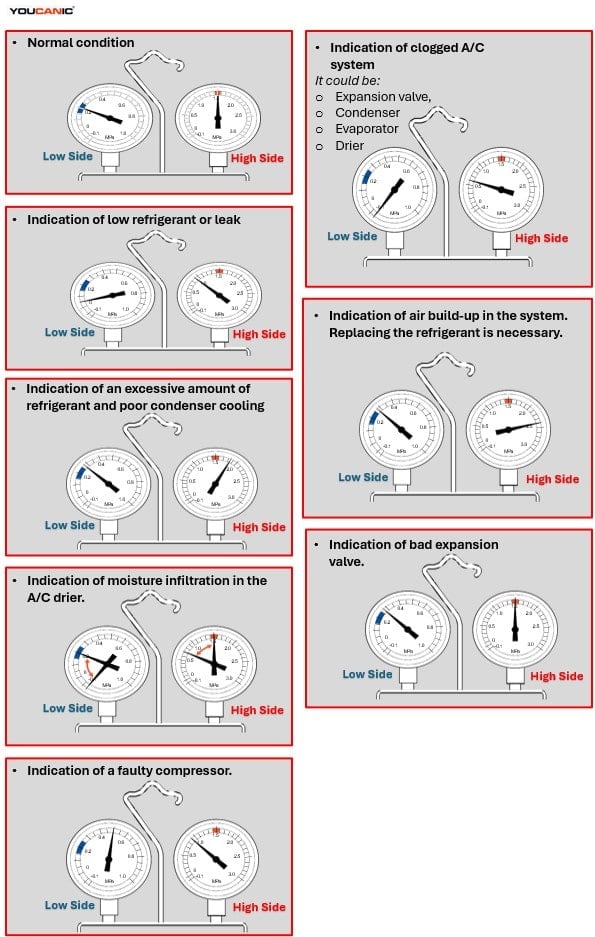
⚠️ Low A/C Refrigerant -Low refrigerant levels, most often caused by a leak in the refrigerant reservoir, will cause low pressure in the A/C system. Causing the cooling to be insufficient.
⚠️ Faulty A/C Compressor– A faulty compressor may not properly pump and cycle the refrigerant into the system.
⚠️ Faulty Expansion Valve– A faulty expansion valve may block or not control the flow of the A/C refrigerant.
⚠️ Defective Drier – Driers in the A/C system can become clogged, leading to moisture buildup, making it malfunction.
⚠️ Dirty Evaporator – A dirty evaporator can block cool air and might lead to harmful microorganisms being blown through the vents, which are bad for health.
⚠️ Dirty Condenser – A dirty condenser may cause insufficient refrigerant cooling.
⚠️ Faulty Blower Motor – A faulty blower motor will not rotate to blow the cool air from the evaporator.
⚠️ Defective Resistor Block – A defective resistor block will stop working or will not deliver enough energy to the blower motor to operate the low and high speed.
⚠️ Faulty Auxiliary Fan – A faulty auxiliary fan will cause the condenser not to properly cool the refrigerant, leading to insufficient cooling of the A/C.
⚠️ Faulty Pressure sensor – A faulty pressure sensor may not switch the A/C compressor to operate. The sensor is responsible for detecting the refrigerant pressure.
⚠️ Faulty Temperature Sensor – A faulty temperature sensor may send incorrect data to the module and cause an abnormal cooling temperature inside the vehicle’s interior.
⚠️ Faulty A/C Controller / Module – A faulty A/C controller may lead to abnormal operation affecting the A/C cooling.
⚠️DirtyA/C Filter – A dirty A/C filter may block the airflow coming from the blower.
⚠️ Faulty Flap Motors – A malfunctioning flap motor will affect where the cold air is blown when the A/C is turned on. For example, you feel cold air hitting your feet, but hot air is hitting your face.
🛠️ Pro Tip: Use an OBD-II scanner to check for error codes related to the issue.
Common Symptoms
A/C is Not Cold – If any of the components of the A/C system stop working, this may lead to warmer temperatures when the A/C is turned on.
Low-Speed Auxiliary Fan is Not Operating – If the auxiliary fan is not operating at a low speed, this may affect the cooling of the A/C, causing an insufficient cold temperature.
Loud A/C Compressor – The A/C compressor should be silent. If you hear unusual noises when the A/C is turned on, it could indicate a problem with the compressor. It will make a clicking or hissing noise when in operation.
No Air Coming Out on the Vents – You will not feel air coming from the vents if the blower is not operating. Blocked air ducking, leakage, or a dirty A/C filter could also be causing the problem.
The Air Flow is Stuck / Can’t Change the Modes – If the A/C controller or the flap motor is faulty, you may not be able to change the airflow settings.
Can Not Change the Blower Speed – The blower speed can not be changed because of a faulty A/C controller, blower motor, or resistor block.
Stinky Smell – A dirty air filter or evaporator will cause a bad smell. Sometimes the smell is coming from outside, check and change the setting air circulation to inside.
Troubleshooting
Before taking your car to a mechanic, try these DIY fixes:
Use an OBD-II scanner – Scan the vehicle for any diagnostic trouble codes (DTCs) related to the A/C system. Try to delete these codes and scan the system again to verify whether they are DTCs related to the A/C system.
Check the Fuse and Relay – Check the fuse box cover to locate the A/C fuse and relay. Look for any signs of damage or melting that may cause the issue. You can check the quality of a fuse and relay by using a multimeter tool or by swapping the fuse with one of the same amperage to confirm the fuse port is functioning properly.
Check the A/C Refrigerant Volume -Use an A/C gauge or A/C machine to check the refrigerant level. A machine can also perform other maintenance tasks, like recharging the A/C system.
Check A/C Refrigerant Leaks – Use a refrigerant leak detector tool to locate the leak.
Check Cabin Filter or A/C Filter – Inspect your A/C filter and replace it if necessary. Cleaning it by using air is not recommended.
Check the Blower – Check the blower condition by using a multimeter. A bad motor will give you a reading of “OL.” You can also direct a 12V supply to check if the blower works. Look for any big dirt or garbage inside the blower housing that may block the rotation and sometimes create unusual sounds.
Check Resistor Block – Inspect the resistor block by checking the resistance. Check your owner’s manual for the correct reading. A bad resistor block may cause the blower not to change speed.
Check the A/C Auxiliary Fan – The auxiliary fan will operate by starting the vehicle and turning on the A/C. If it does not work, inspect the wiring of the A/C auxiliary fan or the motor itself. You can supply a direct 12V to check if the fan is working.
Check A/C Compressor – Start the vehicle and turn the A/C on. Check if the A/C compressor clutch is engaging. If not, this is a sign of a faulty A/C compressor. Make sure the refrigerant levels are good, and check the other A/C components. You may supply a 12V on the magnetic clutch to confirm if it is faulty.
Need some help scanning your Volvo for DTCs? Watch our video guide to diagnose your vehicle like a pro!
CCM-0021 – A/C pressure sensor signal too high/low
CCM-0022 – A/C high-pressure sensor faulty signal
CCM-0023 – A/C evaporator temperature sensor faulty signal
CCM-0025 – Cabin temperature sensor fault
CCM-0076 – Cabin fan motor fault
CCM-0080 – Recirculation motor fault
CCM-0040 – Low refrigerant level or loss of gas
CCM-0060 – Evaporator temperature sensor out of range
FAQs
When should I replace the A/C refrigerant?
➡️ There is no regular maintenance schedule for your A/C refrigerant. Only add or replace the fluid if you have a problem with the system. Do not repair if there is no issue.
What is the best type of refrigerant for my car?
➡️ Every car uses different types of refrigerant. Use the manufacturer’s recommended specifications applicable to your vehicle. The most common type of refrigerant is R134a and R1234yf. Some countries are not strict on this new refrigerant. Check your country’s regulations.
Does a faulty A/C system affect the engine performance?
➡️No, an issue with the A/C will not affect the engine. It will only affect some of the features.
Does engine overheating affect the A/C system?
➡️Yes,especially if the cause of the engine overheating affects the function of the auxiliary fan.
Can A/C still work if the engine is turned off?
➡️ No, there would be no cooling if the engine is turned off because the refrigerant will not flow through the system. With the engine turned off, the magnetic clutch of the compressor will not operate, but you can still have air coming from the air blower.
Final Thoughts
While a faulty air conditioner system in your Volvo will not create dangerous driving conditions, it can make for a very uncomfortable driving experience. Following these troubleshooting steps and scanning for fault codes can save time and money while ensuring your car remains safe and reliable.
Experts Who Contributed to This Article
Elbert Nonog, Automotive National Cert., BS Mechanical Eng.
Diagnostic Specialist13+ years of experience
Elbert G. Nonog is an Automotive Technical Writer and Training Manager with over 10 years of experience across major brands including Chevy, MG, Ford, Volkswagen, and Toyota. Rising from technician to leadership roles, Elbert excels at transforming complex automotive concepts into accessible training materials and documentation. His expertise spans conventional and electric vehicle systems, nationwide dealership training, and aftersales operations management. With TESDA certification and pursuing further education from the Technological University of Philippines, Elbert effectively bridges the gap between automotive engineering and practical application for industry professionals and enthusiasts.
rhila, ASE Certified
Diagnostic Specialist15+ years of experience
Rushit Hila is a dedicated automotive engineer with ASE G1 certification and specialized training from an esteemed Automotive Specialty School. His hands-on experience and technical expertise in advanced diagnostics, system integration, and performance optimization make him a trusted voice in the industry.