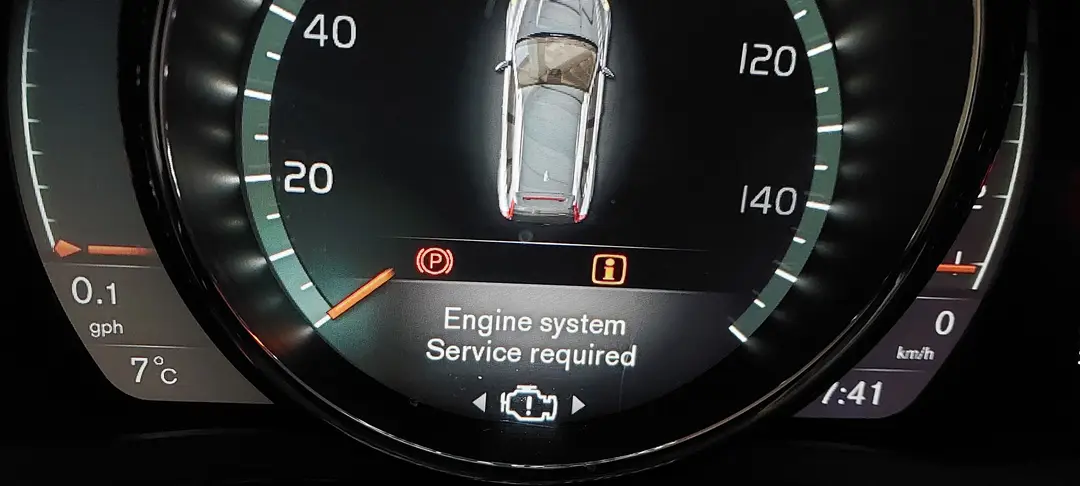
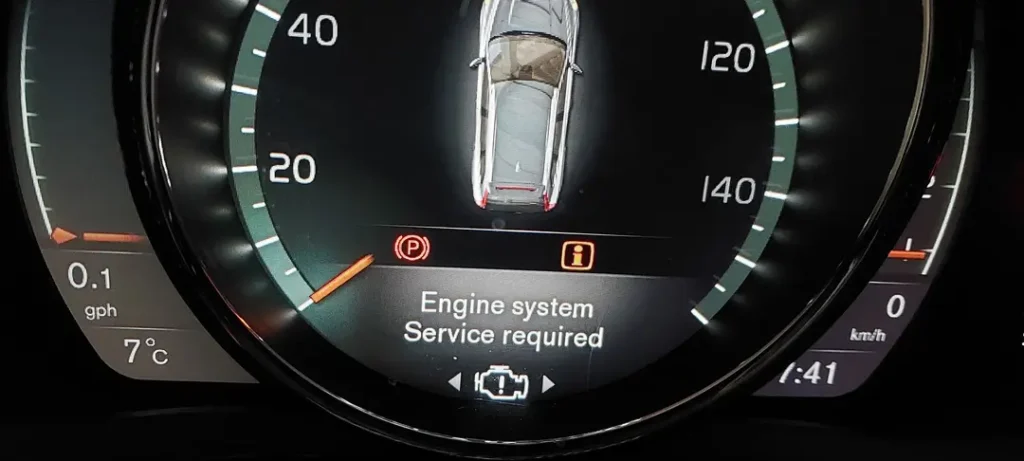
If the “Service Engine” warning message lights up on your Volvo dashboard, it could indicate multiple issues with the engine, emissions system, or other critical components that require immediate attention. Ignoring this warning can lead to abnormal engine operation and harmful emissions. It is important to diagnose and fix the issue as soon as possible.
Common Causes
Faulty gas cap – A faulty or loose gas cap can cause various problems, such as fuel odor and warning messages. The gas cap has a seal that wears out over time and may need to be replaced.
O2 Oxygen sensor—A defective oxygen sensor can trigger the check engine warning message or engine malfunction indicator light on the dashboard.
Bad catalytic converter—A faulty or clogged catalytic converter may trigger the engine warning message, resulting inexcessive emissions with a foul odor.
Vacuum Leaks – A vacuum leak occurs when unmetered air enters the engine, disrupting the air-fuel mixture.
Spark Plugs – If the vehicle has over 100k miles and the spark plugs were never replaced, they can trigger the check engine light.
Common Symptoms
Volvo Check Engine Light on along with other warnings.
Misfiring- An engine misfire occurs when one or more cylinders fail to ignite the air-fuel mixture properly.
Low power output – Low power output indicates that the engine is experiencing inefficient combustion due to an underlying mechanical or system failure.
Hard starting – An engine that struggles to start indicates an issue with the fuel, ignition, battery, or sensors.
Engine stalling—Engine stalling requires immediate attention. It may be caused by faulty fuel components, ignition issues, sensor failures, malfunctioning modules, or other related problems.
Troubleshooting
Before taking your car to a mechanic, try these DIY fixes:
Check Battery Health – Use a battery tester, multimeter, or scanner to check for low voltage (below 12.4V is considered too low). Keep track of when you last replaced your battery; car batteries typically last 3-5 years and must be replaced after that time.
Inspect Wiring and connections – Look for loose or frayed wires around the ignition, fuel, air induction, and exhaust systems. Loose connections can usually be snapped back in place, but damaged wires need to be replaced.
Inspect Fuses – look for damaged or melted fuses in your vehicle’s fuse box. This could be an indicator of an electrical issue in your car. You should find and correct the electrical issue before replacing the fuse to prevent the new fuse from tripping. ONLY REPLACE OLD FUSES WITH NEW ONES OF THE SAME AMPERAGE.
Top-Off Fluids—Check if the oil, coolant, and brake fluid are all at the correct levels and in good condition. If any need to be topped off, refer to your owner’s manual for the correct fluid specifications. If the coolant or brake fluid in your vehicle looks dirty, take your car to a mechanic to have the reservoir flushed.
Use an OBD-II Scanner – Read and clear error codes to see if the issue is temporary.
Reset the System – If the warning light/error message was caused by a glitch in the system, it can be cleared by disconnecting the battery for 30 minutes or using a scan tool.
Having trouble finding and reading the fault codes related to your service engine warning message? Check out our YouTube guide, and diagnose your Volvo like a pro!
Common OBD-II Fault Codes
FAQs
Can I still drive with the warning message?
➡️Yes, you can still drive the vehicle with the warning message. However, you should visit a repair shop or fix the problem yourself as soon as possible to prevent accidents on the road and even more costly repairs.
Do I need a scanner to check the warning message?
➡️Yes, because the warning message is only meant to alert the driver that there is something wrong in the vehicle, and in some instances, this kind of warning light could indicate that there are multiple things wrong in your car.
Why is the catalytic converter clogging?
➡️Clogging is typical in all vehicles due to carbon deposits. However, we can prevent this from happening by performing proper maintenance.
Can I remove the catalytic converter?
➡️No, because this is designed to filter the Carbon Monoxide (CO), Hydrocarbons (HC), and Nitrogen Oxides (NOx) to prevent air pollution. It converts toxic gases into less harmful substances before releasing them into the atmosphere. Removing or tampering with a catalytic converter is illegal in most countries due to environmental regulations and will not solve the warning message issue.
Final Thoughts
The Service Engine warning message should never be ignored, as it could indicate a serious issue with your vehicle’s engine performance and emission. The problem can be as simple as a faulty gas cap, but it can also indicate more serious engine problems, such as a worn timing chain. Following these troubleshooting steps and scanning for fault codes can save time and money while ensuring your car remains safe and reliable.
Experts Who Contributed to This Article
Elbert Nonog, Automotive National Cert., BS Mechanical Eng.
Diagnostic Specialist13+ years of experience
Elbert G. Nonog is an Automotive Technical Writer and Training Manager with over 10 years of experience across major brands including Chevy, MG, Ford, Volkswagen, and Toyota. Rising from technician to leadership roles, Elbert excels at transforming complex automotive concepts into accessible training materials and documentation. His expertise spans conventional and electric vehicle systems, nationwide dealership training, and aftersales operations management. With TESDA certification and pursuing further education from the Technological University of Philippines, Elbert effectively bridges the gap between automotive engineering and practical application for industry professionals and enthusiasts.
rhila, ASE Certified
Diagnostic Specialist15+ years of experience
Rushit Hila is a dedicated automotive engineer with ASE G1 certification and specialized training from an esteemed Automotive Specialty School. His hands-on experience and technical expertise in advanced diagnostics, system integration, and performance optimization make him a trusted voice in the industry.