

2004 to 2013 BMW 3-Series Jump Start Instructions
Reviewed/Verified by:

Do not jump a 2004 to 2013 3 Series at the battery itself. The battery is in the trunk, and BMW provides a positive post under a red cap in the engine bay along with a separate ground point, which is what the jump leads are meant to go on. The reason is the intelligent battery sensor clamped to the negative terminal, which monitors every amp going in and out so the charging system can manage the battery correctly.
At a Glance
- Use the engine bay jump points. The battery is in the trunk, and BMW provides a positive post under a red cap and a ground point under the hood.
- Connection order: positive to positive, donor negative, then the final clamp to the ground point on the BMW. Remove in reverse.
- Let the donor run for five minutes before trying to start.
- Drive for 20 to 30 minutes afterwards so the alternator can recharge the battery.
- Find out why it went dead, and reinitialize the windows and sunroof if one touch stops working.
Symptoms
- The BMW engine won’t start.
- The engine won’t crank.
- Clicking noise but not starting.
What you will need
- Portable jump box
or - Jumper or Booster Cables
Procedure
- Switch the ignition off and remove the key. BMW vehicles are very sensitive to voltage spikes, and the BMW 3-Series is no exception. To avoid electrical problems, start by removing the key from the ignition.

- Open the hood. Locate the hood release underneath the dash. Pull the lever until you hear the hood pop open. Next, release the hood safety latch at the middle front of the hood.
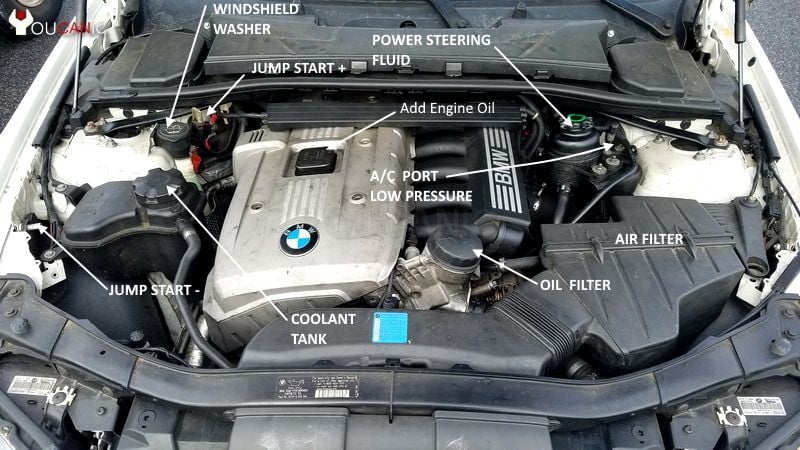
- Locate the terminals on the passenger side of the engine where you can jump-start your BMW 3-Series.
- Connect Positive; attach the red (positive) cable to the positive jump start terminal. Using another car to jump-start your BMW 3-Series, you will connect the red clamp.
- Connect the black (negative) cable to the ground post, which is the negative terminal.
- Start Engine. You are now ready to start your BMW using a jump box. If you use jumper cables to start the car, proceed to the following steps.
- The red jumper cable clamps to the positive battery terminal of the donor vehicle and the positive jump-start terminal of the disabled car.

- Negative jumper cable: attach one end to the negative terminal of the donor vehicle and the other side to the bare metal of the engine block of the disabled car.
- Start the donor vehicle, let it charge for a few minutes, then start the disabled car.



These instructions will help owners of the following BMW models:
- 316i
- 318i
- 320i
- 323i
- 325i
- 325xi
- 328i
- 328xi
- 330i
- 330xi
- 335i
- 335is
- 335xi
- 320d
- 320xd
- 325d
- 330d
- 330xd
- 335d
- M3
- M3 GTS
Use the engine bay terminals, not the trunk battery
The battery on this generation of 3-Series lives in the trunk, but BMW does not intend you to jump start from it. There is a dedicated positive jump start post in the engine bay, under a red plastic cap, and a designated ground point nearby, and those are the connections to use. They are there precisely so that nobody has to work across a battery in an enclosed space.

🔧 Find out what is actually wrong before you pay someone to guess
Dealer level diagnostics at home with the YOUCANIC UCAN-II Pro.
- ✔ Covers most makes and models, including many luxury brands. Send us your VIN and we will confirm your car before you order
- ✔ Reads every module, not just the engine, so you find the faults a basic reader says are not there
- ✔ Commands the car: test a fan or pump, bleed ABS, retract an electronic parking brake, register a battery
- ✔ No subscriptions. Free lifetime updates, so the price you pay is the whole price
- ✔ Backed by real mechanics in the USA you can email before and after you buy
Featured in The Wall Street Journal
The ground connection matters more than people realize. Never clamp the negative lead directly to the battery negative terminal on these cars. A small module called the intelligent battery sensor is fitted to that terminal and monitors every amp going in and out so the charging system can manage the battery correctly. Clamping onto the post bypasses the sensor during the jump and can damage it, after which the car never charges the battery properly again and you are left chasing a fault that the jump start created.
Use the marked ground point in the engine bay, or failing that a solid unpainted bracket or engine lifting eye well away from the battery, the fuel lines and anything that moves. Connecting the final clamp away from the battery also keeps any spark away from the hydrogen a charging battery gives off.
Get the order right and be patient
Connect positive to positive first, then the ground lead to the donor battery negative, and only then the final clamp to the ground point on the BMW. Disconnect in exactly the reverse order. Keep the leads clear of belts and fans throughout, and do not let the two clamps on the same cable touch each other at any point.
Rather than cranking immediately, leave the donor car running for five minutes or so with the leads connected before attempting to start. A deeply discharged battery on a car like this has a great deal of electronics to wake up, and giving it a few minutes to take some surface charge makes the difference between a start and a frustrating series of clicks. If it still does not start after two or three attempts of a few seconds each, stop. Continued cranking will flatten the donor battery too and can overheat the starter.
Do not attempt to jump a battery that is visibly damaged, leaking, swollen or frozen solid in cold weather. Any of those can rupture under charge.
Once it starts, the job is not finished
Drive the car for a decent run rather than switching it off at the end of the street. An alternator needs sustained running to replace what a dead battery has lost, and twenty to thirty minutes at steady speed will do far more than idling on the driveway.
Expect some electronics to misbehave afterwards. On these cars the one touch operation of the windows and the sunroof is commonly lost when the battery goes fully drained and has to be re initialized by holding each switch at the end of its travel for a few seconds. Modules also log low voltage faults during the event, and those do not always clear by themselves, so a warning light that appeared after the jump is often a stored fault rather than a new problem. A scanner that supports BMW, such as the YOUCANIC UCAN-II Pro, will clear those and tell you whether anything genuine was left behind.
Most importantly, work out why it went dead. A battery that needs jumping once after headlights were left on is unremarkable. One that goes dead on its own is telling you something, and the candidates are a battery at the end of its life, an alternator not keeping up, or a parasitic drain from a module that will not go to sleep. If the battery does turn out to need replacing, remember that these cars require the new battery to be registered to the vehicle, otherwise the charging system keeps using the profile of the old one and the new battery fails early.
Frequently Asked Questions
Where is the battery on a 2004 to 2013 BMW 3 Series?
On the E90, E91, E92 and E93 the battery is in the trunk, under the floor on the right side. That is why BMW provides jump start terminals in the engine bay; use those instead of the battery itself.
Why are there warning lights after a jump start?
Low voltage during cranking makes many modules log faults, so ABS, airbag or steering warnings can appear. If they stay on after a drive, read and clear the codes, then check the battery.
Can I use my BMW to jump start another car?
You can, using the same engine bay terminals, but keep your engine at idle and do not rev it. Disconnect the cables in the reverse order as soon as the other car starts.
Do I need to register a new battery after it dies?
If the battery has to be replaced, register it so the car charges it correctly. A battery that died once may be weak, so have it tested after the jump start.
More guides: browse all of our BMW repair and troubleshooting guides.


