
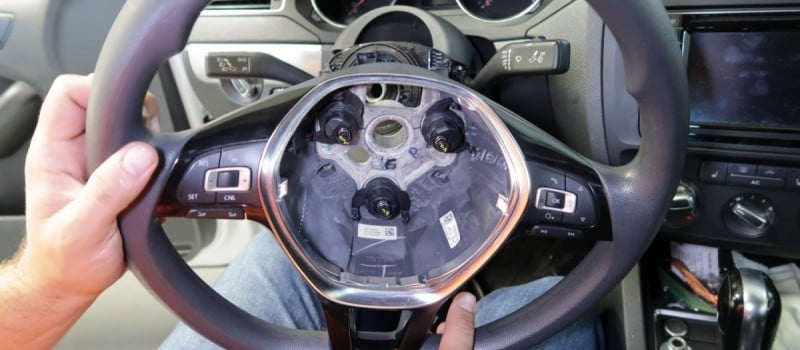
VW Steering Wheel Removal DIY
Reviewed/Verified by:

You need an M12 triple square bit. A Torx 55 will usually turn the bolt, but it is not an exact fit and it rounds them. Disconnect the negative battery terminal and wait 15 minutes before touching the airbag. On torque, do not copy a figure from another model: older cars such as the Mk4 Golf and Jetta are commonly listed at 50 Nm, while many later VWs use a single use stretch bolt tightened to a torque plus an angle, which has to be replaced every time.
At a Glance
- Tools: M12 triple square bit, extension, breaker bar, flat screwdriver.
- Safety: disconnect the negative battery terminal and wait 15 minutes before removing the airbag.
- Store the airbag face up, away from heat, and never probe it with a meter.
- Mark the column shaft and tape the clock spring before the wheel comes off.
- Bolt torque varies by model, and later cars use a single use bolt; check your service manual.
- Afterwards: clear the airbag code and calibrate the steering angle sensor with a scanner.
You must remove the driver’s airbag to remove the steering wheel on a VW. Remove and handle the airbag with caution. If the airbag deploys while being removed, it can cause damage or injuries.
What you will need
- M12 Triple Square Bit
- Torx 55 is known to work but is not an exact fit.
- 4-inch Ratchet Extension
- Breaker bar
- Flat blade screwdriver
- Thread locker

Procedure
How to remove a Volkswagen steering wheel.

🔧 Find out what is actually wrong before you pay someone to guess
Dealer level diagnostics at home with the YOUCANIC UCAN-II Pro.
- ✔ Covers most makes and models, including many luxury brands. Send us your VIN and we will confirm your car before you order
- ✔ Reads every module, not just the engine, so you find the faults a basic reader says are not there
- ✔ Commands the car: test a fan or pump, bleed ABS, retract an electronic parking brake, register a battery
- ✔ No subscriptions. Free lifetime updates, so the price you pay is the whole price
- ✔ Backed by real mechanics in the USA you can email before and after you buy
Featured in The Wall Street Journal
- Turn the front wheels so that they point straight forward.

- Switch the ignition on (position I) so the steering column unlocks and you can turn the wheel to reach the airbag release holes on the back. Leave the key in that position. On models with a Start/Stop button, do this before disconnecting the battery, or the steering lock can stay engaged. The battery is disconnected in the next step, so the airbag circuit is not powered while you work.
- Open the hood, disconnect the negative battery terminal, and wait 15 minutes before proceeding.

- Remove the driver’s airbag. There are two holes on the back of the steering wheel where you insert a screwdriver to release the airbag.
- Handle the airbag carefully, and keep your body at least one foot away from the airbag at all times.For more help, watch our video and guide on how to remove the VW driver’s airbag.
- Disconnect the airbag wires. Use a flathead screwdriver to remove the orange plastic that locks the connectors. Once the orange plastic is pulled out, you will pull and disconnect the electrical connector.
- Have a friend counter-hold the steering wheel. Use an M12 triple square bit to loosen the bolt at the center of the steering wheel. Do not depend on the steering lock to counter; hold the steering wheel while loosening the steering wheel bolt. This is a common mistake many people make when removing a VW steering wheel, leading to the failure of the steering lock.
- Mark the steering column with a marker so that when the steering wheel is installed again, it is in the same location. Otherwise, your steering wheel will be offset when you drive in a straight line.

- Grab the steering wheel on both sides and pull it toward you to remove it from the steering column.
- Reinstall the steering wheel in reverse order. Fit a new bolt if your model calls for one, otherwise apply thread locker to the old bolt, and tighten it to the specification below.


 For more help, watch our video and guide on


When removing a VW steering wheel, mark the steering column shaft before you remove the wheel. Also, tape the clock spring so it doesn’t rotate. The clock spring is mounted behind the steering wheel and exposed when you remove it.
After you remove your VW steering wheel, make sure to put tape on the clock spring so it does not spin to the left or right. The clock spring must be in the exact position and should not be spun. If it has spun, center it before refitting the wheel, as described below.
Steering Wheel Bolt Torque
The specification depends on the model and generation. Older models such as the Mk4 Golf and Jetta are commonly listed at 50 Nm (37 lb-ft), while many later VWs use a single use stretch bolt tightened to a torque plus an angle, which must be replaced every time. Confirm the figure and whether the bolt is reusable in the service manual for your exact car.
How do you break loose VW steering wheel bolts?
The bolt at the center of the steering wheel requires a significant amount of force to break loose. It also requires an M12 triple square bit, but a Torx-55 can be used cautiously. A Torx-55 socket doesn’t fit perfectly, so there is a risk of stripping the bolt. You will need a second person to counter-hold the steering wheel while you break it loose.
What tool do you need to remove a VW steering wheel?
The unique tool required to remove a VW steering wheel is an M12 triple-star socket. While not ideal, a T-55 bit also works, increasing the chances of stripping the bolt. The picture in this guide is based on a Volkswagen Jetta MK6, but the procedure is very similar and will help you if you are looking to remove the steering wheel on a VW Beetle, Golf, Polo, Caddy, Cabrio, and other models.
How to handle and store the airbag
Once the airbag module is out of the wheel, how you carry and put it down matters. Hold it by the edges with the trim cover facing away from your body, never by the wiring. Set it on a flat surface with the cover facing upward, never face down. An airbag that deploys while lying face down launches itself off the bench with considerable force, whereas one lying face up simply inflates in place.
Do not place anything on top of it, do not leave it on a seat, and keep it away from heat and from anywhere it could be knocked onto the floor. Never put a multimeter across the airbag connector terminals. The current a meter passes to take a resistance reading is enough to fire the initiator on some units, and testing an airbag circuit is done at the module connector with the correct equipment, not at the bag.
If the airbag is being scrapped rather than refitted, it has to be disposed of as a pyrotechnic device. Most dealers and scrapyards will take an undeployed unit. It does not go in a bin.
Center the clock spring before refitting
The clock spring is the coiled ribbon cable that carries the airbag, horn and steering wheel control signals while still allowing the wheel to turn. It has a finite number of rotations in each direction and it only works if it is centered.
As the guide notes above, tape it in position before the wheel comes off so it cannot rotate. If it has already moved, or if you fitted a replacement, center it by turning it gently to full lock in one direction, counting the turns, then back half that number so it sits in the middle of its travel. Most units have an alignment arrow or window that confirms the center position. Get this wrong and the ribbon tears the first time you turn the wheel fully, which disables the horn, the wheel controls and the driver airbag circuit at once.
Make sure the front wheels are still pointing straight ahead when the steering wheel goes back on, and line up the mark you made on the column shaft. A wheel refitted one spline out leaves the car driving straight with the wheel off center, and that cannot be corrected without taking it off again.
Expect a stored fault and a steering angle reset
Almost every car logs an airbag fault when the driver airbag is unplugged, even with the battery disconnected first. When you reconnect the battery the warning light will usually stay on, and it will not clear by itself no matter how far you drive. The code has to be read and cleared from the airbag control module.
Disturbing the steering wheel also upsets the steering angle sensor on most Volkswagen models, which the stability control system depends on to know where the wheels are pointing. The result is an ESP or traction control light alongside the airbag light, and on some models the lane keeping and parking systems stop working too. The sensor needs a basic setting or calibration procedure carried out with diagnostic software, with the wheels straight and the car stationary.
Both of those are quick jobs with the right tool and impossible without one, so plan for it before you start. A scanner that supports Volkswagen, such as the YOUCANIC UCAN-II Pro, can read and clear the airbag codes and perform the steering angle sensor calibration, which is the difference between finishing the job in the driveway and booking the car into a workshop afterwards.
One last check before you drive. Turn the ignition on and confirm the airbag warning light illuminates briefly and then goes out. A light that never comes on at all is as serious as one that stays on, because it means the system is not reporting its status and you have no way of knowing whether the airbag would fire.
Frequently Asked Questions
Do I need to calibrate the steering angle sensor after removing the wheel?
If the wheel goes back in the same position and the clock spring stayed centered, often not. If the ESP or traction light comes on, or the wheel is off center, the steering angle sensor needs a basic setting with a VW capable scanner.
Can I reuse the steering wheel bolt?
On many VW models the bolt is a stretch bolt meant to be replaced. Check the repair information for your car, and use a new bolt if in doubt.
Why is the airbag light on after putting the wheel back?
Usually the airbag connector was not fully clicked in, or the ignition was turned on with the airbag unplugged. Recheck the connector with the battery disconnected, then clear the code.
How do I keep the clock spring from turning?
Tape the clock spring in place before lifting the wheel off, and do not turn the steering while the wheel is off. A clock spring turned out of its center position can break the first time you steer.


You can connect a scanner that can read the steering angle position. For example, with the YOUCANIC scanner you can see the value of the steering angle sensor.
If you dont mark the steering wheel and column prior to removing the steering wheel is there a way to determine the position?