

How to Check and add Coolant on your Volkswagen
Reviewed/Verified by:

Volkswagen coolant is not interchangeable between generations. Many models up to about 2008 use the G12 family, many later ones use G13, and models from about 2019 use G12evo. Mixing types is what turns a top up into a repair. If you buy concentrate, mix it 50/50 with distilled water, and if you find yourself adding coolant regularly, stop topping up and find the leak.
At a Glance
- Check with the engine cold. The level should sit between MIN and MAX on the reservoir.
- Use the right coolant: G12 family on many models up to about 2008, G13 on many later ones, and G12evo from about 2019. Do not mix types.
- Mix 50/50 with distilled water if you buy concentrate.
- Topping up often means a leak. Check the thermostat housing, water pump, reservoir seams and cap.
- Routan is different: it uses the coolant in its own manual.
While you may need to check and add coolant every now and then, frequent coolant additions should not be necessary since the cooling system is closed. If you have to top off your coolant reservoir regularly, there may be a leak in the system. If you suspect there is a leak, take your car to a trusted mechanic.
Procedure
- Park your Volkswagen on level ground. Turn off the ignition and set the parking brake.
NOTE: If your engine has been running, wait until it has cooled before you begin working. The contents will be very hot. - Pull the hood release under the dashboard. Go to the front of the vehicle, release the hood latch, and lift the hood. Secure the hood with the hood rod or make sure it will stay up on its own before you attempt any work on your car.
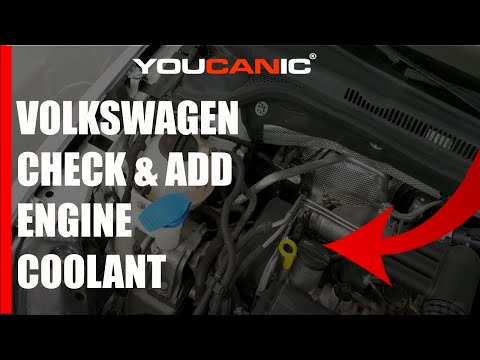
- Locate the engine coolant reservoir on the left side of your engine bay. It will have either a blue or black cap. If you are having a hard time finding it, look it up in your car’s user manual.

- Check the engine coolant level by looking at the side of the reservoir. Most Volkswagens have a translucent or semi-translucent coolant reservoir, so you should be able to check the current engine coolant level without removing the cap by simply looking at the side of the reservoir.
- If the coolant level is below the MIN level mark, turn the cap counterclockwise and remove it.
WARNING: Do not open your coolant reservoir if it is hot or warm. Contents are under pressure, so opening the reservoir when hot can spray scalding coolant. - Add engine coolant. Use coolant that meets your Volkswagen’s specification. Many models up to about 2008 use the G12 family, many later models use G13, and many models from about 2019 use G12evo. The correct type is in the owner’s manual and often on the reservoir cap. Do not mix coolant types. The antifreeze/coolant is typically mixed 50/50. Add the necessary coolant to bring the level to or near the maximum.
- Reinstall the lid. Start the vehicle and ensure the engine coolant light has turned off.


If the engine coolant light remains on or the engine is overheating, do not continue to drive. Take your VW to a trusted mechanic, and have them check your coolant reservoir.

🔧 Find out what is actually wrong before you pay someone to guess
Dealer level diagnostics at home with the YOUCANIC UCAN-II Pro.
- ✔ Covers most makes and models, including many luxury brands. Send us your VIN and we will confirm your car before you order
- ✔ Reads every module, not just the engine, so you find the faults a basic reader says are not there
- ✔ Commands the car: test a fan or pump, bleed ABS, retract an electronic parking brake, register a battery
- ✔ No subscriptions. Free lifetime updates, so the price you pay is the whole price
- ✔ Backed by real mechanics in the USA you can email before and after you buy
Featured in The Wall Street Journal
What coolant to use on a Volkswagen?
The OEM Volkswagen coolant is typically G12 or G13, mixed with 50% antifreeze and 50% distilled water. While you don’t have to use Volkswagen coolant, you are required to use a coolant that meets the specifications, mixed 50/50 with antifreeze and distilled water.
Notes
- Warning! The engine may be hot and can potentially cause burns. Allow the engine to cool down before you check or add engine coolant to a VW.
- These instructions will help you check the engine coolant level on a VW Golf, Jetta, Bora, Beetle, Tiguan or Passat. The Routan is different: it is built on a Chrysler minivan and uses the coolant listed in its own owner’s manual, not VW G12 or G13.
If you keep having to add coolant, find the leak
A sealed cooling system does not consume coolant. Topping up more than once or twice a year means it is escaping somewhere, and the reservoir is only hiding the problem. Park over clean cardboard overnight and look for colored drips, then check the usual Volkswagen leak points with the engine cold: the plastic thermostat housing and coolant flange, the water pump, the seams of the expansion tank itself, and the cap, which loses its ability to hold pressure long before it looks worn out.
Some leaks never reach the ground. A sweet smell inside the car, a greasy film on the inside of the windshield or damp carpet on the passenger side points to the heater core. Coolant disappearing with no external trace at all, white smoke from the exhaust or a creamy deposit under the oil filler cap suggests it is going into the engine, and that needs a workshop rather than another bottle of antifreeze.
A cooling system pressure tester, borrowed from most parts stores, will show a slow leak in a few minutes that would take weeks to find by eye.
Do not mix coolant types
Volkswagen’s G12, G12+, G12++ and G13 coolants are designed to work with one another, so topping up a G12++ system with G13 in an emergency is not a disaster. Conventional green silicate coolant is a different chemistry, and mixing it with the VW specification can drop the additives out of suspension as a sludge that blocks the radiator and the heater core. If you do not know what is in the system, have it flushed and refilled with the correct specification rather than guessing.
In a genuine emergency, distilled water will get you home. Plain tap water leaves scale behind, and water alone offers no corrosion protection or freeze protection, so have the mixture corrected as soon as you can.
If the warning light stays on with the level correct, the fault is more likely the level sensor in the reservoir or the coolant temperature sensor than the coolant itself. A full system scanner will read the stored code and show live coolant temperature, which separates a sensor fault from a real overheating problem.
Safety
- Never open the coolant reservoir cap on a hot engine. The system is under pressure and hot coolant can spray out and cause burns.
- Wait until the engine is cold, then open the cap slowly with a rag over it.
- Coolant is toxic and tastes sweet to pets. Wipe up spills and store it out of reach.
Coolant Light On but the Level Looks Fine?
VW reservoirs use a level sensor in the bottom of the tank. Over time it can fail or give false readings, especially if the coolant is old or contaminated, so the warning appears even when the level is between MIN and MAX. Confirm the level with the engine cold; if it is correct and the light stays on, the sensor or the reservoir with its built in sensor is the usual fix. Reading the codes tells you whether the car sees a low level or a sensor fault.
Frequently Asked Questions
How often should I check the coolant on my VW?
Check it every few weeks or at every fuel stop on long trips, and any time the coolant light comes on. The level should stay steady between services.
Can I add water instead of coolant?
In an emergency, distilled water will get you home, but it dilutes the antifreeze and corrosion protection. Have the mixture corrected with the right VW coolant soon after.
Why is my VW losing coolant with no visible leak?
Check the thermostat housing, water pump and heater core, which can leak where you cannot easily see. A sweet smell inside the car or misting windows points to the heater core; white exhaust smoke with coolant loss needs urgent attention.
More guides: browse all of our Volkswagen repair and troubleshooting guides.


