Mitsubishi Check Automatic Transmission Fluid Level
Reviewed/Verified by:

Does your Mitsubishi transmission slip, erratic shifting, and hesitate when shifting gears? Learn how to fix the problem by checking the ATF fluid level and adding ATF (Automatic Transmission Fluid) to your Mitsubishi.
At a Glance
- Check whether your car even has a dipstick. Many later Mitsubishi automatics and all the CVT models are sealed and are checked through a level plug instead.
- If it has a dipstick: check with the engine running, at operating temperature, on level ground, after cycling the selector through every position.
- If it is sealed: the level is only correct inside a specified fluid temperature window, and you need to read that temperature live. There is no dash readout for it.
- Fluid spec: CVT models require CVTF-J1 or CVTF-J4 depending on the unit. Conventional automatics use Diamond ATF SP-III. These are not interchangeable with each other or with universal fluid.
- Low fluid is a symptom, not a cause. If it is low, find the leak. These units do not consume fluid.
This guide provides step-by-step instructions on how to check transmission fluid levels on Mitsubishi vehicles such as the Lancer, Outlander, Mirage, Eclipse, Galant, ASX, and Carisma.

Symptoms
Typical symptoms of low transmission fluid level include:

🔧 Find out what is actually wrong before you pay someone to guess
Dealer level diagnostics at home with the YOUCANIC UCAN-II Pro.
- ✔ Covers most makes and models, including many luxury brands. Send us your VIN and we will confirm your car before you order
- ✔ Reads every module, not just the engine, so you find the faults a basic reader says are not there
- ✔ Commands the car: test a fan or pump, bleed ABS, retract an electronic parking brake, register a battery
- ✔ No subscriptions. Free lifetime updates, so the price you pay is the whole price
- ✔ Backed by real mechanics in the USA you can email before and after you buy
Featured in The Wall Street Journal
- Hesitation shifting gears
- Erratic shifting
- Transmission surges into gear
- Delayed gear engagement
- Transmission slipping
- Transmission wines (similar noise to low-power steering fluid)
Insufficient fluid or excessive fluid could cause transmission problems.
What you will need
- Mitsubishi Transmission Fluid
- Clean lint-free cloth
Only use the recommended fluid type noted in your Owner’s manual.
Procedure
How To Check Mitsubishi Automatic Transmission Fluid Level:
- Drive the Mitsubishi for 15 min to warm up the transmission fluid.
- Park the Mitsubishi on level ground and set the parking brake.

- Start the engine and move the transmission shifter between all the gears with the brakes applied. Move the shifter into Reverse, Neutral, Drive, and Low gears, stopping for a few seconds on each gear. Move the shifter back in Park and allow the engine to idle.
- Pull the hood release under the dashboard and open the hood.


Locate the transmission dipstick and pull it up.  Wipe the dipstick clean with a lint-free cloth.
 Re-insert the dipstick, ensuring it is fully inserted, then remove it after a few seconds.
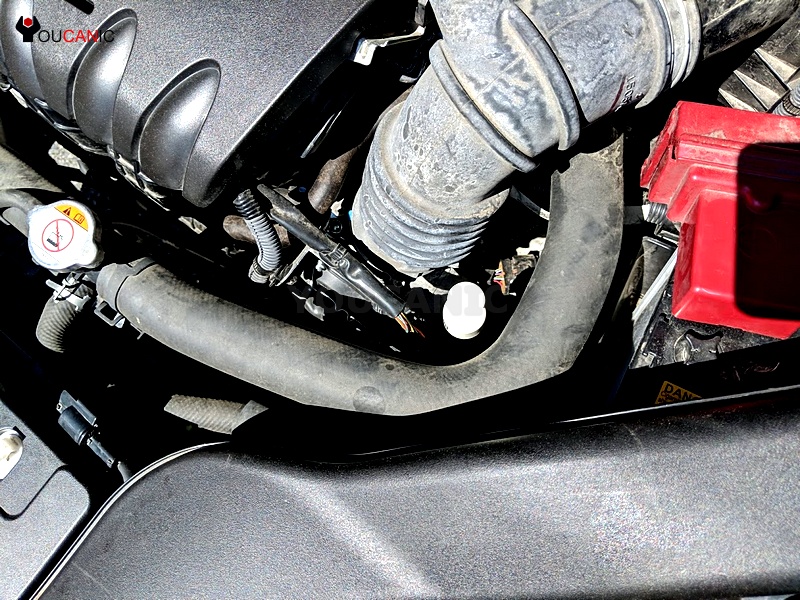 Note the transmission fluid level. It should be between the Max and Min lines marked with an H for Hot. If you measure the transmission fluid without warming the car, the level should be in the C: Cold range.
 Add transmission fluid level via the dipstick tube if the level is below the minimum mark. Wait a few minutes and recheck the level. Do not overfill past the MAX line.
If your Mitsubishi has started to shift erratically, the problem could be a low transmission fluid level. Before you spend money on transmission repairs or diagnostics, check the transmission fluid level.
Notes
- Make sure the engine is running when checking the transmission fluid level.
- Do not overfill the transmission with fluid past the Max line, as this can cause shifting problems and even damage your transmission.
- There are several Mitsibushi transmission fluid types. Only use what is recommended in your Owner’s manual.
- Before starting the warm-up trip, follow the same steps in this guide to check that there is transmission fluid. The level should be in the dipstick’s C (cold) marks.
Recommended Mitsubishi Transmission Fluid
Mitsubishi Diamond SP-III ATF
- Mitsubishi Transmission Fluid for the 3, 4, and 5-speed automatic transmissions
- Most common Automatic Transmissions, except for 6 Speed and CVT
- Meets requirements of SP II
- Part number MZ320200
- They are used in most 2000 to 2011 models, such as Eclipse, Endeavor, Glanat, I-MIEV, Lancer, Mirage, Montero, and Outlander.
- Also, Kia and Hyundai vehicles require SPIII Automatic transmission fluid.
Mitsubishi J4 (J1) CVT Transmission Fluid
- Lancer, Outlander, and Outlander Sport Models with CVT transmission 2008 to 2018
- Total transmission capacity: 4.2 Quarts.
- Part number MZ320185
- J4 replaced the J1 CVT Fluid. If your Owner’s manual says to use J1, you can use J4 as well.
Mitsubishi J2 Automatic Transmission Fluid
- 6 Speed Automatic Transmission
- Outlander V6 3.0L Engine 2007 to 2009
- Part number MZ313771
- Capacity: 4.0 Quarts.
CVT fluid and ATF are not interchangeable
The list above includes both conventional automatic transmission fluids and CVT fluid, and the distinction between them is the most expensive mistake available on this page. If your Mitsubishi has a continuously variable transmission, which covers a large share of the Outlander, Outlander Sport and Lancer range, it takes the CVT fluid and nothing else.
A CVT does not use clutch packs and a torque converter in the conventional sense. It drives through a steel belt or chain running between variable pulleys, and the fluid is formulated to grip at that interface rather than to slip. Fill a CVT with ordinary automatic transmission fluid and the belt slips against the pulleys under load, which destroys the transmission, often within a few hundred miles, and draining it out afterwards does not undo the damage.
The reverse applies too. CVT fluid in a conventional automatic will not give the friction characteristics the clutch packs need, and the result is slipping and overheating. Universal or multi vehicle fluids claiming to cover Mitsubishi applications are a false economy against the cost of either unit. Check which transmission you actually have before buying anything.
If your Mitsubishi has no dipstick
Many later models, and most CVT equipped models, have no transmission dipstick at all. On those the level is checked from underneath through a level or overflow plug, with the engine running and the fluid at a specific temperature window, usually somewhere between about 35 and 45 degrees Celsius depending on the model.
That temperature requirement is not optional. Transmission fluid expands significantly as it warms, so a level checked cold reads low and a level checked hot reads high, and a transmission filled to the correct mark at the wrong temperature ends up genuinely over or underfilled. Reading the fluid temperature requires a scan tool that can access the transmission module, which is why this check is usually done in a workshop. A full system scanner that supports Mitsubishi will show that temperature live along with any stored transmission codes.
Both too little and too much cause problems
As the article notes above, overfilling is as harmful as running low, and people often assume more fluid is safer. It is not. Excess fluid is whipped into foam by the rotating components, and foam does not transmit hydraulic pressure or carry heat away, so an overfilled transmission slips and overheats in the same way an underfilled one does.
While the dipstick is out, look at the fluid as well as the level. Healthy fluid is translucent red or amber. Dark brown fluid that smells burnt has been overheated and the transmission has already taken some damage. Milky or pink fluid means coolant has entered through a failed cooler in the radiator, and that needs attention immediately because it will destroy the transmission quickly. Finally, if the level is low, the fluid went somewhere: these are sealed systems and do not consume fluid, so look for leaks at the pan gasket, the cooler lines and the axle seals rather than simply topping up.
What This Repair Costs
| Repair | Typical total cost |
|---|---|
| DIY fluid top up | $20 to $60 |
| Fluid and filter service, independent shop | $170 to $380 |
| Fluid and filter service, dealer | $280 to $550 |
| Leak repair, pan gasket or seals | $150 to $500 |
| CVT replacement | $3,500 to $5,500 |
Rough US estimates for planning, not quotes. Prices vary widely by model, parts brand and region, so get a written quote before committing.
Topping up a CVT that is low without finding the leak buys you a few months. The fluid went somewhere, and running one of these low is what destroys the belt and pulleys.
When to Stop and Hand It Over
- The fluid is dark, smells burnt, or has metal glitter in it.
- The car judders at light throttle, which on a CVT points at belt and pulley wear rather than level.
- You cannot read fluid temperature on a sealed unit. Do not set the level by guess.
Checking a Sealed Transmission
On a sealed unit the level question and the temperature question are the same question, and a generic OBD2 reader cannot answer either. Transmission fluid temperature is not emissions data, so a basic reader has no access to it.
The YOUCANIC UCAN-II Pro reads live transmission and CVT fluid temperature on Mitsubishi along with transmission specific codes that a basic reader cannot see. On CVT models it also shows input and output shaft speed, which is how you tell a low fluid complaint apart from a slipping belt. Those are a $40 problem and a $4,000 problem, and they feel similar from the driver seat.
What the Fluid Tells You
- Red or pink and clear: normal for automatic transmission fluid. CVT fluid can look lighter or slightly green, depending on the type.
- Dark brown with a burnt smell: the fluid is overheated or worn. Plan a fluid service and have the transmission checked.
- Milky or foamy: coolant or water may be mixing with the fluid, or the level is too high. Do not keep driving it.
- Metal flakes on the dipstick: a sign of internal wear. Have it inspected before spending money on a fluid change.
If the transmission is slipping or the check engine light is on, read the stored codes before adding fluid. A scan tool like the YOUCANIC UCAN-II Pro can read transmission codes and fluid temperature on supported models, which helps you check the level at the right temperature.
Safety First
- Set the parking brake and keep the shifter in Park while the engine runs.
- Keep hands, sleeves and the cloth away from the belt and cooling fan.
- The exhaust and engine parts get hot quickly once the car is warmed up.
More Photos: Checking Mitsubishi Transmission Fluid


Frequently Asked Questions
What are the signs of low transmission fluid on a Mitsubishi?
Slipping, a delay when shifting into Drive or Reverse, harsh shifts and, on a CVT, a whining noise are common signs. Check for leaks if the level is low.
What does burnt smelling fluid mean?
It means the fluid has overheated, often from slipping or heavy use. Change the fluid and have the transmission checked before the damage gets worse.
How often should I check the transmission fluid?
Check it at least at every oil change, and any time you notice a leak, a new noise or a change in how it shifts.
What transmission fluid does a Mitsubishi use?
It depends on the transmission. Older conventional automatics typically use Mitsubishi Diamond ATF SP III, while CVTs use a CVT fluid such as CVTF J1 or J4. Your owner’s manual lists the correct type, and the wrong fluid can damage a CVT.
Why is the level different hot and cold?
Fluid expands as it warms up. That is why the dipstick has a cold range and a hot range, and the hot reading after a drive is the more accurate one.
How much fluid do I add if it is low?
Add small amounts, about a quarter liter at a time, and recheck. Overfilling causes foaming and erratic shifting, so it is better to add too little and recheck.
Check these troubleshooting and repair guides for more help on your Mitsubishi.
Related Guides
- Check Transmission Fluid Level Mitsubishi Mirage
- Mitsubishi Transmission Level Fluid Check