
Toyota Read Check Engine Codes without the OBD2 Scanner
Reviewed/Verified by:

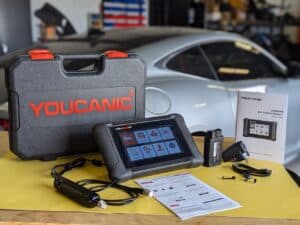
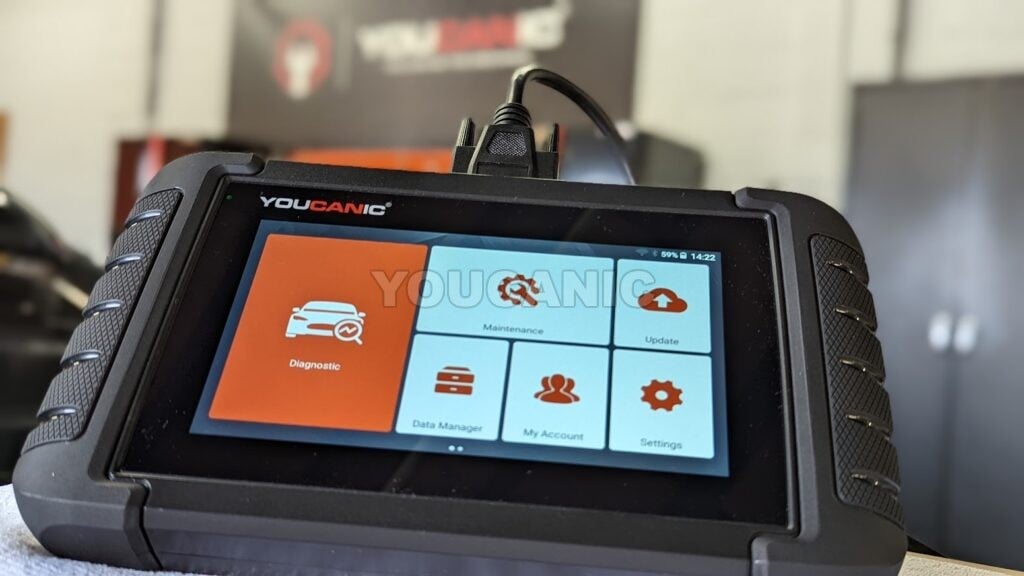
You can read the fault codes on Toyota vehicles equipped with OBD-I without a diagnostic tool. Unfortunately, this procedure only works on 1995 and older Toyota vehicles. If you need to read codes on a newer Toyota, see how to read Toyota OBD-II fault codes. The YOUCANIC UCAN-II Pro can read and clear fault codes in the control modules of supported vehicles.
At a Glance
- Works on OBD I Toyotas, roughly 1995 and older; 1996 and newer need an OBD II scanner.
- Find DLC1, the diagnosis box in the engine bay, and bridge TE1 to E1 with a paper clip.
- Ignition on, engine off; count the check engine light flashes.
- Long flashes are tens and short flashes are ones; code 1 (steady even blinks) means no faults.
- Remove the jumper when you are done.
- On newer Toyotas, a scanner such as the YOUCANIC UCAN-II Pro reads OBD II and Toyota specific codes across all systems, with live data on supported models.
- Park the vehicle and set the parking brake.

- Turn the key to position II. All dash lights should be ON. Do not start the engine.

- Pull the hood release and open the hood.
- Locate the diagnostic port in the engine bay. This is known as Diagnosis Connector 1 or DLC1.
- Use a copper wire or paper clip to short terminals TE1 and E1. The terminal names are printed inside the connector lid; bridge only these two, because shorting the wrong pins can damage the engine computer.
- Return to the car and count the flashes for the check engine light.


This procedure will not work on Toyota vehicles equipped with OBD-II. For 1996 and newer vehicles, you will need a code reader to read and check engine fault codes.
OBD-I Codes
- 1 Normal Condition.
- 2 Air Flow Meter signal.
- 3 Ignition signal.
- 4 Engine Coolant Temperature Sensor Signal.
- 5 Oxygen Sensor.
- 6 RPM signal (Crank Angle Pulse).
- 7 Throttle Position Sensor signal.
- 8 Intake Air Temperature Sensor signal.
- 9 Vehicle Speed Sensor signal.
- 10 Starter signal.
- 11 Switch signal.
- 11 ECU/ECM.
- 12 Knock Control Sensor signal.
- 12 RPM signal.
- 13 Knock Control CPU (ECM).
- 13 RPM signal.
- 14 Turbocharger Pressure.
- 14 Ignition signal.
- 21 Oxygen Sensor.
- 22 Engine Coolant Temperature Sensor signal.
- 23 Intake Air Temperature Sensor signal.
- 24 Intake Air Temperature Sensor signal.
- 25 Air-Fuel Ratio Lean.
- 26 Air-Fuel Ratio Rich.
- 27 Sub Oxygen Sensor signal.
- 28 No. 2 Oxygen Sensor signal.
- 31 Air Flow Meter signal (Vacuum Sensor signal).
- 32 Air Flow Meter signal.
- 34 Turbocharger Pressure signal.
- 35 Turbocharger Pressure Sensor signal.
- 35 HAC Sensor signal.
- 41 Throttle Position Sensor signal.
- 42 Vehicle Speed Sensor signal.
- 43 Starter signal.
- 51 Switch signal.
- 52 Knock Sensor signal.
- 53 Knock Sensor signal.
- 54 Inter-cooler ECM signal.
- 71 EGR System.
- 72 Fuel Cut Solenoid signal.
- 78 Fuel Pump Control signal.
- 81 TCM Communication.
- 83 TCM Communication.
- 84 TCM Communication.
- 85 TCM Communication.
If you need a good OBD2 scanner, check out the scanner, which can read and clear codes on Toyota and all other makes.

🔧 Find out what is actually wrong before you pay someone to guess
Dealer level diagnostics at home with the YOUCANIC UCAN-II Pro.
- ✔ Covers most makes and models, including many luxury brands. Send us your VIN and we will confirm your car before you order
- ✔ Reads every module, not just the engine, so you find the faults a basic reader says are not there
- ✔ Commands the car: test a fan or pump, bleed ABS, retract an electronic parking brake, register a battery
- ✔ No subscriptions. Free lifetime updates, so the price you pay is the whole price
- ✔ Backed by real mechanics in the USA you can email before and after you buy
Featured in The Wall Street Journal
Frequently Asked Questions
Can I read Toyota check engine codes without a scanner?
Yes, on OBD I Toyotas from roughly 1995 and older. Bridge TE1 and E1 in the DLC1 box with a paper clip and count the check engine light flashes.
How do I read the Toyota flash codes?
Long flashes are tens and short flashes are ones. Steady, even blinking is code 1, which means no faults are stored.
Does the paper clip method work on 1996 and newer Toyotas?
No. 1996 and newer Toyotas use OBD II and need a scanner plugged into the port under the dash.
Where is the DLC1 diagnosis box?
It is a small box with a cover in the engine bay. The terminal names are printed inside the lid.
Related guides: Read Toyota Check Engine Light Clear Fault Codes · Toyota Dashboard Warning Lights Explained