
Mercedes-Benz ABS Wheel Speed Sensor Replacement
Reviewed/Verified by:

Check whether yours is covered before paying for anything. Wheel speed sensors on 2003 to 2006 E-Class, 2006 CLS and 2003 to 2012 SL models fitted with SBC carry 25 year Mercedes coverage, and 2012 to 2018 Sprinter 2500 and 3500 models carry 10 years. Outside that, the part runs roughly $30 to $90 aftermarket or $130 to $210 genuine, and it sits on the back of the steering knuckle behind the rotor.
At a Glance
- Most common cause: a failed wheel speed sensor, a corroded connector or a damaged tone ring.
- What lights up: ABS, ESP and BAS warnings together, sometimes with cruise control and the speedometer acting up.
- Find the corner first: read the ESP or ABS module codes, then watch live wheel speed on all four wheels. The bad one reads zero, lags or jumps.
- Part cost: roughly $30 to $90 aftermarket and $130 to $210 genuine, by model.
- Free on some cars: 2003 to 2006 E-Class, 2006 CLS and 2003 to 2012 SL with SBC have 25 year Mercedes coverage on wheel speed sensors. 2012 to 2018 Sprinter 2500 and 3500 have 10 year coverage.
- Safe to drive? Carefully. Base brakes work; ABS, ESP and traction control do not.
Symptoms
- ABS ESP Warning Light ON
- Fault codes include wheel speed sensor signal implausible or wheel speed sensor supply.
- Loss of anti-lock brakes.
- Electronic Stability Control (ESP) will be disabled.
- Erratic shifting of the transmission or limp mode in some cases.
A defective ABS sensor illuminates the ABS, ETS, or ESP light on your instrument cluster. In rare cases, it may even set a check engine light or cause your car to not shift and go into limp (safe) mode. With a bad wheel ABS sensor, the anti-lock brakes will not function properly, and you increase the risk of skidding if you make emergency stops.

What you will need
- Mercedes ABS Wheel Speed Sensor
- Long Arm Metric Hex Key Set
- Torx Socket Set
- Torque Wrench
Some Mercedes-Benz has an Allen bolt, while others use a Torx bolt.

🔧 Find out what is actually wrong before you pay someone to guess
Dealer level diagnostics at home with the YOUCANIC UCAN-II Pro.
- ✔ Covers most makes and models, including many luxury brands. Send us your VIN and we will confirm your car before you order
- ✔ Reads every module, not just the engine, so you find the faults a basic reader says are not there
- ✔ Commands the car: test a fan or pump, bleed ABS, retract an electronic parking brake, register a battery
- ✔ No subscriptions. Free lifetime updates, so the price you pay is the whole price
- ✔ Backed by real mechanics in the USA you can email before and after you buy
Featured in The Wall Street Journal
How to change an ABS wheel speed sensor on a Mercedes-Benz?
Before you get started, use a Mercedes-Benz scanner to read the codes from the ABS module and find out which sensor is faulty. You don’t need to replace all the sensors, just the faulty ones.
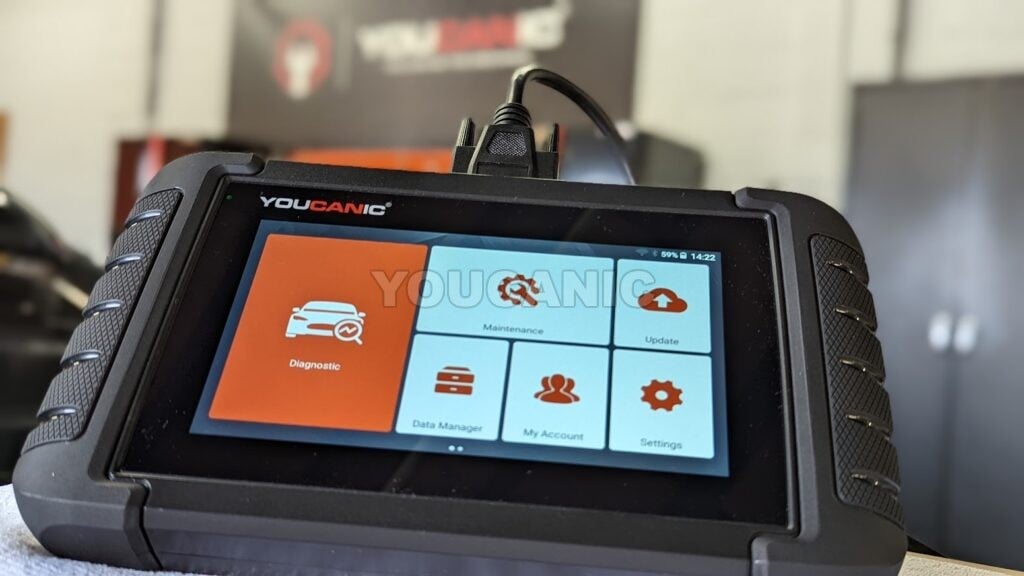
The YOUCANIC Full System Scanner can read and clear fault codes through every control module on a vehicle, if the vehicle is supported.
- Raise the Car. First, loosen the lug nuts but do not remove them. Second, raise the car using your jack. Third, support your car with jack stands such as Torin 3-Ton Jack Stands.
- Locate Mercedes Wheel ABS Sensor. Remove the front wheel and locate the ABS wheel speed sensor.

- Behind the rotor, you will see a couple of cables connected to two sensors. One wire goes to the brake pads, which is the brake pad wear sensor. The second sensor goes to the ABS wheel sensor.
- Remove the ABS sensor bolt. Use a Torx socket to remove the bolt that holds the ABS sensor in place.

- The sensor is held by one bolt. Depending on the model it takes an Allen (hex) key or a Torx bit, so check yours before you start. This ABS sensor (also called RPM sensor) is located on the back of the steering knuckle.
- Remove the damaged ABS sensor. Pull out the old sensor.

- It is a good idea to take a picture of how your ABS wire is routed. When you install the new sensor, you may wonder how and where to place the wire.
- Remove cable. The ABS electrical wire is held in place by plastic clips. Pull the wiring harness away from the clips. You may have a plastic cover over the ABS sensor. Make sure to remove that before you pull out the ABS sensor. The plastic is typically held with clips that can be easily removed.
- Disconnect the ABS Sensor. Follow the ABS sensor cable to where it joins the connector under the front subframe.
- Pull up the metal C clip and unplug the old sensor from the connector. You may have to remove the wheel well liner to get to the connector. Separate the two connectors. You need a small screwdriver to pry the clips and separate the ABS and brake pad wear sensor.
- Install new wheel ABS Sensor. Install the new Mercedes ABS sensor in reverse order. Tighten the bolt to your model’s specification. A Haynes derived figure for the W203 C-Class is 25 Nm front and only 8 Nm rear; the bolt threads into aluminum, so do not guess high.


How much does it cost to change a Mercedes-Benz ABS wheel speed sensor?
Parts are the cheap part: aftermarket sensors from Bosch, ATE, Bremi, Febi or URO run roughly $30 to $90, and genuine Mercedes sensors roughly $130 to $210 (see the price table below). Labor depends mostly on whether the old sensor comes out cleanly. If you own a W211 E-Class, C219 CLS or R230 SL with SBC, Mercedes covers the sensor for free.
Applications
- 2006 MERCEDES-BENZ CLS500 Front
- 2006 MERCEDES-BENZ CLS55 AMG Front
- 2007 to 2008 MERCEDES-BENZ CLS550 Front
- 2007 to 2008 MERCEDES-BENZ CLS63 AMG Front
- 2003 to 2008 MERCEDES-BENZ E320 Front
- 2006 to 2008 MERCEDES-BENZ E350 Front
- 2003 to 2006 MERCEDES-BENZ E500 Front
- 2004 to 2006 MERCEDES-BENZ E55 AMG Front
- 2007 to 2008 MERCEDES-BENZ E63 AMG Front
Part Numbers
- 2115402317
- ALS1288
- 5S11042
- SU12495
- 2115401317
- 211 540 23 17
Parts sellers currently list W211 E-Class and C219 CLS front sensors as 211 540 29 17 (front left) and 211 540 30 17 (the other side), so the numbers above may be superseded. Confirm by VIN before ordering.
Expect the old sensor to be seized in the hub
This is the part of the job that goes wrong, and it is worth preparing for rather than discovering halfway through. The sensor sits in a close fitting bore in an aluminum hub carrier, and over years of heat, water and road salt the steel sleeve corrodes itself solidly into the aluminum. Pull it straight out with pliers and the plastic body snaps off, leaving the sleeve in the bore and a far bigger problem than you started with.
Give yourself the best chance. Remove the retaining bolt, then soak the joint in penetrating oil and leave it, ideally overnight. When you come back, twist the sensor in its bore rather than pulling on it. Rotating it breaks the corrosion bond around the circumference, and once it turns freely it will usually come out with steady pressure. Gentle heat on the surrounding carrier helps, since aluminum expands faster than steel.
If it does snap, do not start drilling immediately. The remaining sleeve can often be collapsed inward with a small chisel and picked out in pieces, or drawn out with an internal puller. Drilling risks going into the bore itself, and a damaged bore means a new hub carrier, which turns an inexpensive sensor into a major repair. Clean the bore thoroughly before fitting the new sensor and apply a thin smear of the grease the sensor maker recommends to the sleeve only, never the tip, so the next person has an easier time.
Check the encoder ring, not just the sensor
If the code returns with a new sensor fitted, the sensor was probably never the problem. These sensors read a ring of alternating magnetic poles, and on many models that ring is part of the wheel bearing seal rather than a separate visible toothed wheel. Rust creeping under the seal, debris, or a bearing pressed in the wrong way round during an earlier repair all damage it, and the sensor then reports nothing while testing perfectly.
The signature is distinctive: a wheel speed signal that works at walking pace and drops out as the car gains speed, or a reading that is erratic rather than absent. Rust scale built up in the sensor bore causes the same thing by holding the sensor slightly too far from the ring, which is why cleaning the bore properly matters. Where the encoder itself is damaged, the repair is the wheel bearing.
What the warning means for driving
A failed wheel speed sensor on a Mercedes rarely announces itself as one message. Because so many systems depend on that signal, you will typically see several at once: ABS, ESP, BAS and on some models the ETS lamp, along with cruise control refusing to engage and in some cases the transmission holding a gear.
Your ordinary brakes are unaffected and the car stops normally, since the hydraulic system works independently. What you lose is anti lock braking, stability control and traction control, which matters most in rain and snow and in any emergency maneuvere. Short local trips are reasonable while you arrange the repair; a winter on it is not, and the car will fail inspection in most places.
Read the code before buying anything, because it names the specific wheel and saves you removing the wrong one. These faults are stored in the ABS and ESP modules rather than the engine module, so a basic OBD-II reader will report no faults at all while the dashboard is lit up. A full system scanner that supports Mercedes will name the corner and show the live speed from all four wheels at once, which confirms the diagnosis in seconds.
What Wheel Speed Sensors Cost
| Model and position | Genuine | Aftermarket |
|---|---|---|
| E-Class W211, CLS C219 front | $210.99 (front left) | $36 to $61 (Bosch, Bremi, Febi) |
| E-Class W212 front | $150.99 to $166.99 | n/a |
| E-Class W212 rear | $191.99 | $36 to $55 (Vemo, Bosch) |
| C-Class W204 | n/a | $36 to $53 (Bosch, ATE) |
| C-Class W205 | n/a | $32 to $76 (URO, ATE) |
| ML W164, GL X164 rear | n/a | $46 to $91 (Bosch, ATE) |
| S-Class W221 front | $133.99 | $46.99 (URO) |
Retail prices from FCP Euro and ECS Tuning in October 2026. Some sensors are side specific (W211 and W212 fronts), others fit either side (W212 rear, W221 front). Check by VIN.
SBC Cars: Mercedes Covers This for 25 Years
If you own a 2003 to 2006 E-Class (W211), a 2006 CLS (C219) or a 2003 to 2012 SL (R230) with Sensotronic Brake Control, read this before paying for anything. In August 2018 Mercedes-Benz USA extended coverage on SBC components to 25 years from the original warranty start date, unlimited miles, regardless of owner.
Covered parts include the hydraulic control unit, pump, pressure reservoir, brake operating unit, front and rear wheel speed sensors, brake lamp switch and yaw rate sensor. Owners who already paid can ask for reimbursement with receipts. Mercedes owner letter.
Renting against buying for a single sensor
If you are changing one wheel speed sensor on your own car and do not expect to do it again, you do not need to own a scan tool. You can rent one for seven days for the week, which covers reading the code beforehand and confirming the fault is cleared afterwards. Shipping both ways is included, United States addresses only.
The reason a reading matters at all on this job is that the four sensors are interchangeable in appearance and the dashboard does not tell you which one failed. Comparing the live wheel speeds while the car rolls identifies it in a minute and stops you replacing the wrong corner, which is the single most common waste on this repair.
Related Recalls
- 21V-042: 48,667 Sprinter 3500 (2012 to 2018) camper and RV conversions. Moisture shorts the rear wheel speed sensors and ESP/ABS warnings come on. Remedy: moisture resistant rear sensors. Recall report. Mercedes also extended 2012 to 2018 Sprinter 2500 and 3500 wheel speed sensor coverage to 10 years, unlimited miles (letter).
- 16V-603: 2016 C-Class and GLC with an ESP hydraulic unit damaged in transport. Recall notice.
- 23V-360: 7,558 2022 to 2023 S-Class and EQS. ESP software can flag false faults and limit ABS, ESP and brake force distribution. Software update. Recall notice.
- 22V-315 and 24V-298 (not a sensor fault, but critical): 2006 to 2012 ML, GL and R-Class brake booster corrosion. Mercedes advises owners not to drive affected vehicles until inspected. Recall.
Check your VIN at nhtsa.gov/recalls.
How to Find the Faulty Sensor
- Charge or test the battery first. Low voltage alone sets these faults.
- Read codes from the ESP or ABS module with a Mercedes capable scan tool. A generic OBD2 reader usually cannot see this module.
- With the car moving slowly, watch live wheel speed data. The sensor that drops to zero, lags or jumps is the suspect.
- Inspect the sensor wiring and connector at that wheel, and the tone ring for cracks, rust or debris.
- Do not test modern Mercedes sensors with an ohmmeter. They are active sensors; Pico warns that active wheel speed sensors must never be resistance tested. Check for supply voltage at the connector instead. Pico guide.
- After a repair, clear codes and road test. If steering or suspension work was done, a steering angle reset may also be needed.
When to Stop and Hand It Over
- The brake pedal feels soft, low or different.
- The red brake warning is on, not just the yellow ABS or ESP lights.
- Your car has SBC (W211, C219, R230): the fix is covered by Mercedes.
- The fault points to the ESP hydraulic unit or control module.
Related guides: Fixing Mercedes EBR, ABS, ESP Inoperative Issues: Comprehensive Guide · Run Flat Inoperative, ABS, ESP Malfunction on Mercedes-Benz · Solving BMW’s ABS Issues: Understanding the Wheel Speed Sensor
Reading the Brake System Properly
These faults live in the ESP module, which a basic code reader usually cannot reach. The YOUCANIC Full System Scanner reads Mercedes ESP and ABS codes and shows live wheel speed data, which is how you find the one bad sensor instead of replacing four.