
BMW Fuel Pump Control Unit Problems | EKPS module
Reviewed/Verified by:

The EKPS is the module that runs your BMW’s in tank fuel pump. When it fails, the car stalls hot, cranks without starting, or throws a fuel pump warning, and those symptoms look identical to a failed pump. The costs are not identical: roughly $200 for an upgraded aftermarket module, $394 to $451 for a genuine BMW part, against a sourced dealer total of about $890 on an E70 X5.
Read This First: The Test Light Trap
The single most expensive mistake on this repair is checking for power at the fuel pump with a test light, seeing it glow, and concluding the pump is bad.
The EKPS does not send the pump a steady 12 volts. It controls pump speed electronically, and a failing module can deliver just a few volts. That is enough to light a test light and nowhere near enough to run the pump. A documented case on an E70 X5 shows exactly this: the technician saw the test light glow, replaced the pump, and the car still would not start. A proper voltage reading at the pump during cranking showed about 3 volts. The real fault was a water damaged EKPS. A new pump went in that the car never needed.

🔧 Stop paying the dealer for every warning light
Get dealer level diagnostics at home with the YOUCANIC Full System Scanner.
- ✔ Works with all makes and models, including most luxury brands
- ✔ Topology map view shows all vehicle modules on one screen for faster diagnostics
- ✔ Bi directional controls to test fans, pumps, actuators and more so you do not have to guess
- ✔ Special resets and calibrations such as ABS bleed, EPB service, battery registration and more
- ✔ Free lifetime updates with no recurring fees
Use a multimeter, not a test light. The number matters, not just the presence of voltage. The expected readings are in the diagnosis section below.

At a Glance
- What it is: the electric fuel pump control module. BMW’s own bulletins call it the EKP; parts sellers call it EKPS, EKPM2 or EKPM3. They are the same part family. On cars that have one, it replaces the old fuel pump relay.
- Classic failure: stalls or cuts out when hot, then restarts after cooling down. That pattern points at the module overheating rather than at the pump.
- Other common causes: water getting into the rear of the car and corroding the board, and a failing pump drawing too much current and burning out the module’s driver.
- Where it is: in the trunk or rear area on most models, usually the right side. Exact positions by chassis are below.
- The decisive test: voltage at the pump while cranking, measured with a multimeter. Roughly 10 to 11.6 volts is normal. About 3 volts means the module is failing.
- Cost: about $200 for an upgraded aftermarket module, around $394 to $451 for a genuine BMW part, and a sourced dealer total of about $890 on an E70 X5.
What the EKPS Does, and What It Is Called
Older cars switched the fuel pump on and off with a relay. Most BMWs from the mid 2000s onward instead use a control module that varies pump speed, so the pump delivers only as much fuel as the engine is asking for. The engine computer (DME) tells the module what it needs over a data line, and the module adjusts the pump.
You will see four names for it. EKP is what BMW uses in its own service bulletins. EKPS is the common aftermarket name. EKPM2 and EKPM3 are two hardware generations. If you are searching for parts, try all four.
One practical consequence: on a car with an EKPS, there is usually no separate fuel pump relay to test. Owners of the E70 diesel, for example, routinely search for a relay that does not exist on their car.
Symptoms, and What Each One Points To
| Symptom | Most likely cause |
|---|---|
| Stalls when hot, restarts after cooling | Module overheating (most specific sign of module failure) |
| Intermittent no start that clears after the car sits | Module overheating, or water damage to the module board |
| Fuel pump warning, or reduced power with jerking or bucking | Pump not reaching the speed the engine asked for. BMW lists exactly these symptoms in its service bulletin, covered below. |
| Long crank before starting | Low or slow fuel pressure. This can be the module, the pump or a leak down, so on its own it does not point anywhere specific. |
| Cranks, no fuel pressure at all | Module output dead, pump dead, or a power or ground fault. The test sequence below separates these. |
| Battery drains overnight | Can be a pump that keeps running when the car is off. This is a field observation rather than a documented BMW fault, so confirm it with a current draw test. |
BMW’s own wording on the dashboard for this fault is “Fuel pump/drive with care” or “Engine fault/reduced power”.
Where the EKPS Is, by Chassis
| Chassis | Where to look |
|---|---|
| E90, E92 3 Series | Trunk, passenger side wheel well area. Some sources place it under the passenger side rear seat cushion or behind the right rear trim panel, so check all three. |
| E93 3 Series convertible | Different from the coupe and sedan: in the space between the trunk and the rear seat, mounted low beside the white parking sensor module. |
| E60, E61 5 Series | Right rear of the trunk behind the trim, forward of the battery. |
| E70 X5, E71 X6 | Trunk. Open the spare tire area and lift out the plastic storage tray that spans the trunk. The module is on the right side and easy to reach. |
| F and G chassis (F10, F30, F15, F25, G20, G30, G05 and others) | In the trunk area. Parts suppliers describe it only as trunk mounted and no reliable source gives an exact panel for these chassis, so we are not going to guess one. |
A note on the E60 V8: on the N62 engined 545i and 550i, some specialists report that there is no EKPS at all and the pump runs on a relay. Other sources list the module for later six cylinder E60s. If you have an E60 V8, confirm your car actually has a module before chasing a fault in one.

How to Diagnose It: Module, Pump, or Something Else
Work through these in order. Each step either finds the fault or rules a whole category out, and none of them requires buying a part.
- Test the battery first. A weak battery or a charging fault can make the module shut down and mimic a module failure. Load test it and confirm about 13.5 to 14.5 volts at idle before going further.
- Check the fuse. On the E90 the pump circuit is fed through fuse F70 in the junction box. Other models use F70 or F73. Check yours against the fuse chart for your car.
- Prove the pump on its own. Unplug the pump and feed it 12 volts directly from the battery through a fused jumper lead. If it does not run, the pump is bad and the module is not the cause of that symptom.
- Measure voltage at the pump while cranking, with a multimeter. The pump only runs for about 3 to 5 seconds when you press start without the engine catching, so have a helper crank while you read. Expect roughly 10 volts on an E90 and about 11.6 volts on an E60. It will not read full battery voltage, because the module deliberately runs the pump at reduced speed. A reading around 3 volts means the module is not delivering, and that is your answer.
- Check the voltage drop on the pump wiring. Up to 0.5 volts of drop is acceptable. More than that points at wiring or connectors between the module and the pump.
- Check low side fuel pressure. On the E90 the spec is at least 5 bar (72.5 psi) at start, it should fall no more than 0.5 bar over 15 minutes, and the pump should deliver a pint in 30 seconds or less. If low side pressure is in spec but the engine still reports low fuel pressure, the problem is on the high pressure side, usually the high pressure pump, and the EKPS has nothing to do with it.

Reading It With a Scan Tool
A scan tool turns this from guesswork into a direct comparison. The module reports what the engine asked for and what the pump actually did.
- Specified pump speed against actual pump speed. If the engine is asking for speed and the actual reading is zero or far below it, with low pump current, the module output is dead.
- Both speeds correct but fuel pressure still low points at the pump itself or the supply side.
- Pump current abnormally high means a failing pump is dragging the module down. This matters a great deal, as explained below.
- Commanded pump test. Run the fuel pump activation test. If the engine computer commands the pump and the module produces no output, suspect the module.
None of this is visible to a generic OBD2 code reader. EKPS faults are stored in the EKPS module itself, not in the engine computer, and a basic reader only talks to the engine. That is why so many owners scan the car, see nothing relevant, and start replacing parts.
The Trap: A Bad Pump Can Kill a Good Module
A pump that is wearing out or partly shorted draws more current than it should. That extra current overheats and eventually burns out the driver inside the EKPS. So a failed module is sometimes the result of a failing pump rather than the original problem.
If you replace only the module, the old pump kills the new one. Always check pump current draw before fitting a new module. A healthy pump typically draws around 8 to 12 amps. A reading well above that means replace the pump at the same time.
Fault Codes, and Which Module Stores Them
This distinction matters more than the codes themselves. Some fuel faults are stored in the EKPS and some in the engine computer. Knowing which module holds the code tells you which side of the system to look at.
| Code | Stored in | Meaning |
|---|---|---|
| 481B05 | EKPS | Pump speed insufficient. This is the code in BMW’s own service bulletin. |
| 481B01 | EKPS | Motor voltage too low |
| 6292 | EKPS | Control voltage too low |
| 6293 | EKPS | Control current too high (often a pump drawing too much) |
| 6295 | EKPS | No control current |
| 29DC | Engine (DME) | Cylinder injection cut out |
| 29F2, 29F3 | Engine (DME) | Fuel pressure low |
| 2DED | Engine (DME) | Power management, current drawn while the car is off. Can accompany a pump that keeps running. |
If you see engine side fuel pressure codes with no EKPS codes, do not assume the module. Low side pressure, the high pressure pump and injectors are all candidates. If you see EKPS codes such as 6293 alongside them, measure pump current before buying a module, because 6293 is often the pump talking.
What BMW Says: Service Bulletin SI B16 05 15
BMW issued a service bulletin on exactly this fault for the F80 M3 and F82 and F83 M4 built between March 2014 and April 2015. It is the clearest official statement of how BMW itself separates a module failure from a pump failure, and the logic applies well beyond those three cars.
- Fault code: 481B05, EKP pump insufficient speed.
- Symptoms: reduced engine performance while driving, engine jerking or bucking, and no start, with “Fuel pump/drive with care” or “Engine fault/reduced power” on the dashboard.
- Cause named by BMW: the electric fuel pump control module.
- Part: 16 14 7 398 495.
- BMW’s decision rule: replace the module, restart, and run the short test again. If 481B05 does not come back, the repair is confirmed. If other EKP codes remain, replacing the fuel pump will most likely be necessary.
Read that last point carefully, because it is the whole diagnostic logic in one sentence: replace the module first, and if pump related codes persist afterwards, the pump is the problem too. Source: BMW SI B16 05 15 on the NHTSA site.
Is There a Recall?
There is no recall on the EKPS module itself. We looked. There are, however, three separate BMW fuel system recalls that owners sometimes confuse with it. They are worth checking because a covered repair costs you nothing:
- 16V-746, in tank fuel pump. About 136,000 vehicles, including the E70 X5 and E71 X6 (2007 to 2011 model years), F10 5 Series (2011 to 2012), F07 5 GT (2010 to 2011) and F12 and F13 6 Series (2012). A poorly crimped connector at the pump can overheat and leak fuel. The fix is a new pump and a repair cable. Recall document.
- 18V-323, 2018 M5 (F90). Engine computer software that could let fuel pressure drop. Fixed by reprogramming the engine computer, not the EKPS. Recall document.
- 21V-586, diesel high pressure pump. 2014 to 2018 diesels including F10, F15, F25, F30 and F31. The high pressure pump can shut down as a protective measure. Recall document.
Check your own VIN free at nhtsa.gov/recalls. A BMW dealer can also run it in a minute.
Does a Replacement Need Coding?
Sources disagree, and the honest answer is that it depends on the age of the car.
- Older E chassis cars (E60, E70, E90 and similar): used modules are swapped all the time and frequently work once the fault codes are cleared. Retailers still say a new genuine module should be coded, and a dealer may refuse to sell one without programming it.
- Newer F and G chassis cars: the software is managed more strictly. Owners report mismatch errors when fitting a used or new module, fixed only by coding with BMW level software. Expect coding to be needed.
- Repairing your original module sidesteps the question entirely, because the unit that goes back in is the one already matched to your car.
Some aftermarket modules are sold as needing no coding at all. Treat that as the seller’s claim until it is proven on your chassis.
Part Numbers and Real Prices
Prices below are from named US retailers in October 2026. They will drift, but they give you a real basis for comparing quotes.
| Part | Fits | Typical price |
|---|---|---|
| 16147229173 (genuine, EKPM3) | Most E chassis: E82, E88, E90 to E93, E60 and E61 six cylinder, E70 X5 xDrive35d, E71 X6, E89 Z4. On E8x and E9x, cars built before March 2010. | $393.94 (BimmerWorld) |
| 16147411596 (genuine) | Most F chassis: F01, F02, F07, F10, F12, F13, F15, F16, F22, F23, F25, F26, F30 to F34, F87 M2. | $450.99 (Turner, ECS Tuning) |
| 16149452468 (genuine) | G chassis and late M cars: G01, G02, G05 to G07, G11, G14 to G16, G20, G22, G23, G26, G29, G30, G32, G42, G8x M3 and M4, F90 M5, F9x X3 M to X6 M, G87 M2. | $450.99 (ECS Tuning) |
| 16147276073 (Vemo, aftermarket) | F10, F11, F12, F13, F01, F02, F25 X3 (selected engines) | $456.99 (BimmerWorld) |
| Arc Terminator upgraded EKPM3 with cooling fan | About 80 E chassis applications; needs coding | $199.99 (ECS Tuning) |
| Used modules | Varies | Roughly $52 to $75 for common G chassis units |
Always confirm the number against your VIN with a parts counter before ordering, because the supersession chains are long and fitment depends on build date.
Two things worth knowing. First, the upgraded module with a built in cooling fan is designed against the overheating failure, and costs less than half the genuine part. Second, some listings for “fuel pump control unit” are actually the mounting bracket (part 16147199343, about $32). Check that you are buying the module.
What to do next: four checks before you order a module
You have established that the module is suspect. Do these four things before any money is spent, because each one changes what you buy.
- Measure pump current draw. A healthy pump typically draws around 8 to 12 amps. A reading well above that means a failing pump is dragging the module down, and fitting a module on its own means the old pump kills the new one. This single measurement is the difference between one repair and two.
- Look for water in the trunk and under the rear seat. These modules live in the rear of the car and water damage is a common cause. Find and fix the leak first or the replacement goes the same way.
- Confirm the complaint is on the low pressure side. If low side pressure is in spec but the engine still reports low fuel pressure, the problem is the high pressure pump and the EKPS has nothing to do with it. That is a different repair entirely.
- Decide your route before ordering. On an E chassis car with the classic overheating pattern, dies hot and starts cold, the upgraded unit with a cooling fan addresses the actual cause. On F and G chassis cars coding is needed anyway so genuine makes more sense. Repairing your original sidesteps coding completely, because the unit going back in is already matched to your car.
After fitting, follow BMW’s own rule from the service bulletin: clear the codes, restart, and run the short test again. If 481B05 does not return, the repair is confirmed. If other EKP codes remain, the pump will most likely need replacing too.
The YOUCANIC UCAN-II Pro reads the BMW EKPS codes, runs the commanded fuel pump test, and shows specified against actual pump speed along with pump current for step one. It is available as a seven day rental. Coverage varies by chassis and year, so email support with your VIN before ordering.
When you do not need a scan tool for this
Step two needs a torch and nothing else. And if you unplug the pump and feed it 12 volts directly through a fused jumper lead and it does not run, the pump is dead and the module was never your problem. That test costs nothing.
Be careful with the opposite shortcut though, covered at the top of this page: a test light glowing at the pump proves nothing, because the module varies pump speed and a few volts will light a test light while leaving the pump unable to run.
What It Costs, Route by Route
| Route | Typical cost |
|---|---|
| DIY, upgraded aftermarket module plus coding | About $200 plus coding |
| DIY, genuine BMW module plus coding | About $394 to $451 plus coding |
| Repair of your original module | Avoids coding entirely; pricing varies by repairer |
| Dealer, module fitted and programmed (sourced E70 X5 example) | About $890 total ($448 parts, $563 labor, after a discount) |
The dealer figure is a single real invoice from an E70 X5 owner rather than an average, and labor rates vary widely by region. It is useful mainly as a benchmark to compare quotes against. If the pump is also failing, its cost comes on top of every route in the table.
Replace, Upgrade or Repair?
- Upgrade if your car has the overheating pattern (dies hot, starts cold) and is an E chassis car the upgraded unit fits. It is the cheapest route and it addresses the cause.
- Replace with genuine on F and G chassis cars, where coding is needed anyway and fitment is tighter.
- Repair the original if you want to avoid coding altogether. Module Medics, a YOUCANIC sister company, repairs these units by mail, and other specialist repairers do the same. Whichever you use, fix any water leak first, and check pump current draw, or the repaired unit fails again.
Where a Scan Tool Fits In
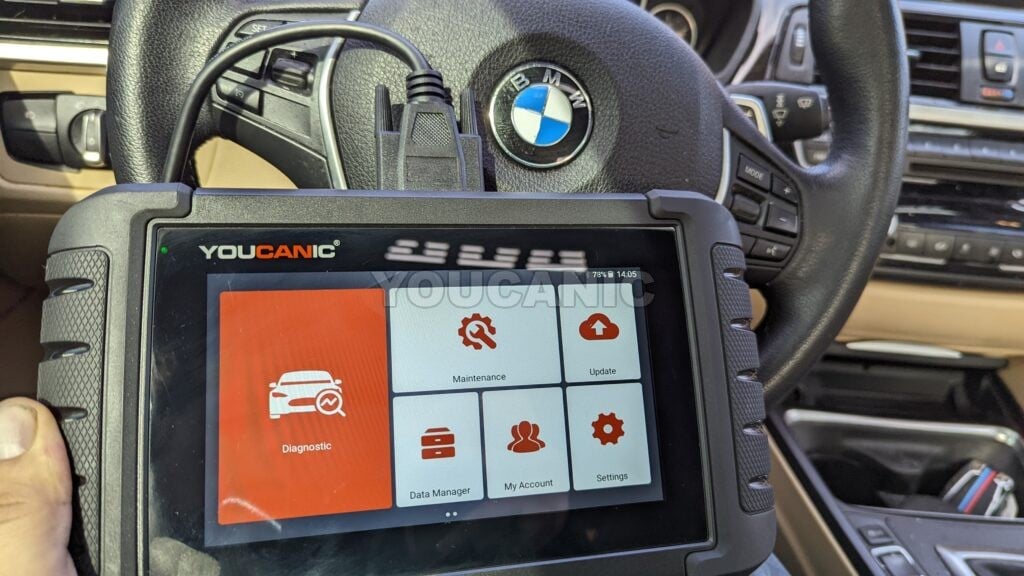
Three parts of this job need a scan tool that can talk to the EKPS, and a basic OBD2 code reader cannot do any of them: reading the EKPS fault codes (they are not stored in the engine computer), running the commanded fuel pump test, and comparing specified against actual pump speed and pump current live. That last reading is the one that tells you whether you are looking at the module, the pump, or both.
The YOUCANIC UCAN-II Pro reads BMW EKPS and engine codes, runs the pump activation test, and shows the live pump speed and current values described above. If you are only doing this once, a specialist with BMW software is a perfectly reasonable alternative.
Safety
- You are working on a live fuel system. No smoking, no sparks, and keep a fire extinguisher within reach.
- Relieve fuel pressure before disconnecting any fuel line.
- Disconnect the battery before unplugging the module, and refit and register the battery correctly afterwards on cars that need it.
- When jumping the pump directly for a test, use a fused lead and keep the connection away from any fuel vapor.
When to Hand It Over
- The module needs coding and you do not have BMW level software. This applies to most F and G chassis cars.
- Low side pressure is fine but the engine reports low fuel pressure. That is the high pressure side and a different repair.
- You find water in the trunk or under the rear seat. Find and fix the leak before fitting anything, or the new module goes the same way.
- Fault codes come straight back after a new module. Follow BMW’s own rule above: the pump is likely failing too.
Related guides: Top 5 ways you can Complete BMW Battery Registration · Solving the Issue of a BMW That Won’t Start in Cold Weather




Brother, where did you find the relay fuse? This thing is driving me crazy 🙁
I have a 2011 F10 – got a Drivetrain Malfunction Warning so I plugged in the Foxwell BMW scanner. The code that came up was EKPS Fuel-pump Control – it says No Fault. What does that mean? Is it the high or low fuel pump? It’s not giving me any further info. Thank you!
Im having the same problems..I have a temporary fix.. until I replace it.. I got it cheaper than the dealer price.. but still a pretty penny. My car shut down one day while I was driving, so I pulled over and was like WTF. So, before METRO arrived I creeped over to the shoulder and began simple troubleshooting via YouTube.. ended up swapping out my Fuel Pump Relay cause it was overheating. Followed that up to the Fuel Control Module and here I am.. I picked up a New OEM Module for about $250
Hi. Very helpful article. It mentions replacing the unit with a used one. I found a used one from the same vehicle I have 2013 BMW 328i. Do I simply just unplug the old (faulty) one and plug in the new (used) one?
BMW wants $1,700+ to replace it and the used one I found was less than $100.