
Check/Add Engine Oil Mazda 3 2013 to 2018
Reviewed/Verified by:

Is the oil pressure warning light displayed on your Mazda 3 dashboard? Learn how to fix the problem by checking the oil level and adding engine oil to your vehicle. This guide is a step-by-step procedure for checking and adding engine oil on a 2013 to 2018 Mazda 3.
How to Add/Check Mazda Engine Oil Level
What you will need
- Engine Oil (0W-20)
- Funnel
Procedure
- Unlock the vehicle and pull the hood release under the dashboard.

- Locate the hood latch on the vehicle’s front and slide the tab to the right to unlock it.
- Pull the hood up and set the hood strut to hold the hood.
- Pull the oil dipstick on the middle of the engine cover and wipe it clean.

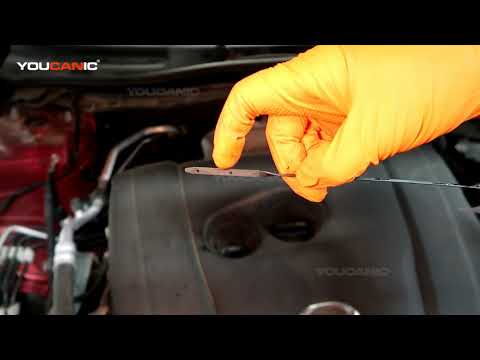
- Insert the oil dipstick and pull it out again. Then, check the oil level by looking at the tip of the dipstick. The dot at the bottom indicates the MIN (minimum) level, while the dot at the top indicates the MAX (maximum) oil level. The correct oil level should be between the two dots.
 The two holes on the tip of the dipstick indicate the minimum and maximum oil levels.
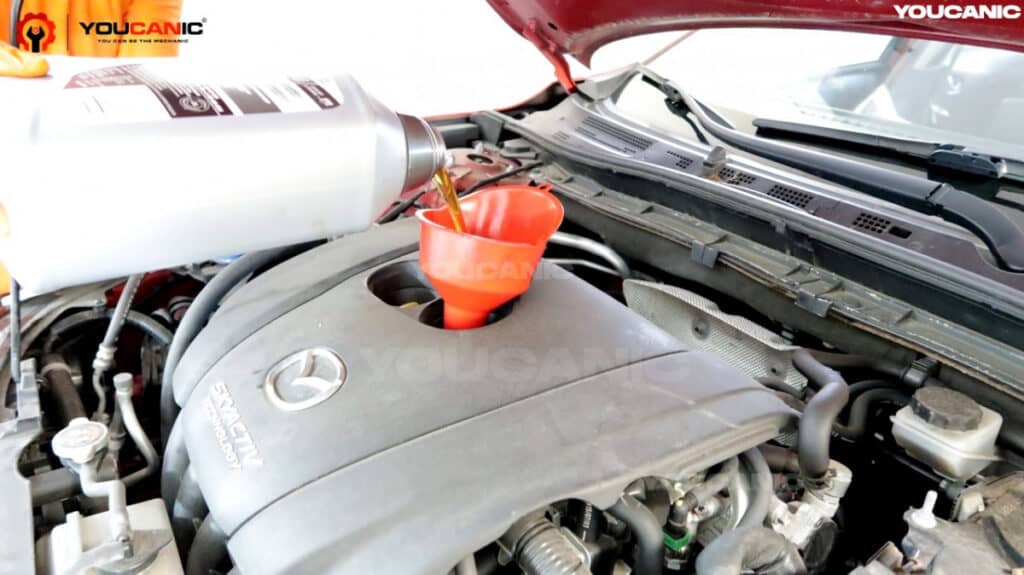
- To add engine oil, remove the oil cap by twisting it counterclockwise. Check the oil cap to determine what engine oil to use. If the recommended oil level is not printed on the cap, it should be in the owner’s manual. If the owner’s manual is unavailable, use 5W-30 full synthetic engine oil.
- Pour engine oil if the level is low. Use a funnel to prevent the oil from spilling.

- Recheck the oil level after adding engine oil. Repeat procedures 4-5 to recheck the oil level. Do not fill more than the MAX (top dot) level.

- Reinstall the oil cap by twisting it clockwise.


 The two holes on the tip of the dipstick indicate the minimum and maximum oil levels.
 Check the oil cap to determine what engine oil to use. If the recommended oil level is not printed on the cap, it should be in the owner’s manual. If the owner’s manual is unavailable, use 5W-30 full synthetic engine oil.


Check these troubleshooting and repair guides for more help on your Mazda.

🔧 Find out what is actually wrong before you pay someone to guess
Dealer level diagnostics at home with the YOUCANIC UCAN-II Pro.
- ✔ Covers most makes and models, including many luxury brands. Send us your VIN and we will confirm your car before you order
- ✔ Reads every module, not just the engine, so you find the faults a basic reader says are not there
- ✔ Commands the car: test a fan or pump, bleed ABS, retract an electronic parking brake, register a battery
- ✔ No subscriptions. Free lifetime updates, so the price you pay is the whole price
- ✔ Backed by real mechanics in the USA you can email before and after you buy
Featured in The Wall Street Journal
Two different oil warnings, two different responses
The yellow or amber oil can symbol, usually alongside a message asking you to check the oil level, means the level sensor has seen the oil drop. Topping up is exactly the right response and this guide covers it.
The red oil pressure warning is a different thing entirely and must never be treated as a top up. It means the engine is not receiving oil at pressure, which can be a failed pump, a blocked pickup or worn bearings. Adding oil to a system that is not circulating it will not help. Switch the engine off as soon as you are somewhere safe and have it looked at, because the damage from running an engine without oil pressure is measured in minutes rather than miles.


