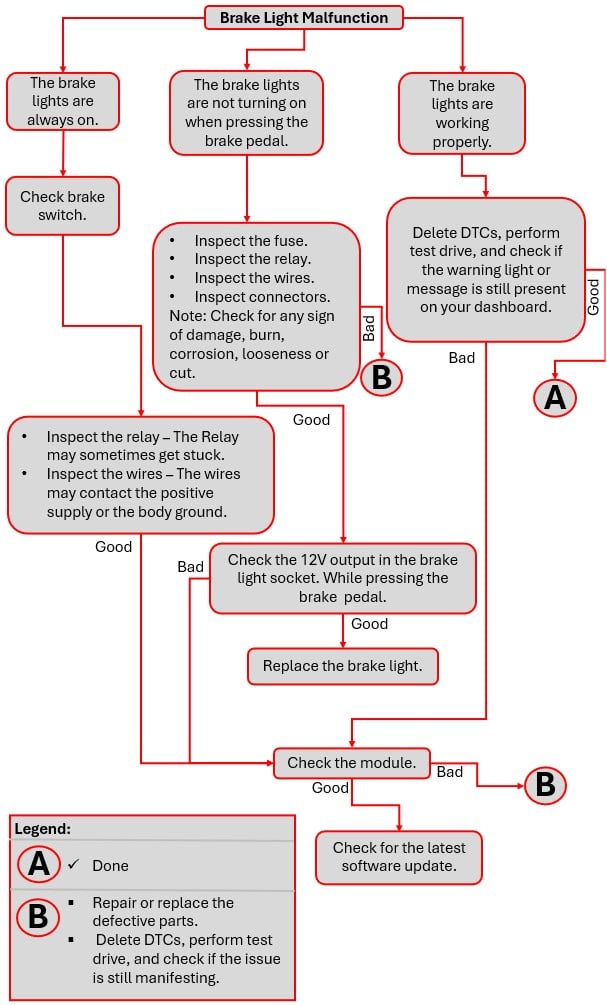
When the “Brake Light Malfunction” warning message comes on the dashboard of your Volvo, it could signal a burned-out lightbulb, but this warning message could also indicate an issue with your brake system that requires attention. Ignoring this warning could lead to an accident or being rear-ended by another vehicle.
What Does the Brake Light Malfunction Message Mean?
Brake lights signal to other drivers behind you when you are turning or stopping. Without the brake lights, other drivers on the road cannot know when you are stopping or turning. This will eventually lead to an accident. When this warning message appears in your vehicle, the brake system is faulty, or your brake lights have burned out.
⚠️ Why You Should Fix It As Soon As Possible
Safety Risk – It can lead to accidents and traffic fines.
Performance Issues – Insufficient braking performance while pressing the brake pedal.
Costly Repairs if Ignored – Ignoring the issue may worsen the damage.
Estimated Repair Cost – The repair cost could be anywhere from $50 to $2000, excluding towing service.
Common Causes
Burned-out Brake Bulbs or LEDs / Faulty Tail Light Assembly – Brake lights burn out over time or can stop working because of an electrical issue. Having faulty brake lights creates unsafe driving conditions, increases the risk of accidents, and can lead to you being pulled over when driving. Fix this issue right away!
Blown Fuse – A faulty fuse can cut or disrupt the electrical current flow to the brake light, causing it to malfunction or not turn on.
Faulty Relay – A defective relay may malfunction or short-circuit, cutting off energy flow to necessary components. The rear brakes on a Volvo are usually controlled by the Central Electronic Module (CEM) therefore, a faulty or water-damaged CEM can also be the culprit.
Electrical Wiring – Faulty electrical wiring, such as loose or frayed wires, may cause electrical failure.
Faulty Brake Switch – A faulty brake switch can cause the brake lights to malfunction, sometimes getting stuck in the closed or open position.
Brake Fluid – While not common, low brake fluid can also cause the issue. Low brake fluid creates low braking pressure, leading to insufficient braking because the system cannot register if you apply the brakes, especially in newer models.
CAN Network – Everything in a car is connected, meaning that if one component is broken or malfunctioning, it can affect other systems. These parts could stop working due to electronic failure, short-circuiting, or overheating.
🛠️ Pro Tip: Use an OBD-II Scanner to check for error codes related to the issue.
Common Symptoms
No Brake Lights – You can usually see your brake lights out of the rear windshield of your Volvo when you press and hold the brake pedal. If you cannot see them from the driver’s seat when holding the brake pedal down, it could mean the brake lights are not functioning. You can double-check the functionality of your brake lights by having someone stand behind your car while you press the brake pedal. If they give you a thumbs down, the brake lights are not working.
Brake lightsIlluminate inconsistently – If the warning light is caused by an electrical issue, such as a blown fuse or weak battery, the brake lights will not always turn on or can be dim when illuminated.
Engine Won’t Crank – The system will prevent the engine from starting or cranking because of the safety protocols programmed into your vehicle. (e.g., applying the brake pedal while the transmission is in P position) If one of these protocols is missing, the system will prevent the engine from starting. This can often happen due to a faulty brake light switch.
Troubleshooting
Before taking your car to a mechanic, try these DIY fixes:
Check the fuse in your fuse box – Look for any sign of loose or damaged fuses in your fuse box, as this is one of the most likely causes of the problem. Test the brake system fuse with a multimeter tool. A good fuse may give a reading of less than 5 ohms.
Check the relay condition– Look for any sign of loose or damaged relays. Try to hold the relay while someone is pressing the pedal. You may feel and hear a clicking sound. This indicates that the relay is functioning. Just to be safe, swap the old relay for a new one. Relays sometimes may create a clicking sound but have a faulty contact.
Check the wire condition, including connectors – Look for loose connections and frayed or bent wires that may be causing an electrical issue. Damaged wires will not communicate or provide necessary systems with enough power.
Check the wire voltage output – Use the multimeter to check the voltage output of your brake light. The reading will give you 0 Volts if the brake pedal is not pressed and 12 Volts if pressed.
Check the brake light – The brake light is brighter than the park light, and the color will be red if the brake pedal is pressed. If the lights are not turning on or are very dim, the bulbs should be replaced.
Check the brake switch – Look for any sign of looseness, burning, or corrosion in the connectors. Check the condition of the brake switch using a scanner or a multimeter. Scanners like the YOUCANIC Pro Scanner allow users to record live data. You may check if the switch is functioning correctly by checking the system when applying the brakes. If you are using a multimeter, you need to remove the socket to check the brake switch’s resistance. A good switch may give you a reading of less than 5 ohms in the closed position and an “OL” reading in the open position.
Check the brake fluid level– If the brake fluid level is near or below the “MIN” line on the side of the brake fluid reservoir, top off the brake fluid. Make sure you are using the correct fluid specification. Check the brake fluid cap or user’s manual for the type of brake fluid you need to use. If the brake fluid level looks fine, check the color of the brake fluid, as this indicates the condition of the brake fluid. Dirty fluid can damage the brake system. Replace if necessary. Regular brake bleeds are important to prevent air buildup in the brake fluid reservoir.
Check the module – Look for any sign of corrosion, water, dirt, bent, or damage to the pin of the module that may cause the issue.
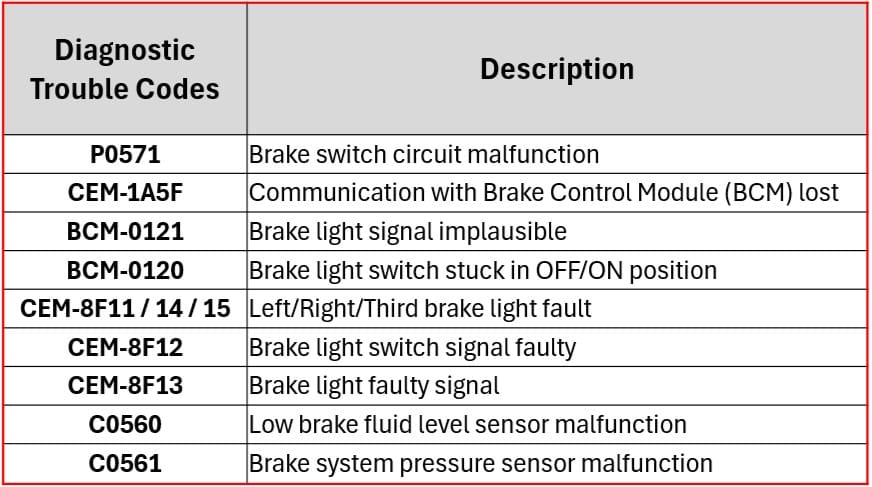
Use the OBD-II scanner to scan the vehicle– Scan the car to check for any diagnostic trouble codes (DTCs). Record the data before deleting it, then scan again to check if there are active or frozen DTCs in the Central Electronic Module (CEM) that may cause the issue.
Having trouble finding what is wrong with your brake lights? Watch our YouTube guide, “Volvo Full System Health Check,” and diagnose your Volvo like a pro!
Common OBD-II Fault Codes
FAQs
Is replacing the assembly tail light necessary for LED brake lights?
➡️ LED brake lights usually are only found on newer models, and there are different types of LEDs. Some manufacturers use a flexible or linear LED in the brake light, while others use the standard LED tube. No matter the type of LED your vehicle has, your dealership recommends replacing the assembly instead of just the lights.
Why is bleeding the brake system important?
➡️Bleeding the brake system will improve your braking performance. Brake fluid creates vapor because of heat from the metal. When the brake fluid gets hot enough, it can evaporate, causing air build-up or condensation. Air can be compressed more easily than fluid. The vapor may cause insufficient braking performance. This is why your aftersales dealership recommends performing this job for your safety.
Can I still drive the vehicle with the warning message?
➡️ Yes, you can still drive the vehicle if the fault is not critical. You should be prepared for the consequences, like expensive fines for traffic violations. Ensure your brakes are working correctly, and visit a workshop as soon as possible to solve the issue.
Can I use other colors for my brake light?
➡️No, using other colors for your brake light is illegal. The red color of the brake light is standard for all vehicles.
Final Thoughts
A malfunctioning brake light should never be ignored, as it could indicate a serious issue with your vehicle’s driving safety. Following these troubleshooting steps and scanning for fault codes can save time and money while ensuring your car remains safe and reliable.
Experts Who Contributed to This Article
Elbert Nonog, Automotive National Cert., BS Mechanical Eng.
Diagnostic Specialist13+ years of experience
Elbert G. Nonog is an Automotive Technical Writer and Training Manager with over 10 years of experience across major brands including Chevy, MG, Ford, Volkswagen, and Toyota. Rising from technician to leadership roles, Elbert excels at transforming complex automotive concepts into accessible training materials and documentation. His expertise spans conventional and electric vehicle systems, nationwide dealership training, and aftersales operations management. With TESDA certification and pursuing further education from the Technological University of Philippines, Elbert effectively bridges the gap between automotive engineering and practical application for industry professionals and enthusiasts.
rhila, ASE Certified
Diagnostic Specialist15+ years of experience
Rushit Hila is a dedicated automotive engineer with ASE G1 certification and specialized training from an esteemed Automotive Specialty School. His hands-on experience and technical expertise in advanced diagnostics, system integration, and performance optimization make him a trusted voice in the industry.
Searching...
33% OFFFlash Sale — Ends Soon
⭐⭐⭐⭐⭐ 4.8 stars · 247 Verified Reviews
Stop paying $150 every time a warning light comes on.
The UCAN-II-D gives you full system diagnostics, bidirectional controls, and lifetime free updates. One scanner. Own it forever.
Was
$750
→
Now
$499
Save $251
+ Free shipping · No subscription ever
Free lifetime updates included — no annual fees ever