
Mercedes Adaptive Damping System ADS Suspension
Reviewed/Verified by:

We take a look at the Mercedes Adaptive Damping System or ADS. What is it, and how can you tell if your Mercedes-Benz has it? Many Mercedes-Benz vehicles have Airmatic suspension, including E, S, ML, GL, R, and SL classes.
At a Glance
- What ADS does: the Adaptive Damping System varies shock firmness electronically. When it faults, the car defaults to a fixed setting, usually the firm one.
- Most common cause: one failed damper solenoid or its wiring. The connectors at the struts sit in the splash zone and corrode.
- Second cause: a body acceleration or level sensor, which tells the system what the wheels are doing.
- Less common: the ADS control module.
- Cost: $400 to $1,200 per adaptive damper. $150 to $400 per sensor. The gap between those two is the reason to read the code before ordering.
There is a lot of confusion about the Mercedes Adaptive Damping System (ADS). Sometimes, Mercedes ADS is even confused with Active Body Control (ABC) hydraulic suspension.
A few Mercedes vehicles are equipped with (ADS) and Airmatic. Think of ADS as an add-on to the Airmatic. Even though ML, GL, and R classes sold in the US have air suspension as standard, not all have ADS.

🔧 Stop paying the dealer for every warning light
Get dealer level diagnostics at home with the YOUCANIC Full System Scanner.
- ✔ Works with all makes and models, including most luxury brands
- ✔ Topology map view shows all vehicle modules on one screen for faster diagnostics
- ✔ Bi directional controls to test fans, pumps, actuators and more so you do not have to guess
- ✔ Special resets and calibrations such as ABS bleed, EPB service, battery registration and more
- ✔ Free lifetime updates with no recurring fees
What does ADS mean on a Mercedes-Benz?
On vehicles equipped with an Adaptive Damping System in addition to Airmatic (automatic vehicle height adjustment), the driver can select the suspension stiffness (ride quality) at the push of a button. Mercedes with ADS has a button on the center console that allows the driver to select the stiffness of the suspension. Typically, there are three settings.
- Sport: Suspension becomes very stiff.
- Normal
- Comfort: Very soft suspension; you feel like driving a Lexus.
If your Mercedes does not have ADS, you can not adjust the stiffness of the suspension. The vehicle adjusts the ride height automatically, or you can raise the vehicle. But that does not change the stiffness of the suspension.
Having used an R500 with ADS, my preferred setting is NORMAL. Sport makes you feel every little bump on the road. Simultaneously, the COMFORT setting feels like the car needs new struts and has too much bouncing. The soft setting is good if you drive in a city with bad roads, but the downside is that it can shorten the life of the airbags. In Comfort ADS settings, the suspension airbags move up and down the most.
How can I determine if my Mercedes has ADS?
There are two straightforward ways to determine if your Mercedes-Benz has ADS.
First, there is a button on the dashboard to adjust the ride quality. The button shows a shock and has the words “SPORT” and “COMF” written on it.

A car without ADS will not have this button. Cars with airmatic but no ADS still have a button to raise the vehicle.

Second, the airmatic struts in vehicles with ADS have a solenoid installed next to the airmatic strut that is not installed on cars without ADS.
Mercedes Airmatic Strut with ADS
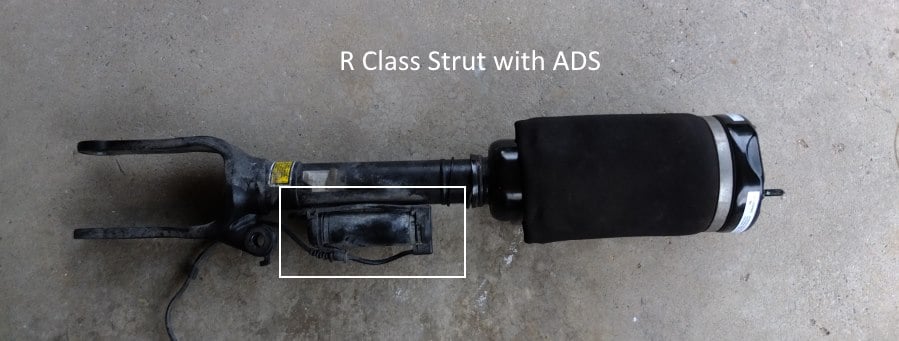
Airmatic strut from GL/R Class with ADS.
Mercedes Airmatic Strut without ADS
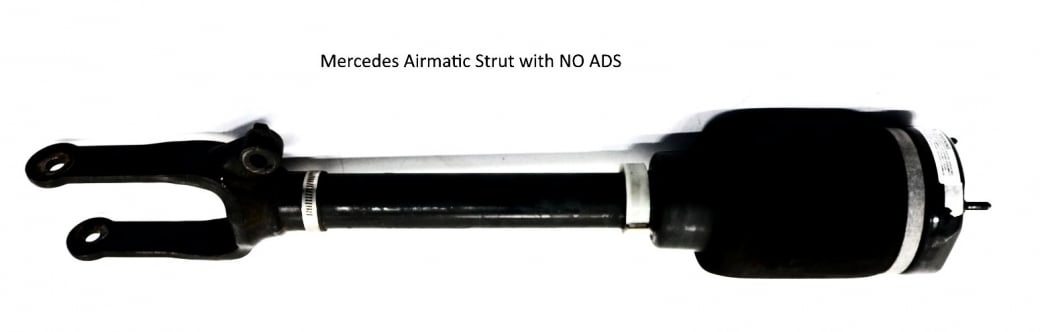
Airmatic strut from GL/R Class without ADS.
Struts from vehicles with ADS are not interchangeable with struts from vehicles without ADS.
Order struts by VIN, not by model
As the guide above explains, ADS and non ADS struts look similar but are not interchangeable, and the same model year was built both ways. The ADS strut carries a solenoid and an extra electrical connector. Ordering by model and year alone is how people end up with a strut that physically fits but leaves the car with a suspension fault and a warning message, because the module is looking for a damper it cannot find. Quote the full VIN and the supplier can see exactly which the car left the factory with.
Replace in pairs across an axle
Fitting one new strut against an old one gives the car two different damping characteristics on the same axle, which the system cannot compensate for and which makes the handling feel unsettled over bumps. The old unit on the other side is the same age and usually within months of failing anyway. Budget for the pair.
Air leaks and damper faults produce different symptoms
A car that sits low overnight and pumps itself back up has an air leak in the strut bag, the valve block or a line. A car that sits at the right height but crashes over bumps or feels floaty has a damping fault, which on an ADS car is often the solenoid or its wiring rather than the strut itself. They are different repairs, and the fault codes stored in the suspension module separate them quickly.
Check the compressor before it fails too
A leaking strut makes the compressor run far more than it was designed to, and the compressor eventually burns out from the extra duty. If a leak has been left for a while, the compressor and its relay are worth checking at the same time, because replacing the strut and then losing the compressor a month later is a common and avoidable sequence on these cars.
What This Repair Costs
| Repair | Typical total cost |
|---|---|
| Acceleration or level sensor | $150 to $400 installed |
| Connector or harness repair | $100 to $300 |
| Adaptive damper, one corner | $400 to $1,200 |
| ADS control module rebuild | $300 to $700 |
| Diagnosis at an independent shop | $120 to $250 |
Rough US estimates for planning, not quotes. Prices vary widely by model, parts brand and region, so get a written quote before committing.
Dampers are commonly replaced in pairs across an axle for handling balance, so budget for two if one has failed and the other is the same age.
When to Stop and Hand It Over
- More than one corner faults at the same time, which points upstream to the module or supply.
- The car sits unevenly as well as riding badly, which can mean a level sensor or an air suspension fault rather than ADS.
- The module needs coding after replacement.
Finding Which Corner Before You Order a Damper
An adaptive damper is a four figure part and there are four of them. Ordering the wrong one is an expensive mistake, and the dash message does not say which corner. A generic OBD2 reader cannot read the suspension module at all.
The YOUCANIC Full System Scanner reads Mercedes ADS and suspension codes and shows live damper solenoid current and sensor values per corner, which identifies the failed unit precisely. It also lets you distinguish a damper fault from a sensor fault, which is a difference of around $800.


