

Mercedes AIRMATIC Release Valve Problems and Replacement (Fault 5350)
Reviewed/Verified by:

Fault 5350 points at the pressure release valve, component A9/1y1, which is mounted on the AIRMATIC compressor unit itself rather than on the valve block. That distinction decides whether you are replacing a valve or a compressor. The compressor assembly sits behind the front bumper.
At a Glance
- Fault 5350 points to the pressure release valve (A9/1y1) on the AIRMATIC compressor unit, not the whole compressor.
- Check the wiring first: the harness and connector at the valve, and dirt or rust around the solenoid.
- The valve can often be replaced on its own. It is held by two T25 Torx screws.
- Service the air drier at the same time, or moisture will ruin the new valve.
- Never work under a car held up by air suspension.
After scanning the system, we found this fault code:
- 5350: A9/1y1 AIRMATIC pressure release valve: Open circuit
The owner had taken the vehicle to a Mercedes-Benz mechanic who recommended replacing the whole air suspension compressor. You don’t need to replace the air suspension compressor to fix this problem.

🔧 Find out what is actually wrong before you pay someone to guess
Dealer level diagnostics at home with the YOUCANIC UCAN-II Pro.
- ✔ Covers most makes and models, including many luxury brands. Send us your VIN and we will confirm your car before you order
- ✔ Reads every module, not just the engine, so you find the faults a basic reader says are not there
- ✔ Commands the car: test a fan or pump, bleed ABS, retract an electronic parking brake, register a battery
- ✔ No subscriptions. Free lifetime updates, so the price you pay is the whole price
- ✔ Backed by real mechanics in the USA you can email before and after you buy
Featured in The Wall Street Journal
Symptoms of a Faulty Release Valve
- The car sits low or will not rise to normal height after starting.
- The compressor runs for a long time, or the AIRMATIC Visit Workshop or Vehicle Too Low message appears.
- A hissing sound from the compressor area right after the engine is switched off.
- The compressor fuse or relay keeps failing because the compressor never stops running.
A leaking air spring or air line causes many of the same symptoms, so confirm where the air is escaping before buying parts.
Possible Solutions
- Jack up the vehicle and secure it. Remove the front wheel on the side where the air compressor is mounted. The air suspension compressor is located behind the front bumper. You access it by removing the lower splash shield or the wheel well liner. Depending on the model, it is on the driver’s or passenger’s side.

- Locate the air suspension release valve.


Here is what you need to do.
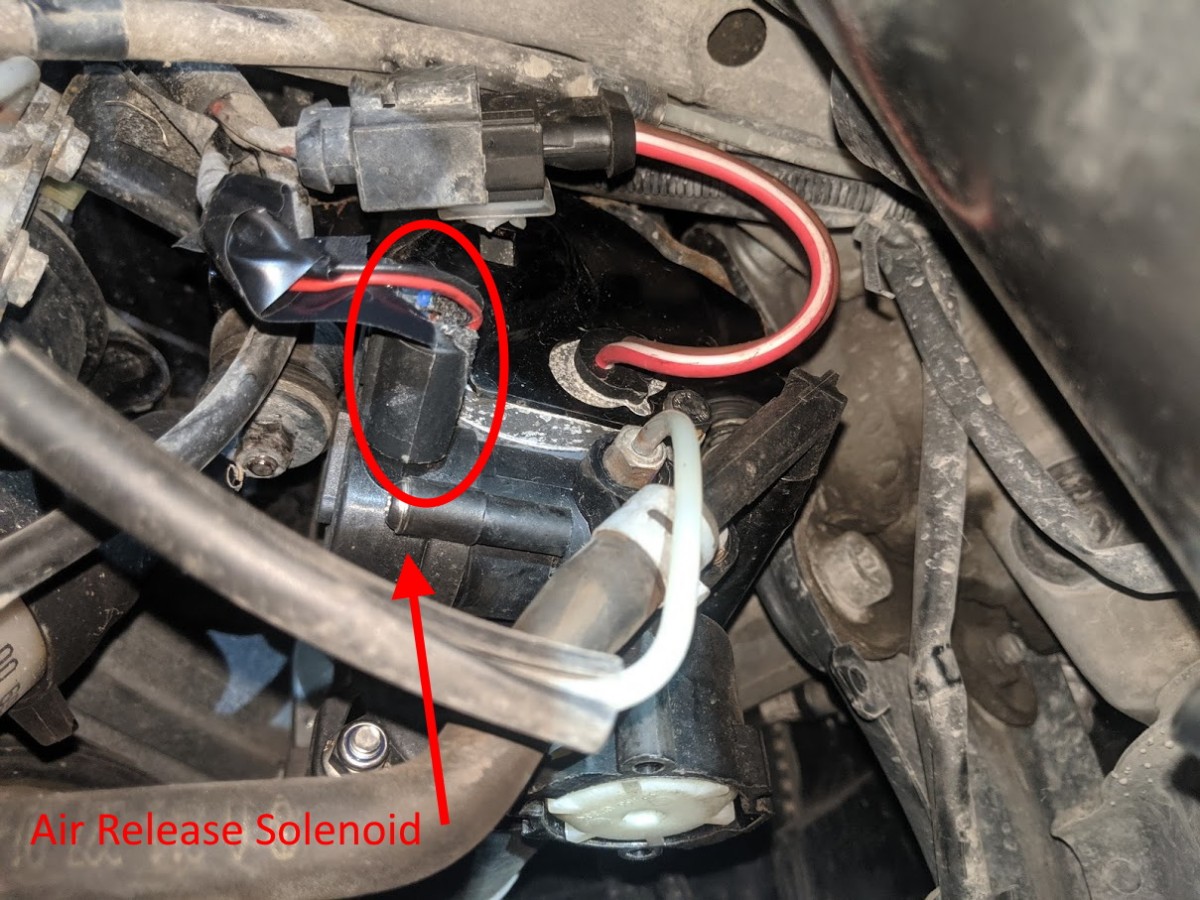
- Check the wire harness to the air release valve (solenoid). The wire harness that connects to the air suspension compressor can get damaged. Once this happens, you will get the AIRMATIC Failure Visit Workshop on the dashboard.
- Remove the air release valve and ensure it is not stuck. Cleaning the air release valve can sometimes fix the problem. Especially if the plunger is stuck due to dirt or rust built around the solenoid.
- Replace the air release valve. Sometimes you may not be able to fix the air release valve. If the valve is available on its own, you can replace just the valve instead of the whole compressor. It is held in place with two T25 Torx screws and takes less than 5 minutes to replace.
What the release valve actually does
The release valve named in fault 5350, component A9/1y1, is mounted on the AIRMATIC compressor unit (A9/1) itself, and it is what lets air out of the system. The compressor puts air in, individual solenoids route it to each corner, and the release or exhaust valve vents it back to atmosphere when the car needs to lower. If it sticks closed the car will raise but refuse to come down. If it sticks open or leaks past its seal, air escapes continuously and the car settles on its bump stops, usually overnight.
That second failure mode is the one that costs money beyond the valve itself. A system leaking air through the release valve makes the control module call for the compressor constantly to keep the car up, and these compressors are duty cycle rated and not designed to run continuously. A leak the compressor has to keep making up for is one of the most common reasons these compressors burn out, so if you are replacing a compressor, work out what was making it run before you fit the new one. Our guide to the Mercedes air suspension compressor covers that side of the system.
Confirm the leak before replacing anything
A fault code naming the valve is a starting point rather than a diagnosis, because the module infers a great deal from pressures and ride heights that other faults can also explain. Spend ten minutes with a spray bottle of soapy water before ordering parts.
With the system pressurized, spray the release valve and the compressor unit itself, along with every air line fitting entering and leaving them, then work outward to the struts, paying attention to the folds of the rubber bellows where they crack with age, and to the connections at each corner. Bubbles tell you where the air is going. A car that sits level overnight but sags over three days has a slow leak somewhere; one on its bump stops by morning has a large one.
Check the ride height sensors and their link rods at the same time, because a sensor reporting a false height will have the module opening and closing valves to chase a target it can never reach, which looks like a valve fault from the driver’s seat. Our guide to the Mercedes ride height level sensor explains how to check those.
Moisture is the usual reason these valves fail
These valves are not fragile, and they rarely fail for no reason. The usual cause is water. The compressor incorporates a desiccant air drier that removes moisture from the air going into the system, and once that drier is saturated, damp air passes through into the lines, the valves and the valve block. There it corrodes the internals and the seals, and in winter it freezes, which is why some cars behave normally in summer and develop intermittent faults in cold weather.
So if you are replacing the release valve, replace or service the air drier at the same time, or the new part will go the same way. Most complete compressor assemblies include a new drier; a bare compressor or repair kit may not.
Work safely and expect a calibration afterwards
Never put any part of your body under a vehicle supported by its air suspension. If a line, a valve or a strut releases while you are underneath, the car drops instantly and without warning. Raise it conventionally, support it on jack stands at the manufacturer’s jacking points, and depressurize the system before disconnecting any air line, because the stored pressure is considerable and a line whipping loose will injure you.
Once the new valve is in, the fault memory needs clearing and the ride heights checking, and most models need a calibration before the car will settle correctly. A scanner that supports Mercedes AIRMATIC, such as the YOUCANIC UCAN-II Pro, can command individual valves open and closed for testing, show each corner’s live height, clear the stored faults and run the level calibration, which is the difference between a parts swap and a finished repair.
What to do next: find where the air is going first
Fault 5350 names the valve, and that is a starting point rather than a verdict. The module infers a great deal from pressures and heights that other faults also explain, so ten minutes of checking beats ordering a part.
- Note how fast the car sits down. Level overnight but sagging over three days is a slow leak. On the bump stops by morning is a large one. That alone narrows where to look.
- With the system pressurized, spray soapy water on the release valve and compressor unit, then every air line fitting, then outward to the struts. Pay attention to the folds of the rubber bellows where they crack with age. Bubbles tell you where the air is going.
- Read the AIRMATIC module, not the engine module, and separate current faults from stored history.
- Put the live corner heights on screen and compare all four against what you can measure with a tape. A corner the module reports wrongly is a sensor or linkage problem, not an air leak.
- Command the valve open and closed and listen. A valve that responds is not the fault. A valve that does nothing, with power and ground present at the connector, is.
- Check the compressor run time. A system leaking through the release valve has the module calling for the compressor constantly, and these compressors are duty cycle rated. That is how a cheap valve becomes an expensive compressor.
- After the repair, clear the fault memory and run the level calibration. Most models will not settle correctly without it.
The YOUCANIC UCAN-II Pro commands individual valves for step five, shows the live corner heights in step four, clears the stored faults and runs the level calibration in step seven. It is available as a seven day rental. Coverage varies by chassis and year, so email support with your VIN before ordering.
When you do not need a scan tool for this
Steps one and two need a spray bottle and a torch. On a car that drops overnight they very often find the fault outright, and a split bellows or a hissing fitting is not a diagnosis that needs confirming electronically.
Where the tool becomes necessary is commanding the valve to prove it, and the calibration afterwards. Neither can be done by hand.
Related AIRMATIC guides
- Testing the AIRMATIC air compressor, for deciding whether the compressor itself is still good before you blame the valve.
- AIRMATIC malfunction and the up arrow warning, which explains the dashboard messages this fault produces.
- AIRMATIC compressor replacement, if the compressor has already been run to death by a leak nobody corrected.
- AIRMATIC control module replacement, for faults that follow the module rather than the air system.
- Ride height level sensors, the other component that has the module opening and closing valves for no good reason.
- AIRMATIC compared with ABC, if you are not certain which system your car actually has.
Frequently Asked Questions
Can I drive with a faulty AIRMATIC release valve?
If the car stays at a normal height, short trips are usually fine. If it sits low, the tires can rub and the suspension can bottom out, so drive slowly and get it fixed.
Should I replace the whole compressor or just the valve?
If the compressor still builds pressure quickly and quietly, replacing only the release valve and the air drier is usually enough and costs far less.
Why did my new compressor fail quickly?
The most common reason is a leak elsewhere, such as an air spring, that keeps the compressor running until it overheats. Fix all leaks before fitting a new compressor.


