
Active Brake Assist Functions Limited Diagnosis Mercedes-Benz
Reviewed/Verified by:

The first thing to try costs nothing: clean the windshield, grille and bumper, especially the radar area behind the badge, then drive about 6 miles on clear roads so the system can recalibrate. It is the first fix because dirt, ice or road film in front of the radar produces the same message as a failed sensor.
At a Glance
- What it means: the collision warning and automatic braking system is temporarily limited, most often because its radar sensor cannot see.
- First fix: clean the windshield, grille and bumper, especially the radar area, then drive about 6 miles (10 km) on clear roads so it can recalibrate.
- Just delivered or repaired? Make sure transport mode has been switched off.
- Still on? Read the fault codes. Damage to the front end or a misaligned radar needs a recalibration.
- Under warranty, let the dealer handle it.
What does Active Brake Assist Functions Limited mean?
Active Brake Assist is a collision prevention system that aims to reduce the risk of a collision by warning the driver of vehicles, cyclists, or pedestrians and reduces the likelihood of injury in case of such a crash. The Active Brake Assist Functions Limited message indicates that the brake assist function is not working correctly. Active Brake Assist Functions Limited warning is usually caused by a sensor that does not function properly or low voltage issues.
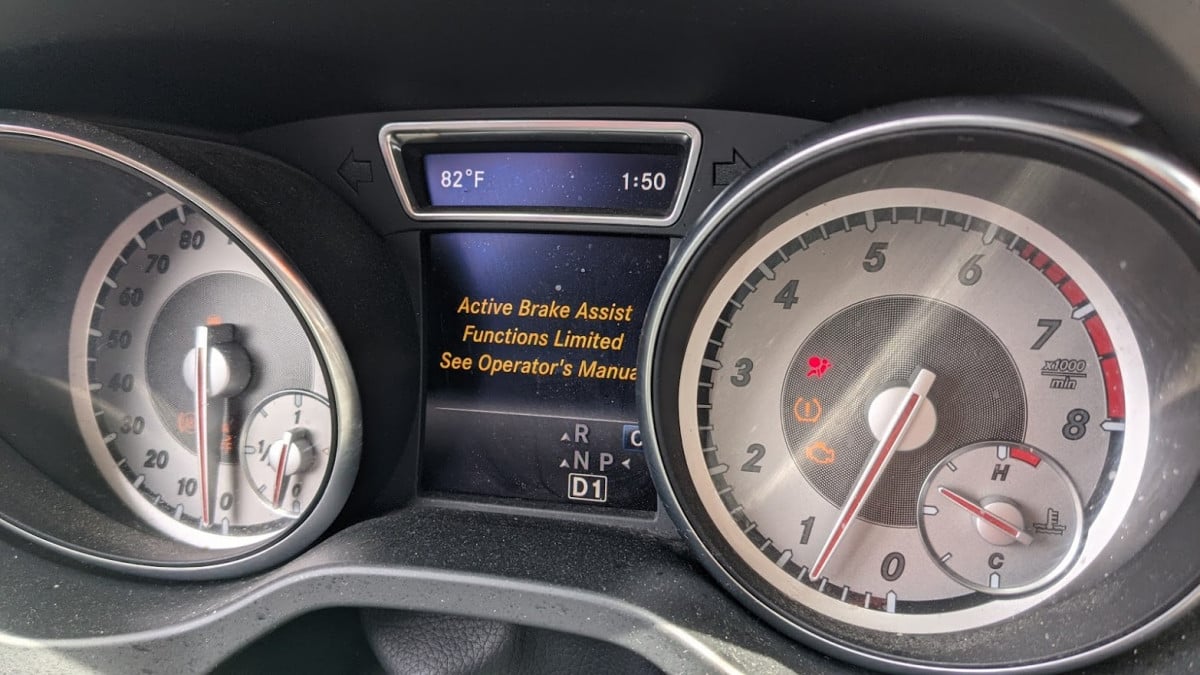
The most likely cause is that the front sensor is covered by dirt and snow. If other warnings appear at the same time, such as the check engine light or several driver assistance messages, suspect low battery voltage or a wider electrical fault rather than a dirty sensor. Pull over somewhere safe, switch the car off for a few minutes and restart it.

🔧 Find out what is actually wrong before you pay someone to guess
Dealer level diagnostics at home with the YOUCANIC UCAN-II Pro.
- ✔ Covers most makes and models, including many luxury brands. Send us your VIN and we will confirm your car before you order
- ✔ Reads every module, not just the engine, so you find the faults a basic reader says are not there
- ✔ Commands the car: test a fan or pump, bleed ABS, retract an electronic parking brake, register a battery
- ✔ No subscriptions. Free lifetime updates, so the price you pay is the whole price
- ✔ Backed by real mechanics in the USA you can email before and after you buy
Featured in The Wall Street Journal
If that doesn’t work, try cleaning the front grille, the left and right side of the front bumper, and the top center of the windshield; in most cases, this fix will clear the messages. If your vehicle battery is getting too weak or if there is a software issue with the Distronic Plus control unit, the active brake assist warning may come up.
Depending on the Mercedes-Benz model, the warning message may say:
- Active Brake Assist Functions Limited See Owners Manual
- Active Brake Assist is malfunctioning. Consult a qualified specialist workshop.
- Active Brake Assist Inoperative See Oper. Manual
- Active Brake Assist Functions are Currently Limited
- Active brake assist is not available
If the message continues, you must read the fault codes by connecting a YOUCANIC UCAN-II Pro to the OBD-II port under the dashboard.
Can you drive with the Active Brake Assist light on?
Yes. Your ordinary brakes are unaffected and the car drives normally. What you lose is the warning and the automatic braking that would step in if you did not react in time, so leave a longer following distance and do not rely on adaptive cruise control, which often switches off alongside it. A fault that genuinely restricts how the car drives announces itself with its own message rather than through this one.
Possible Issues
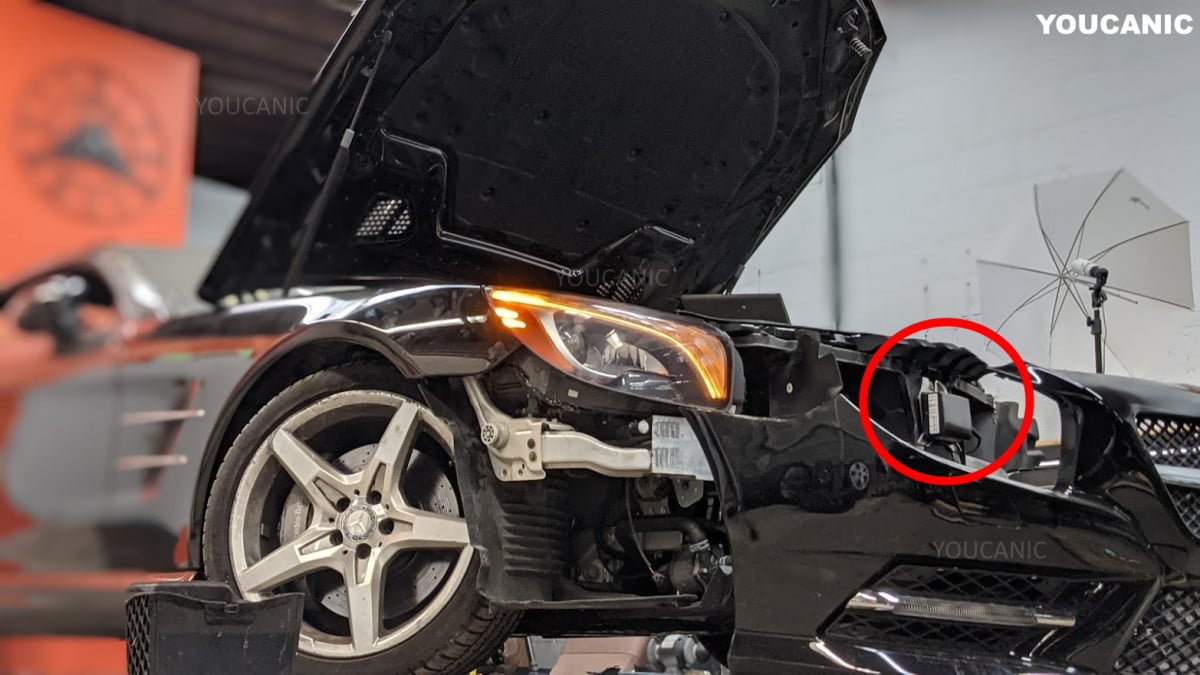
As stated earlier, in most cases, Active Brake Assist Functions Limited means the brake assist ‘sensor’ at the front of the car is dirty and, therefore, can’t sense distances to the object at the front. It is also a common fault for Mercedes-Benz cars when you drive in the snow.
Try clearing the snow from the front of the vehicle and the windshield, and most likely, remove errors from the dashboard. Or even better, take the car for an exterior wash.
Other possible causes of Active Brake Assist Functions Limited include:
- Loose connection
- Coding issue
- Low battery voltage
- Damaged radar sensor
According to the owner’s manual, the system may be impaired or may not function in the following situations:
- In snow, rain, fog, heavy spray, if there is glare, direct sunlight, or varying ambient light.
- If the sensors are dirty, fogged up, damaged, or covered
- If the sensors are impaired due to interference from other radar sources, e.g., strong radar reflections in parking garages
- If a loss of tire pressure or a defective tire has been detected and displayed
- In complex traffic situations where objects cannot always be identified
- If pedestrians or vehicles move quickly into the sensor detection range
- If other objects hide pedestrians
- If the typical outline of a pedestrian cannot be distinguished from the background
- If a pedestrian is not detected, e.g., due to unique clothing or other objects
- On bends with a tight radius
- Active brake assist may require calibration
- An incorrect windshield was installed
Possible Fixes
If your Mercedes-Benz is still under warranty, take the car to the dealer and let the dealer resolve the issue. If your car is out of warranty, the following suggestions will usually help resolve the Active Brake Assist Functions Limited warning.
- Remove all dirt and snow from the front windshield, grill, and bumper.
- Drive the car for about 6 miles (10 km) on clear roads. If the car was just delivered or repaired, also make sure transport mode has been switched off, which needs a dealer or a scanner. Once the fault code turns passive, the sensor can calibrate itself. The Active Brake Assist should recalibrate automatically, and the error clears if the code is due to a dirt issue.
- Disconnect the 12-volt battery for 15 minutes and reconnect it.
- If the problem persists, read the fault codes.
For more help, see the Message (yellow) in IC: “Active Brake Assist currently restricted, see operator’s manual”.
How does Active Brake Assist work?

Active Brake Assist with Cross-Traffic Function is designed to avoid an impact entirely with pedestrians, animals, or other objects and vehicles ahead, reduce damage, or minimize its harmful effects if the driver’s reaction to an emergency event is delayed. If the driver brakes too gently, the system adds braking force. If the driver does not react at all, Active Brake Assist can brake the car on its own.
The big question is, ‘Is my Mercedes equipped with active brake assist?’ Most Mercedes-Benz models from about 2014 onward have it, often as standard equipment. If you are uncertain, call any Mercedes-Benz dealer and give them your VIN to be decoded, and they can tell if your vehicle has an active brake assist installed. Autonomous braking can be initiated in critical situations if you do not react to the warning. In especially critical cases, Active Brake Assist can initiate autonomous braking directly.
The distance warning function issues a warning in the following situations:
- From approximately four mph (7 km/h), if your vehicle is close to a car or pedestrian, you will hear an intermittent warning tone, and the distance warning lamp lights up in the instrument cluster.
Brake immediately or take evasive action, provided it is safe to do so, and the traffic situation allows this.
Active Brake Assist consists of the following functions:
- Distance warning function
- Autonomous braking function
- Situation-dependent braking assistance
- Vehicles with Driving Assistance Package: Evasive Steering Assist
How do you turn off active brake assist?

The active brake assist can be turned off via the steering wheel controls.
- Go to vehicle settings
- Then scroll down to Assistance
- Scroll down to Active Brake Assist.
- Choose a warning setting: Early, Medium, Late, or Off.
- To disable brake assist, select OFF.
Note that the vehicle will not brake automatically with brake assist off to avoid a collision. On many models, if you switch it off, it goes back to the Medium setting the next time you start the car.
Active Brake Assist Disabled
Active Brake Assist may cancel the brake application when one of the following conditions is fulfilled:
- You maneuver to avoid the obstacle.
- There is no longer a risk of collision.
- The vehicle can no longer detect an obstruction, block, or barrier.
Fault Codes
Possible fault codes include:
- C163691 The calibration of the control unit ‘DISTRONIC’ is malfunctioning. The parameter is outside the permissible range.
- C174AFB The learned value of an operating parameter of the control unit ‘COLLISION PREVENTION ASSIST’ is outside the valid range.
- C174AFA The learned value of an operating parameter of the control unit ‘COLLISION PREVENTION ASSIST’ is outside the valid range.
This is a partial list of Active Brake Assist / Active Distance Assist DISTRONIC-related fault codes. Other fault codes may be stored in the Active Brake Assist module.
Troubleshooting
This error message directs the driver to the owner’s manual for more information, but unfortunately, there is little helpful information. To find out why the Active Brake Assist malfunction is displayed on the instrument cluster, you must read the fault codes from the Active Brake Assist / Active Distance Assist DISTRONIC control module. Follow this guide on how to read Mercedes-Benz fault codes using the YOUCANIC full system scanner.
Start with the sensors and the battery
Before assuming a module has failed, clean the radar sensor area behind the lower grille and the camera patch of windshield in front of the mirror. Road salt, mud, snow pack and even a bug splat in the wrong place will blind the system, and the car reports that as a limited function rather than as a dirty sensor. A message that appears in bad weather and clears on a dry day is the system working as designed.
Low battery voltage is the other frequent trigger on Mercedes models. The driver assistance modules are among the first to drop off the network when voltage sags, so a battery near the end of its life will throw this message alongside several unrelated warnings. If a cluster of messages appeared on the same morning, test the battery before anything else.
When the message persists in clear conditions with a healthy battery, the usual causes are a radar sensor out of alignment after a front end repair, a windshield replaced without recalibrating the camera, or a genuine sensor fault. All three store codes in the driver assistance modules, and a full system scan will read them and show whether the fix is a calibration or a part.
After Bumper or Windshield Work, Check Calibration
Active Brake Assist relies on the radar sensor behind the front bumper or grille, and on many models a camera behind the windshield as well. If either was removed, replaced, or knocked out of alignment, for example after a minor front collision, a new windshield or a bumper repair, the system can show “Functions Limited” until the sensors are calibrated. Calibration needs alignment targets and a scan tool, so it is usually a dealer or specialist job.
Drive Carefully While the Warning Is On
With the warning showing, the car may not warn you or brake automatically before a collision. Your normal brakes still work. Keep a longer following distance until the fault is fixed, and do not rely on adaptive cruise control if it has also been switched off.
What to do next, in the order that costs least
The message tells you the system has limited itself. It does not tell you whether that is dirt, voltage, or a sensor that needs calibrating after body work, and those three have very different price tags. Work down this list and stop as soon as the message clears.
- Clean the radar area and the camera patch of windshield in front of the mirror, plus the grille and bumper. Then drive about 6 miles on clear roads so the system can recalibrate itself. This is free and it resolves the majority of these messages.
- Load test the battery if this appeared alongside other unrelated warnings in the same week. Driver assistance modules drop off the network early when voltage sags, and a cluster of messages on one morning is usually one battery rather than several faults.
- If it persists in clear weather with a healthy battery, read the driver assistance modules, not the engine module. A basic code reader cannot reach them, which is why the scan comes back clean.
- Separate current faults from stored history. A code that is no longer current was the weather. One that is current is a fault.
- Check what happened to the front of the car. A radar knocked out of alignment by a minor impact, a bumper that was removed, or a windshield replaced without recalibrating the camera will all produce this message with no part actually broken.
The YOUCANIC UCAN-II Pro reads the Mercedes driver assistance modules in steps three and four and clears the stored codes once the cause is fixed, and it is available as a seven day rental. Coverage varies by model and year, so email support with your VIN before ordering.
When you do not need a scan tool for this
Most of the time. Steps one and two cost nothing and clear the majority of these messages, and a message that appears in heavy rain or snow and goes away on a dry day is the system working exactly as designed rather than a fault.
Be aware of the limit too: if the codes point at radar or camera calibration, that needs alignment targets and manufacturer software. No aftermarket scanner performs that, and anyone telling you otherwise is selling something. If the car is under warranty, let the dealer handle it.
Frequently Asked Questions
What does Active Brake Assist Functions Limited mean?
The car has switched off or reduced its automatic emergency braking because the radar or camera cannot see properly or has reported a fault. Normal braking is not affected; only the automatic warning and braking help is limited.
Is it safe to drive with this message?
Yes, the brakes work normally. Drive as you would in a car without collision warning, and clean the sensors or have the fault read when you can.
Can you turn off Active Brake Assist?
Yes. On most models it is in the vehicle settings under Assistance, where you can choose Early, Medium, Late or Off. With it off, the car will not warn you or brake on its own to avoid a collision.