
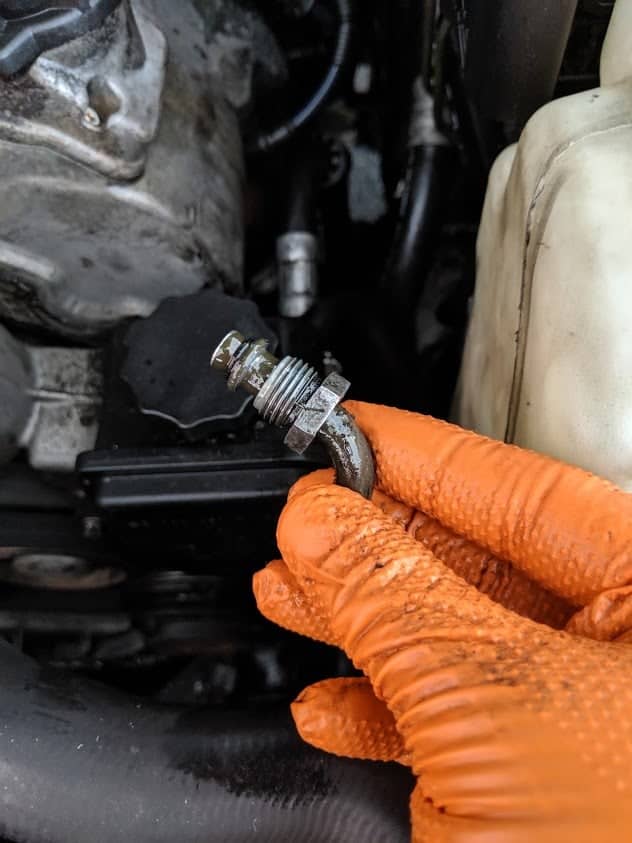
Mercedes-Benz Power Steering Line Replacement
Reviewed/Verified by:

Does your Mercedes-Benz steering feel stiff, and do you keep adding power steering fluid to the reservoir? A leaking power steering hose or line is a common cause. Learn how to replace the hoses by following the procedures below.
At a Glance
- Symptoms: stiff steering, a whining pump and a reservoir that keeps going low
- Tools: floor jack, two jack stands, 17mm socket, syringe to empty the reservoir
- Watch out: two lines meet the steering rack close together; remove the correct bolt
- Must do: fit new copper washers on reinstall, or the line will leak
- After: refill with the specified fluid and turn the wheel lock to lock to bleed air
What you will need
- Power Steering Line
- Floor Jack
- Jack Stands x2
- Mechanic Metric Toolset
- 17mm Socket
Instructions
- Jack up the vehicle and secure it with jack stands.
- Drain the power steering fluid from the reservoir. You will have to suck it out with a syringe or similar.
- Remove the 17mm bolt at the power steering pump.

- Get under the car to access the other end of the line. You will be right below the driver’s footwell. Be careful because two lines go to the power steering rack here. The bolts are very close, and you may remove the wrong bolt.
- Disconnect the wire harness if necessary to make more room.

- Remove the bolt that secures the power steering line to the steering rack.
- Install the new line in reverse order. Ensure you install the copper washers, or you will have a PS leak.
- The bolt that connects to the PS pump has an O ring that needs to go back on.
- Top off the power steering reservoir.


We had a 2001 Mercedes-Benz that had burned the power steering pump. The problem was that the car was losing power steering and needed to be topped off every week.
Well, eventually, the power steering pump burned, and it needed to be replaced. While replacing the pump, we noticed a large leak in the high-pressure line of the PS pump. As you moved the steering wheel, a stream of power steering fluid appeared.

🔧 Find out what is actually wrong before you pay someone to guess
Dealer level diagnostics at home with the YOUCANIC UCAN-II Pro.
- ✔ Covers most makes and models, including many luxury brands. Send us your VIN and we will confirm your car before you order
- ✔ Reads every module, not just the engine, so you find the faults a basic reader says are not there
- ✔ Commands the car: test a fan or pump, bleed ABS, retract an electronic parking brake, register a battery
- ✔ No subscriptions. Free lifetime updates, so the price you pay is the whole price
- ✔ Backed by real mechanics in the USA you can email before and after you buy
Featured in The Wall Street Journal
Finding the Leaking Line
- Clean the area with brake cleaner, run the engine and turn the wheel lock to lock, then look for fresh fluid.
- Check the crimped fittings at each end of the hose; they are the most common leak points.
- Wet rubber boots at the ends of the steering rack point to a leaking rack, not a line.
- Fluid dripping onto the exhaust can smoke and smell, so fix leaks promptly.
Frequently Asked Questions
Can I drive with a leaking Mercedes power steering line?
For a short time if you keep the fluid topped up, but running the pump low on fluid damages it. Replace the line soon.
What power steering fluid does Mercedes use?
Use the fluid listed for your model, often a Mercedes approved power steering fluid or a synthetic like Pentosin CHF 11S on some models. Check your manual.
Do I need to bleed the system after replacing the line?
Yes. Refill the reservoir, then with the engine running turn the wheel slowly from lock to lock several times and top up as the level drops.
Check these troubleshooting and repair guides for more help on your Mercedes-Benz.



great tutorial with a few details left out.
1) Access to the bolt is very limited, which means that it is difficult to line up the banjo bolt while simultaneously turn it to start threading when reassembling.
If that is the case, initially route the line as horizontal as possible , remove the the rack bolts (and reinforcement C bracket) and and rest it on jack stands in order to gain more access/ clearance.
Removing the rack boot splash shield on the driver side will allow a better view wrench access of the banjo bolts as well as prevent your wrists from being raked/ scratched ( 2 @ 8mm head sheet metal screws viewable from the driver side fender area)
If the rack will need to be lowered, removing the return line ( 22mm socket) will also allow more movement.
a straight line from the left fender ( left wheel off) well with an extension may be the best way to slowly thread in the 19mm head banjo bolt.
PS. If the rack is unbolted, after fastening checking or having your alignment checked is recommended