
BMW Steering Angle Sensor Symptoms & Replacement
Reviewed/Verified by:

BMW Steering Switch Unit (also called SZL, center steering column switch, and switch unit in the steering column) is mounted on the BMW steering column where various switches, including a wiper, turn signal, and cruise control, are mounted.
At a Glance
- What the SZL is: the steering column switch unit, which holds the turn signal, wiper and cruise switches and the steering angle sensor.
- Steering angle sensor faults bring on DSC, ABS and brake warnings. Cleaning the sensor fixes many cases.
- SZL faults show up as switches that stop working, such as turn signals or wipers.
- Before removing the steering wheel, point the wheels straight ahead and mark the wheel and shaft.
- A replacement SZL must be coded and the steering angle sensor calibrated.
The steering angle sensor is integrated into the SZL unit. SZL and steering angle sensors can fail on any BMW, causing any switches to stop working or trigger various warning lights.

When the steering angle sensor fails, it triggers warning lights; the DSC lights can often come on randomly or as you start to drive.

🔧 Find out what is actually wrong before you pay someone to guess
Dealer level diagnostics at home with the YOUCANIC UCAN-II Pro.
- ✔ Covers most makes and models, including many luxury brands. Send us your VIN and we will confirm your car before you order
- ✔ Reads every module, not just the engine, so you find the faults a basic reader says are not there
- ✔ Commands the car: test a fan or pump, bleed ABS, retract an electronic parking brake, register a battery
- ✔ No subscriptions. Free lifetime updates, so the price you pay is the whole price
- ✔ Backed by real mechanics in the USA you can email before and after you buy
Featured in The Wall Street Journal
When the SZL module or steering angle sensor fails, the car will drive fine, but you may not have traction control, stability control enabled, or functioning switches.
This problem has affected many BMW models, including 1, 3, 5, 7, X1, X3, X5, etc.
What is the BMW SZL module?

The SZL module is mounted behind the steering wheel.
- The SZL (steering switch unit) module differs from the steering angle sensor. The steering angle sensor is integrated into the SZL, but SZL has other functions and purposes than the steering angle sensor.
 BMW SZL module is often confused with the steering wheel button switch module, which is behind the airbag (in the steering wheel) and controls the steering wheel buttons. The SZL module is below the steering wheel and contains a telescoping wheel switch, a heated steering switch, a wiper switch, a turn signal, and a clock spring.
 BMW SZL module is often confused with the steering wheel button switch module, which is behind the airbag (in the steering wheel) and controls the steering wheel buttons. The SZL module is below the steering wheel and contains a telescoping wheel switch, a heated steering switch, a wiper switch, a turn signal, and a
How do you know if it is a bad steering angle sensor or SZL

A failed steering angle sensor frequently triggers warning messages with Brake, DSC, and ABS lights turned on.
- If the DSC malfunction or any instrument cluster warning lights related to ABS or traction control come on randomly when you start to drive or take turns, the most likely cause is a dirty steering angle sensor.
- If any switches mounted on the SZL module, including turn signals, wipers, or cruise control, don’t work, the problem could be the SZL module, not the steering angle sensor or clock spring.
To confirm, read fault codes using a BMW scan tool.
Symptoms of a faulty steering angle sensor

If the SZL module fails on your BMW, you may experience the following problems. Typically, the problem starts with a random warning message on the instrument cluster, which may go away and return randomly.
- Warning messages as soon as you drive or turn the steering wheel
- DSC Malfunction Drive Carefully
- It has reduced vehicle stability under acceleration and in curves. Drive at moderate speed.
- DBC Malfunction
- Start assistance inactive
- Dynamic damping control malfunction
- Faulty SZL module or Steering Angle Sensor
- Drive Control, Drive Moderately message
- Steering wheel squeaks
- DSC and brake warning light on
- Drive assist malfunction and start-off assist not active
- AWD 4×4 system and DSC malfunction
- Driving stability: Drive control system failure
- Amber brake light, DTC, DSC, and airbag light on
- Dynamic Drive inactive warning
- BMW steering wheel squeaks when turning
- DSC, DBC, Hill-Assist inop
- DSC and FTM warning lights when turning the steering wheel
- Start assistance inactive
- 5e43 code steering angle sensor internal
- Typical Fault codes D373, 5E45, 5E43, 94BE, 94B6 & 94B5
If you have any problems, you should try cleaning the steering angle sensor first.
Symptoms of faulty BMW SZL module

If you have any of the following, the culprit is usually the SZL module or the switch itself and requires the replacement of the component.
- Turn signals don’t cancel
- The wiper doesn’t shut off
- Paddle Shifters are not working
- Cruise control malfunction
- Wipers not working
- BMW turn signals are not working
- Adaptive lights not working or deactivated
BMW Steering Switch Unit Replacement Cost
Replacing the SZL module can be expensive, ranging from $800 to $1500. The great news is that there may be a possible inexpensive fix for this problem.
You can even perform yourself. If you have been quoted hundreds of dollars for SZL replacement because ABS, DSC, and traction control lights are on due to a failed steering angle sensor, you should try cleaning the steering angle sensor as instructed below. It is easy and, in most cases, fixes problems related to warning lights on the dash.
Note that BMW dealerships will not clean the steering angle sensor. BMW dealers will only replace the SZL unit or repair it if BMW issues a Technical Service Bulletin. If you have determined that the steering angle sensor is the culprit, we will show you how to remove the SZL, open the steering angle sensor, and clean it.

If cleaning the steering angle sensor fails, you can save money by replacing the SZL unit. The good news is that you can easily replace the SZL module and let the BMW dealer or BIMMER auto repair shop code it for you for around $80 to $120.
Coding an SZL takes less than one hour. Ask your BMW dealer or mechanic to perform SZL coding, steering angle sensor adjustment system function, and calibration.

Replacing the SZL yourself is much cheaper than having an auto repair shop or dealer replace it. Replacing the SZL module is so easy you can change it on your driveway. Just don’t forget to code the SZL module to match the steering wheel features of your BMW.
New BMWs require that you also write the VIN into the SZL to match your BMW. Instructions on how to change the BMW SZL module are provided below.

The optical sensor or potentiometer in the steering angle sensor (which is mounted on the SZL) can cause the failure of Active Steering, DSC (Dynamic Stability Control), ARS (Active Roll Stabilization), AHL (Adaptive Headlights), ACC (Active Cruise Control) and the automatic turn signal reset function.
The symptoms caused by a defective SZL are different from a faulty steering angle sensor. A steering angle sensor optical sensor in the SZL can fail and trigger various warning lights. If the SZL unit is defective, any of the steering column switches may stop working. Knowing which component is defective is essential.
The following symptoms are only a guideline. You must read fault codes to diagnose a BMW properly.
How to replace the BMW SZL unit

What you will need
- BMW SZL Module
- Ensure that if you purchase a used SZL, you get one with the same part number. Different revisions may be available for the same chassis. Your SZL may need to be coded to your vehicle to match your car options, such as a Paddle Shifter, Multi-Function Steering Wheel button, heated steering wheel, etc.
- Mechanic Tool Set
- No special tools are needed. Typical tools to replace the SZL module include a socket set, screwdrivers, a Torx set, and a breaker bar.
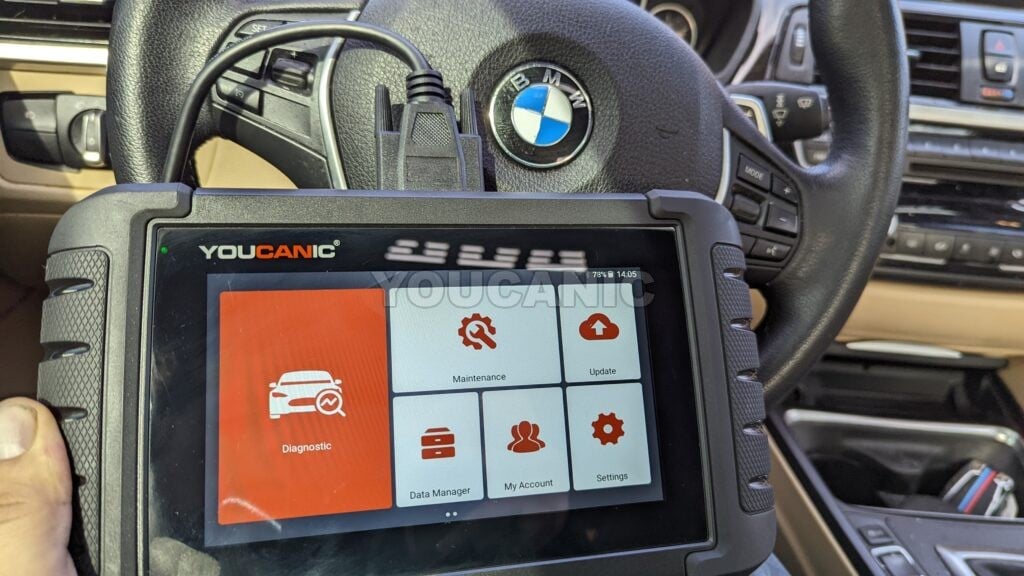
- BMW Scan Tool
- Once the SZL module or steering angle sensor is removed, it needs to be coded, and the steering angle sensor needs to be calibrated. This requires that you have an advanced BMW scan tool. Such tools can be expensive. An alternative is to install the SZL or clock spring yourself and have a BMW dealer or specialist carry out the coding and calibration. The procedure takes only a few minutes. Depending on dealer policy, you will probably get charged for at least 30 minutes or an hour.
Follow these steps to replace the steering angle sensor on a BMW.
- Disconnect the battery and wait five minutes before you start working on the airbags and SZL module.
 Watch the video on how to perform this step.
 Watch the video on how to perform this step.
Remove the airbag from the steering wheel. Use the access holes on the side of the steering wheel to release the airbag spring. Disconnect airbag wires from the steering wheel.
 Watch the video on how to remove airbags on the BMW 5-series E60.
Remove the bolt that secures the steering wheel to the steering column. You will need a breaker bar to get this bolt loose. Remember to counter hold the steering wheel. Before you remove it, set the front wheels straight ahead and mark the steering wheel and shaft so it goes back in exactly the same position.  Watch the video on how to remove the BMW steering wheel.
Remove the clock spring from the SZL module. Remove bolts that secure the clock spring to the SZL module/steering switch unit. Watch the video on how to perform this step.
Remove wiper, turn signal, and cruise control switches if necessary. They are held in place with small bolts. Once the bolts are removed, you pull out the switches. Install the SZL / switch module in reverse order.
Reconnect the battery and start the car. Turn the steering wheel to the right and then to the left. Do this a couple of times.
Always clear the fault codes when you replace the SZL module on a BMW. Use a BMW-specific scanner to clear codes from the SZL module. The steering angle sensor is integrated into the SZL unit. SZL and steering angle sensors can fail on any BMW, causing any switches to stop working or trigger various warning lights.
When the steering angle sensor fails, it triggers warning lights; the DSC lights can often come on randomly or as you start to drive. When the SZL module or steering angle sensor fails, the car will drive fine, but you may not have traction control, stability control enabled, or functioning switches.
How to clean the BMW steering angle sensor

The steering angle sensor is often the culprit, integrated into the SZL module. The most common sign is that your traction control light/DSC and other warning lights will come on as soon as you start to drive and turn the steering wheel.
This problem is often caused by a dirty steering angle sensor that may have gunk built on it. The good news is that it can be cleaned and will fix the SZL problem in most cases. There are two types of BMW steering angle sensors. The cleaning procedure depends on the steering angle sensor installed on your BMW.
Once you remove the SZL, you will tell which type is installed in your BMW. As a rough guideline, most BMWs before 2007 had a potentiometer steering angle sensor. While 2007 and newer use optical sensors.

Around 2007, BMW used a Potentiometer to measure the resistance and calculate the steering wheel position. This steering angle sensor can be cleaned with an Electronic Contact Cleaner.
BMW Steering Angle Sensor uses an Optical disc and sensor
The optical disc will, over time, build up a thin layer of dirt and oil. This layer can interfere with the optical sensor. When the laser sends light to the disk, the coating blocks or diffracts the beam, so the steering wheel position can no longer be determined. Clean the steering angle sensor disk and reinstall it.

Only use a lint-free cleaning cloth. You can also use an eyeglass lens cleaner. Use a product similar to Meguiars Clear Plastic. Note that alcohol can cause a craze on plastic optical disks. It is better to use a product designed to clean discs and plastic.
Once you are done cleaning and putting everything back together, start up the car and turn the steering wheel clock to clock. Restart the vehicle and drive it a short distance; the lights should reset. If the lights remain on, read codes with a BMW scan tool. Carry out steering angle calibration and clear the codes.
Calibrate BMW steering angle sensor

If the DSC light stays on, carry out steering angle sensor calibration. If the DSC light does not get reset, read fault codes.
What to do next: separate the sensor fault from the module fault before you buy anything
The expensive mistake on this job is ordering an SZL before confirming that the SZL is what failed. A dirty sensor ring, a low battery, a wheel speed sensor and a lost calibration all produce the same lit dashboard, and three of those four cost nothing to rule out.
- Read the stored codes in the DSC and the steering column modules, not just the engine. This is the step that decides everything that follows. A code pointing at a wheel speed sensor or at voltage supply means the steering parts are innocent.
- Check battery condition and charging voltage. Several of these faults appear after a weak battery or a jump start and clear once voltage is healthy again.
- Clear the codes and drive it. If the fault does not return, it was stored, not current, and you have just saved yourself the part.
- If it does return, look at the live steering angle value while turning the wheel slowly lock to lock. A signal that drops out, jumps or sticks tells you the sensor is at fault. A signal that tracks smoothly but reads offset from center is a calibration problem, not a hardware problem.
- Only then decide between cleaning, repair and replacement. The cleaning procedure above resolves a meaningful share of these, and it is free.
- After any replacement or disturbance of the column, calibrate. Alignment and mechanical work first, then calibration, then clear and road test.
Steps one, four and six need a tool that reaches the BMW chassis modules rather than a generic code reader, because a basic reader will not show you the live steering angle value or run the calibration. The YOUCANIC UCAN-II Pro reads these modules, displays the live sensor data and performs the steering angle calibration, and is available as a seven day rental if you need it for one repair. Coverage and the exact functions available vary by chassis and year, so email support with your VIN before ordering and we will confirm it covers what you need.
When you do not need a scan tool for this
If the car is going to an independent BMW specialist anyway, let them read it. One diagnostic fee is cheaper than a tool you use once.
And if you have already decided to replace the SZL and the module requires coding to the vehicle, a scan tool is not the whole answer regardless. Confirm what your chassis needs before you order either the part or a tool, because buying both and then finding you still need a dealer visit is the worst of the three outcomes.
BMW SZL Module Part Numbers

The following part numbers are for reference only. Always verify the part number by removing your old SZL module or calling the dealer. Note that part numbers will change if BMW introduces a new or upgraded steering switch unit.
Repairing the SZL instead of replacing it
Cleaning the sensor, as described above, is always worth trying first and costs nothing. When cleaning does not resolve it, there is a third option between living with the fault and paying dealer prices for a new unit, and it is worth knowing about given the figures quoted earlier on this page.
The SZL is an electronic module, and module level repair specialists rebuild them. You remove the unit yourself following the steps above, ship it in, and the repaired module comes back. Specialists such as Module Medics handle this kind of BMW module repair by mail. The practical advantage is the one covered in the coding section: a repaired original module is still the unit already matched to your vehicle, so you avoid both the coding charge and, on later cars, the need to have your VIN written into a replacement.
Weigh that against a used unit from a breaker, which is cheaper to buy but arrives married to somebody else’s car and will need coding regardless, and against a new part from BMW, which is the most expensive route by a wide margin.
Do not skip the calibration
This is the step that most often leaves people with a warning light after an otherwise successful repair. The steering angle sensor reports where the wheels are pointing, and the stability control system treats that figure as absolute. Until the sensor has been taught where straight ahead actually is, the module has no usable reference and will refuse to enable DSC.
Calibration needs the vehicle stationary on level ground with the wheels genuinely straight, not just the steering wheel looking straight. On a car that pulls slightly or has been aligned recently, those are not the same thing. Some models learn the position after a short drive with a few full lock to lock turns, while most require the procedure to be commanded with diagnostic software. If the light persists after a successful calibration, have the wheel alignment checked, because a sensor calibrated against a crooked thrust line will keep setting faults.
Clear the stored codes afterwards as well. Faults logged while the module was faulty do not clear themselves, and a historic code left in memory will keep the lamp illuminated even though the repair is complete. A full system scanner that supports BMW will read the SZL and DSC codes, perform the steering angle calibration and clear the fault memory, which covers every step needed to finish this job without a workshop visit.
One last diagnostic point. Because the DSC system depends on the steering angle, wheel speed and yaw rate signals together, a fault in any of them produces a very similar set of warning lights. If the codes point at a wheel speed sensor or the yaw sensor rather than the SZL, replacing the steering switch unit will change nothing. Read the codes before ordering the part.
Frequently Asked Questions
Can I replace the clock spring without coding the SZL module?
The clockspring is part of the SZL module and is usually replaced as one unit. The clock spring can be swapped, but it is not a simple job.
I cleaned the steering angle sensor, and the DSC inactive keeps returning. What could it be?
Check the alignment on your BMW. Bad alignment can trigger DSC light warnings. Many shops will perform a free alignment check. Lowering the car can also trigger the DSC light. Also, check the battery on your BMW. If it is not holding a proper charge, replace it.
Does an SZL module need programming for the car?
Depends on the year and model. Typically, SZL needs to be coded. VIN programming may be required in some cases. Call your BMW dealer to verify based on your vehicle’s VIN.
Can you replace the BMW SZL module on your own?
Yes, the procedure is simple. You can code and calibrate the steering angle sensor if you have INAP or any BMW scan tool.
Where is the BMW SZL module located?
In the steering column behind the steering wheel.
Do you need front wheel alignment when replacing the SZL module?
No front-end alignment is required if the steering wheel goes back in the same position. Always have the wheels point straight ahead before calibrating the steering angle sensor.
Do I need any special tools to replace the SZL module?
Typical tools used for auto repair, including Torx set. No special tools are required.
Can the BMW SZL or steering angle sensor be programmed out of the car?
No. SZL and steering angle sensors need to be installed in the car; then, you must carry out the steering angle sensor adjustment system function and calibration.
Can I replace the SZL, and then drive it to the dealer to reprogram it?
Yes. DSC, wiper, or other switches may not work until the SZL is programmed.
Related guides: BMW Steering Angle Sensor Calibration · Solving BMW’s ABS Issues: Understanding the Wheel Speed Sensor