
Audi A/C Air Conditioner Recharge Procedure
Reviewed/Verified by:

Check the label under the hood before you buy anything. Audi switched from R134a to R1234yf model by model between roughly 2014 and 2021, the two are not interchangeable, and the correct charge weight in grams is printed on that same label. If the system is completely empty, recharging it is money wasted, because an empty system has a leak.
At a Glance
- DIY recharge only tops up a slightly low system. If the A/C stopped cooling completely, there is a leak to fix first.
- Check the label under the hood for the refrigerant type. R134a kits will not connect to R1234yf systems.
- Connect only to the low pressure port. The kit coupler will not fit the high side.
- Do not overfill. Too much refrigerant cools worse and can damage the compressor.
- Many Audis have no compressor clutch. A regulating valve (N280) controls output and is a common failure.
The procedure below can help you restore the A/C on your Audi. This procedure only works if there is a minor refrigerant leak. Large refrigerant leaks should be repaired before refilling the a/c system.
How to Recharge Audi A/C Refrigerant
Before You Start: Which Refrigerant Does Your Car Use?
- Check the label under the hood. It lists the refrigerant type and the factory charge amount. Most cars built before about 2015 use R134a. Many newer cars use R1234yf; manufacturers switched model by model between roughly the 2014 and 2021 model years.
- The two are not interchangeable. R1234yf systems use different service ports, so an R134a DIY kit will not connect, and mixing refrigerants contaminates the system and the recovery equipment shops use.
- A DIY can only top up a system that is slightly low. If the A/C stopped blowing cold completely, there is a leak. Find and fix it first, then have the system evacuated and charged by weight. See why the system must be evacuated before charging.
- Do not overcharge. Too much refrigerant raises system pressure, makes the vents blow warmer, and can damage the compressor. Stop when the kit gauge reaches the recommended range.
- Protect your eyes and hands. Liquid refrigerant can cause frostbite, so wear safety glasses and gloves.
What you will need
- A/C Recharge Kit
- Work Gloves
- Glasses
Procedure
- Park your Audi in a safe area. Turn off the engine.
- Pull the hood release located under the dashboard on the driver’s side. Open hood.
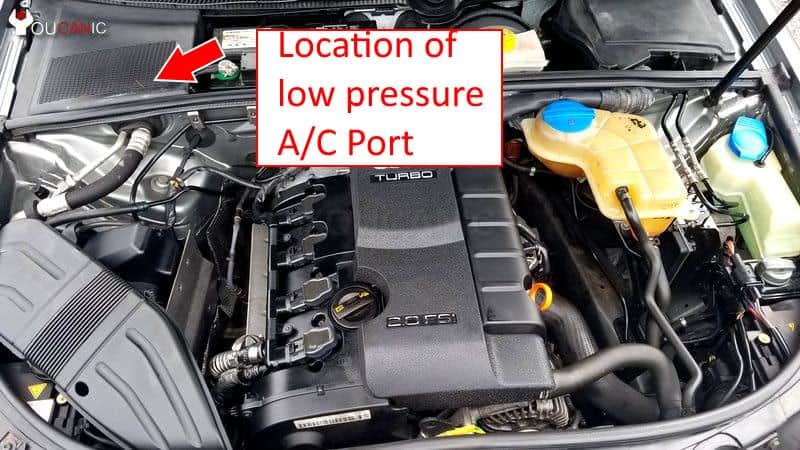
- Locate the low-pressure port. This picture shows the A/C charging port on an Audi A4.
 Note that there also is a high-pressure line. Don’t use that line. The A/C charging kit connector will not fit on the port for the high-pressure line. The A/C kit only fits on the low-pressure port.
- Remove the cap from the low-pressure port of your Audi.

- Connect your A/C hose to the charging port. Get ready to add freon to your Audi A/C system.

- Start the engine and let it idle.
- Turn A/C on. Before adding refrigerant, turn the A/C on to the maximum cold setting. Once you start the engine, you can add refrigerant to your Audi air conditioner system.
- Follow the instructions on your particular A/C recharge kit. As you charge the system, stop pressing the trigger every few minutes to obtain a pressure reading. Continue adding refrigerant until your gauge reaches the charged range. Do not allow the system to overcharge.
 Note that there also is a high-pressure line. Don’t use that line. The A/C charging kit connector will not fit on the port for the high-pressure line. The A/C kit only fits on the low-pressure port.


These instructions on recharging the Audi A/C system work with the following models:

🔧 Find out what is actually wrong before you pay someone to guess
Dealer level diagnostics at home with the YOUCANIC UCAN-II Pro.
- ✔ Covers most makes and models, including many luxury brands. Send us your VIN and we will confirm your car before you order
- ✔ Reads every module, not just the engine, so you find the faults a basic reader says are not there
- ✔ Commands the car: test a fan or pump, bleed ABS, retract an electronic parking brake, register a battery
- ✔ No subscriptions. Free lifetime updates, so the price you pay is the whole price
- ✔ Backed by real mechanics in the USA you can email before and after you buy
Featured in The Wall Street Journal
- A1
- A3
- A4
- A5
- A6
- A7
- Q3
- Q5
- Q7
- TT
If the system is empty, you have a leak
A sealed air conditioning system does not consume refrigerant. If yours is low enough to need topping up, it has leaked out somewhere, and adding more will buy you a season at best before you are back where you started. Common leak points on Audi models are the condenser at the front of the car, where stone damage is frequent, and the O-ring seals at the line connections.
Do not overfill. Too much refrigerant raises system pressure, cools worse than a correct charge, and can damage the compressor, which is by far the most expensive part of the system. If the gauge on your recharge kit reads in the correct range and the air still is not cold, stop adding refrigerant: the problem is not the charge level.
When topping up does not fix it, the usual causes are a failed compressor clutch, a blocked expansion valve, or an electrical fault stopping the compressor from engaging at all. Many Audi models have no compressor clutch: the compressor turns whenever the engine runs and an electronic regulating valve on the compressor (N280) controls its output, and that valve is a common failure. On most Audi models the climate control module stores its own fault codes, and a full system scanner such as the YOUCANIC UCAN-II Pro will read them on supported models and tell you whether the compressor is being commanded on, which saves guessing.
Where Is the Low Pressure Port on an Audi?
The low pressure port sits on the larger diameter aluminum line between the firewall and the compressor, under a cap usually marked L. On many Audi models it is on the passenger side of the engine bay, sometimes hidden under a plastic cover. The high pressure port is on the thinner line and uses a larger fitting, so a DIY kit coupler will not snap onto it.
What Should the Gauge Read?
Most DIY kits have a gauge with a target band that changes with outside temperature, so follow the chart on your kit. On a warm day with the engine idling and the A/C on max, the low side commonly reads somewhere around 25 to 45 psi. A reading near zero means the system is empty and has a leak; a reading in range with warm air means the problem is not the charge level.
Frequently Asked Questions
How much refrigerant does my Audi need?
The exact charge is printed on the label under the hood, usually in grams. Most Audi systems hold well under 1 kg. A DIY can is meant for topping up, not filling an empty system, which should be evacuated and charged by weight.
Can I recharge an R1234yf Audi myself?
R1234yf DIY cans exist, but they use different fittings than R134a kits and cost much more. Never mix the two refrigerants. If your system is empty, a shop with an R1234yf machine can find the leak and charge it by weight.
Why does my Audi A/C blow cold while driving but warm at idle?
That usually points to low refrigerant, a weak condenser fan, or a dirty condenser. Check that the radiator fans run when the A/C is on before adding refrigerant.
Is a leak sealer a good idea?
We do not recommend it. Sealers can clog the expansion valve and contaminate shop recovery machines, and many shops will refuse or charge extra to service a system that contains sealer.
More guides: browse all of our Audi repair and troubleshooting guides.



I cannot locate the charge port on my 2017 Q7 Prestige. Can someone point me in the right direction please.
This is a well explained article. I’ll add how if the A/C starts to blow out hot air, it can be a cause of concern and in some cases very dangerous. In some cases it can be a broke condenser, circuit faults or just a leak.
If not fixed, these problems can cause big trouble. I’d suggest if you experience this even when you do not need an A/C get this fixed asap.
To be more precise on what the issue is, you can use a scanner.