
How to Add Windshield Washer Fluid to Your Audi
Reviewed/Verified by:

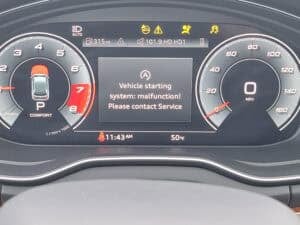
Has the windshield washer warning light come on in your Audi’s dashboard? Is there no washer fluid coming out when you pull the lever? Topping up the washer reservoir takes a couple of minutes, and the steps are below.
At a Glance
- The washer reservoir has a blue cap with a windshield and spray symbol, usually near the front of the engine bay.
- Use ready mixed washer fluid; in winter, choose a fluid rated for your lowest temperatures.
- Do not use plain water in cold climates; it can freeze and crack the reservoir or the pump.
- Fill until the fluid is near the neck, then close the cap firmly.
- If the warning stays on with a full tank, the level sensor in the reservoir is the usual cause.
Symptoms
- No Windshield Washer Fluid
- Low Washer Fluid Warning
What you will need
- Windshield Washer Fluid
Procedure
- Park your Audi on level ground, turn off the engine, and engage the Parking brakes.

- Open the hood of your Audi by pulling the hood release under the dashboard on the driver’s side. This will allow you to access the reservoir in the engine bay.
Locate Windshield Reservoir. The reservoir on Audi vehicles has a blue cap with the wiper symbol on top.
 Location of windshield washer reservoir on Audi A4. The location of the windshield washer reservoir is on Audi A6. Location of the windshield washer fluid reservoir on Audi Q5.
- Lift the cap to open the reservoir. If the fluid is low, this is where you add the fluid.
- Add washer fluid until the level gets about two inches below the reservoir cap.

 Location of windshield washer reservoir on Audi A4.
 The location of the windshield washer reservoir is on Audi A6.
 Location of the windshield washer fluid reservoir on Audi Q5.
Always use windshield washer fluid to avoid damaging the reservoir and delivery lines. In most cases, the same reservoir is used for both if your Audi has a rear wiper or headlight washing system.
Adding more washer fluid to Audi vehicles such as the A3, A4, A6, A7, Q3, Q5, Q7, etc., is straightforward and should only take a few minutes.

🔧 Find out what is actually wrong before you pay someone to guess
Dealer level diagnostics at home with the YOUCANIC UCAN-II Pro.
- ✔ Covers most makes and models, including many luxury brands. Send us your VIN and we will confirm your car before you order
- ✔ Reads every module, not just the engine, so you find the faults a basic reader says are not there
- ✔ Commands the car: test a fan or pump, bleed ABS, retract an electronic parking brake, register a battery
- ✔ No subscriptions. Free lifetime updates, so the price you pay is the whole price
- ✔ Backed by real mechanics in the USA you can email before and after you buy
Featured in The Wall Street Journal
Match the fluid to the season
Washer fluid is sold with a freezing point printed on the bottle, and that number is the one that matters. Summer fluid, and anything sold ready mixed for mild conditions, will freeze solid in winter. When it does, it expands, and what it expands inside is a plastic reservoir, a pump and a set of thin lines running through the car. Cracked reservoirs and burst pumps from frozen fluid are a routine winter repair and an entirely avoidable one.
Before the first frost, either switch to a winter grade rated below the coldest temperature you expect, or use a concentrate mixed to the strength the label specifies for your climate. Run the washers a few times after topping up so the new fluid reaches the nozzles, because the old fluid sitting in the lines is what freezes first.
Plain water is the worst choice of all. It freezes at the highest temperature, it offers no cleaning power against road film and insects, it leaves mineral deposits that block the nozzles, and standing water in the reservoir grows algae that clogs the filter. Household detergents and washing up liquid are not an alternative either: they foam excessively, they are not formulated for automotive paint and trim, and they leave residue on the glass that smears every time you use the wipers.
If the washers do not spray
Listen first. If you can hear the pump running when you pull the stalk but nothing comes out, the fluid is not reaching the glass, which means blocked nozzles, a split or disconnected hose, or fluid frozen in the lines. Blocked nozzles can usually be cleared with a fine pin, taking care not to enlarge the hole, and on cars where the nozzle has an adjustable aim a pin will also move the spray pattern, so check where it lands afterwards.
If you hear nothing at all, the pump is not getting power. Check the fuse before anything else, since the washer circuit is usually a low rated fuse that is easy to find and costs almost nothing. A pump that was run dry repeatedly while the reservoir was empty is also a common failure, because these pumps rely on the fluid passing through them for cooling.
Bear in mind that many Audi models with headlight washers feed those from the same reservoir, and they use a surprising amount of fluid each time they operate. If your washer level seems to drop far faster than you would expect, that is usually the explanation rather than a leak.
When the warning stays on with a full reservoir
This is a common and harmless looking fault that is worth understanding. The level is measured by a float sensor in the reservoir, and those stick, corrode or fail outright. A warning that will not go out after topping up to the brim is far more likely to be the sensor than the fluid.
Before replacing anything, top up fully, drive for a short distance so the fluid sloshes and frees a stuck float, and see whether it clears. If it does not, the stored fault will say whether the module is seeing an implausible signal from the sensor. A full system scanner that supports Audi reads the body and convenience modules where this fault lives, which a basic engine code reader cannot reach.
Frequently Asked Questions
Can I use water instead of washer fluid in my Audi?
Only in warm weather and only briefly. Plain water does not clean well, can grow bacteria, and freezes in winter. Switch back to washer fluid as soon as you can.
Why does my Audi washer pump hum but nothing sprays?
Look for a blocked nozzle, a kinked or disconnected hose, or frozen fluid. If you hear nothing at all, check the fuse and the pump.
How much washer fluid does an Audi hold?
It varies by model, often around 3 to 5 liters, and more on cars with headlight washers. Keep filling until the fluid reaches the neck.