Audi Vehicle Starting System Malfunction: Meaning & Causes
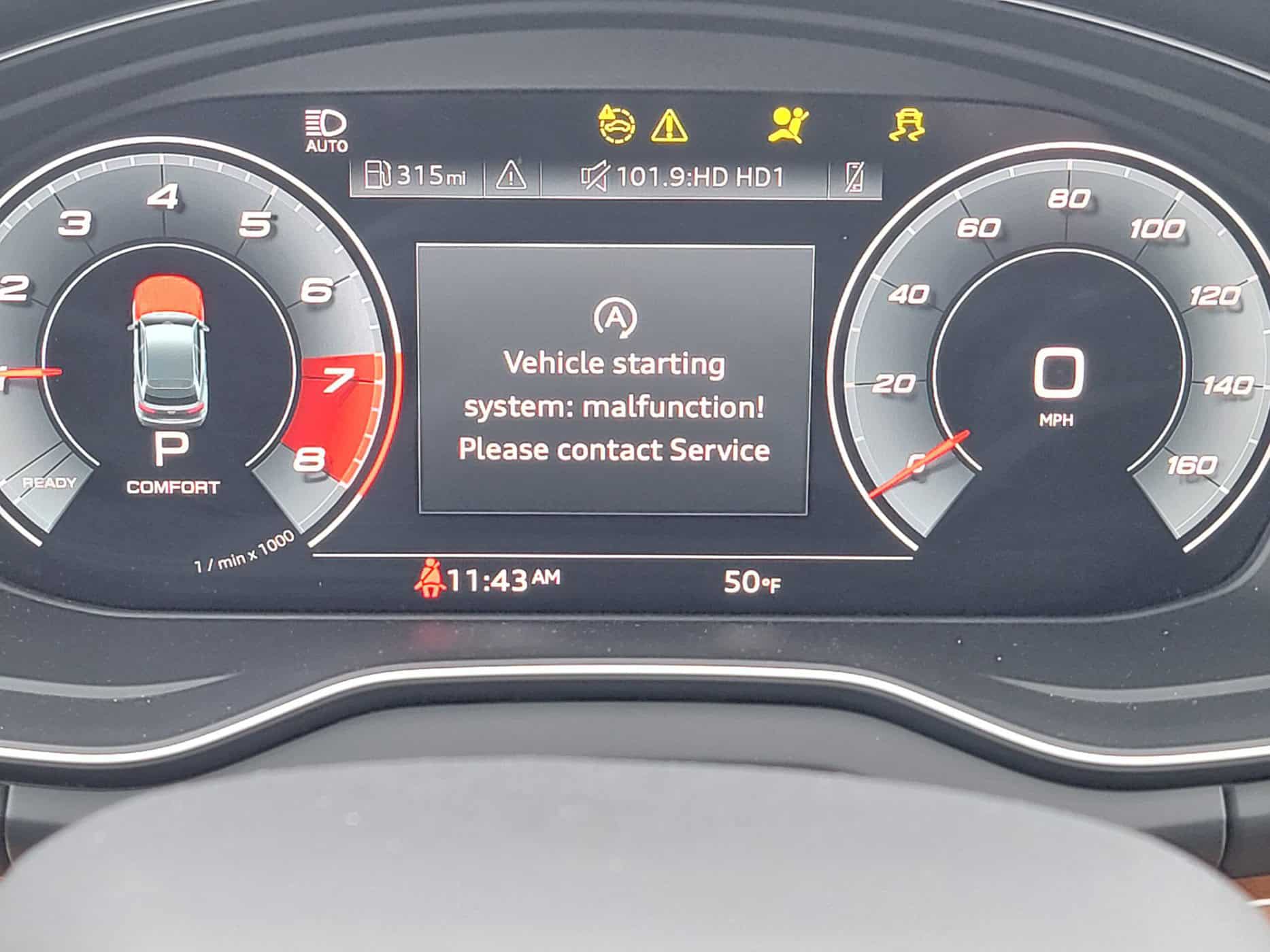
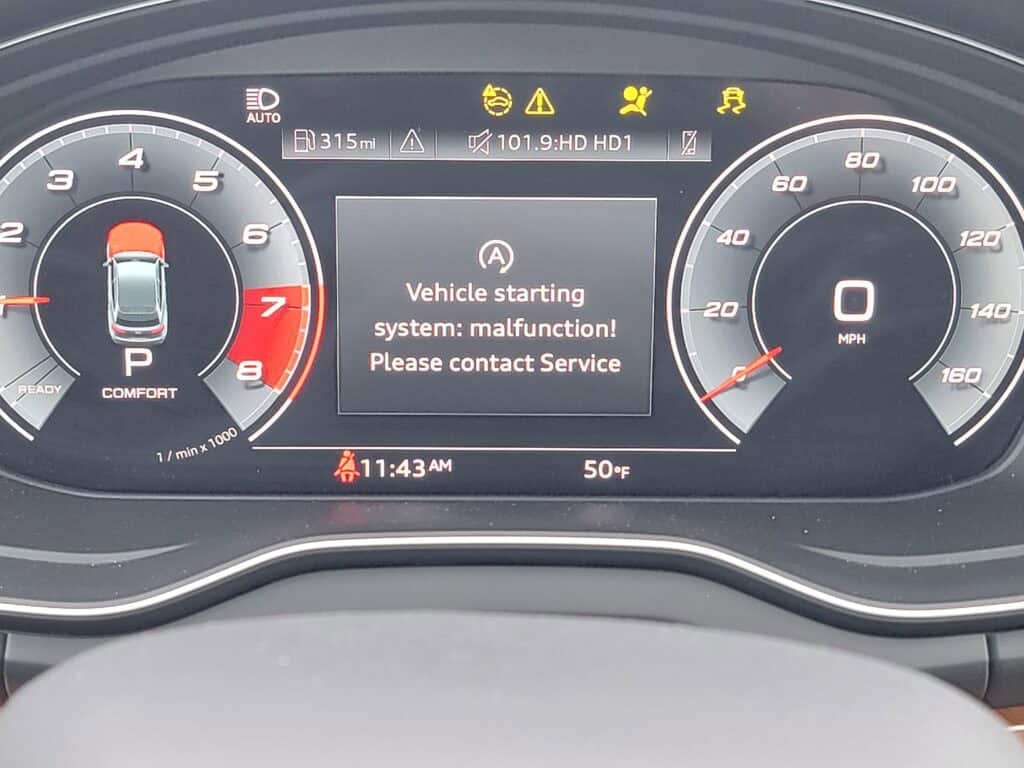
“Vehicle Starting System: malfunction! Please contact Service.” This fault typically refers to a problem that concerns the overall system that starts your Audi, especially in the Automatic start/stop function. If the warning message appears on your dashboard, there will be a noticeable difference in how your vehicle’s automatic start/stop feature will function. It may work well when you first start your car in the morning and will not work properly on the second start, or it may not be working at all. This article will discuss this system fault, what it means, the symptoms you might encounter, common causes, and troubleshooting and prevention tips to address the issue.
What does this mean?
The warning message will appear as “Vehicle Starting System: Malfunction! Please Contact Service” on your dashboard with an open circle with the letter A, the indicator sign for your automatic start/stop function being disabled. There are many factors to consider when pinpointing what is causing the warning message, including the systems related to how the vehicle should start in your Audi’s automatic start/stop mode. To distinguish what these factors are and which are the culprit, we must first understand how Audi’s automatic stop/start system operates.
Audi Start/Stop Function
To increase fuel economy and help reduce carbon emissions, Audi designed its automatic start/stop feature for its cars. When engaged, the system automatically shuts off the engine when the vehicle has stopped at a traffic light, for example, and automatically starts when a certain condition, like releasing the brake pedal, has triggered the system, signaling that the vehicle has to move. Other engine triggers that will turn your engine on are pressing the accelerator pedal when the parking brake is engaged and when the car in front moves forward during a stop, linked to the vehicle’s close-distance sensing and adaptive cruise control system. Many factors could cause the Audi’s automatic start/stop mode to fail. These could be electric issues, damaged sensors, or system malfunctions.

🔧 Stop paying the dealer for every warning light
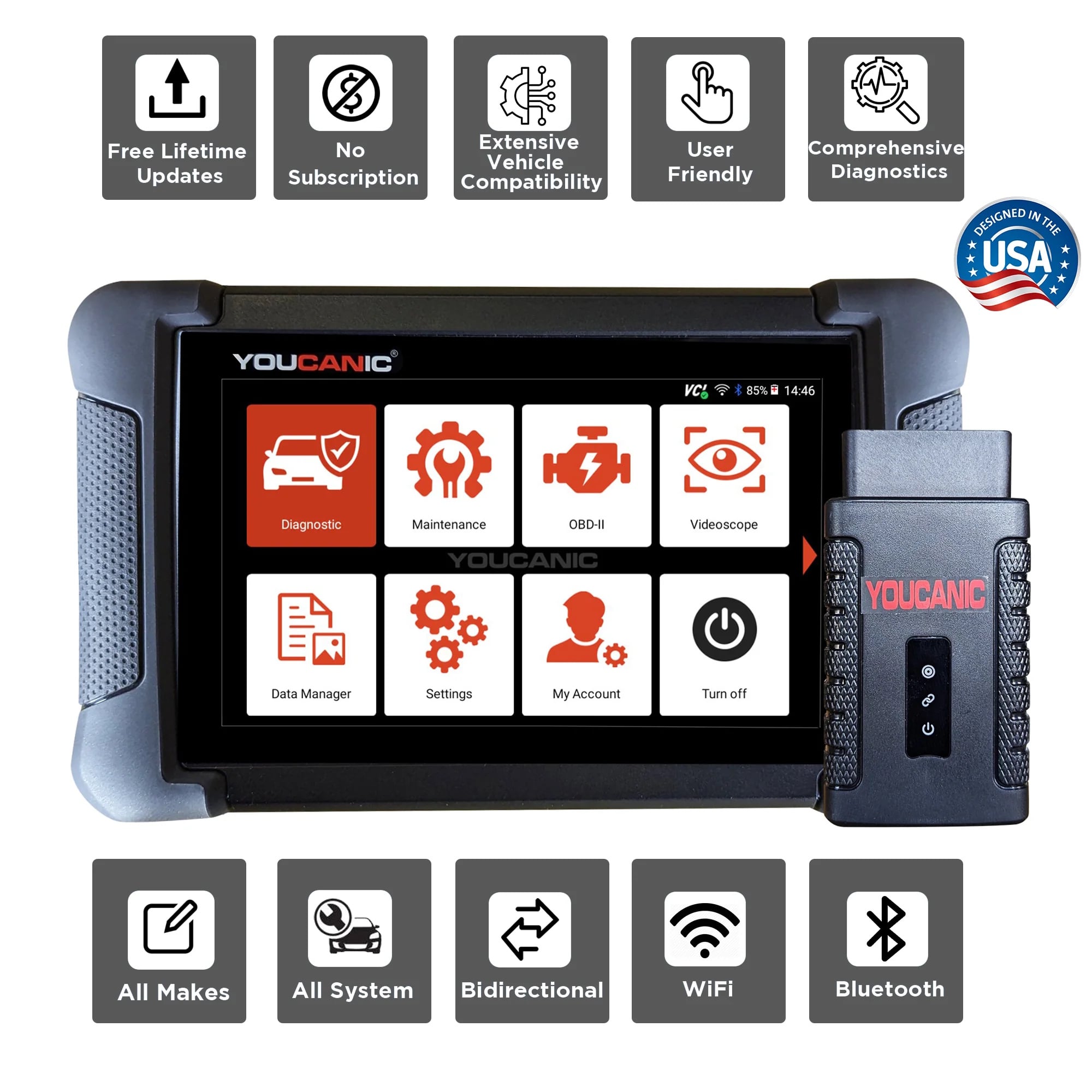
Get dealer level diagnostics at home with the YOUCANIC Full System Scanner.
- ✔ Works with all makes and models, including most luxury brands
- ✔ Topology map view shows all vehicle modules on one screen for faster diagnostics
- ✔ Bi directional controls to test fans, pumps, actuators and more so you do not have to guess
- ✔ Special resets and calibrations such as ABS bleed, EPB service, battery registration and more
- ✔ Free lifetime updates with no recurring fees
It is important to note that there are requirements for the automatic start/stop to function. These include:
- The doors and hood must be closed.
- The driver’s seat belt must be fastened.
- Transmission must be put to either P, N, or D.
- The vehicle must be driven over two mph (3 km/h) from its last stop.
- A trailer cannot be connected to the car.
Common Causes
First, verify using the list above that one is not the problem. All of these are easy fixes that can cause your system not to function properly. For example, the automatic start/stop function may not work if you are towing with
- 12V Battery Failure. The battery must be healthy enough to produce power for the numerous engine startups. A weak battery will affect how well the automatic start/stop function operates, triggering the warning message in your dashboard.
- Alternator. Other faults, such as coolant temperature, battery, and alternator issues, are often connected to the vehicle starting system messages. When these appear with the message, your drive belt might need to be replaced.
- Radar Sensor Failure. System faults can also come with warning messages, such as the distance and pre-sense warnings, that suggest faults in the car’s radar sensors and modules, specifically the distance regulation control modules. When Adaptive Cruise Control warning and distance warning errors flash on the dashboard with the vehicle starting system fault, it usually suggests faulty wires in the system, either by corrosion, insulation, or rodent bites on a single wire harness where these systems are lined up.
Troubleshooting Tips

Start with the obvious. Go around the car and do hand and eye checks for the following:
- Starter – The starter may be drawing too much current or has a failed relay that needs to be replaced.
- Check Battery – Inspect for any loose connections on the positive and negative terminals. Look for loose connections and any signs of corrosion; if you see any white chalky build-up around the terminals, they must be cleaned. When cleaning the battery, always disconnect before cleaning so you do not ruin any electrical systems. Start with the negative (black) terminal, then disconnect the positive (red) terminal.
- Check the sensors and electrical wiring. Open the doors of your car and check to see if the door sensors are worn out. The automatic start should function when the doors and hood are closed. Open the hood of your engine bay. Look for loose sensors from their connectors and snap them back in. Look for any signs of wire corrosion. There are times in Audis when the sensors seem to be the culprit, but it is more often an issue with the connectors or wires. Look for any corroded or cut-off wires near the sensors and connectors. Feel them with your fingers if they can’t be seen from the engine hood. Bond the wires with solder and cover them with shrinking tubes.
- Inspect the engine’s drive belt. When the warning message is triggered along with any faults relating to the coolant, air conditioning, or electrical faults, like the red battery icon, alternator, or charging system, this usually means there is an issue with the drive belt in your car. When these belts wear out, they can’t produce enough traction to the component pulleys (alternator, water pump, compressor, etc.) to produce the necessary power for the systems to function. The charging system will be affected, impacting other systems that rely on the alternator’s power, like the vehicle’s starting systems.
How to inspect for a worn-out drive belt
– Locate the belt on the side of the engine opposite the transmission’s bell housing.
– Inspect the belt while the engine is running. Look for any signs of wobbling pulleys and noisy bearings. If you find any, have the pulleys aligned or replaced by your trusted mechanic.
– Inspect the belt with the engine shut off. The belts can be worn on the inside and outside surfaces. Look for grooves on the smooth side. Grooves, especially deep ones, means there might be a problem with one of the pulleys, causing the belt to be driven off its center. Also, look for any signs of slipping. If the belt looks glossy, it might be slipping. Usually, a loud noise will come from the belt if it is slipping, especially in the first few minutes of the engine running. Look for cracking or chipped-off grooves on the grooved side of the belt. If you can’t see through the engine hood, feel for it. If any of these signs are present, the belt must be replaced.
- Do a battery reset by removing the negative terminal of your battery for at least 30 minutes. Sometimes, faults just need to be reset so the system knows that the fault is not a component failure.
- Check if you have gas of the wrong fuel composition for your car. This can be sensed by the system and will prevent your car from starting.
- Observe the engine temperature gauge in your dashboard. Normally, the engine has reached its working temperature if the indicator is a little bit halfway up the gauge, but it should not be more than half. If the temperature gauge doesn’t go up after running the engine for 15 to 20 minutes, your thermostat might be stuck open. Engine temperature affects how the automatic start/stop system operates.
Inspection with measuring devices

- Inspect the electrical components of the car, primarily the batteries, and fuses, with a multimeter and test light. See our article “Handling Audi Safety System Malfunction” for more information on how to test these components.
- Scan for Codes. Run an OBD-II scanner on your car. This tool can save you hours of trial-and-error troubleshooting because it will give you an idea in an instant what seems to be the issue of your car through the fault codes it reads. Plus, it doesn’t only read your codes. With a good quality scanner, you can access many useful analytics of your car, like real-time data on engine performance, fuel efficiency, and even upcoming maintenance needs. This tool allows car owners and mechanics to troubleshoot more efficiently, monitor the efficiency of the vehicle, and prevent minor issues from turning into expensive repairs.
The YOUCANIC scanner is a great and affordable option for anyone who wants to acquire one quickly. This scanner has all the features above and other useful car monitoring and maintenance tools. Plug the scanner into the car’s OBD-II port and run it. Start the troubleshooting based on what faults appear in the OBD-II scanner. You can also delete the fault codes in your scanner and check if the fault codes come back.
If the procedures above don’t solve the problem, it’s time to bring your car to your trusted mechanic.
The dealership will plug their scanners into your car to assess the severity of the repair. Some issues can be solved by reprogramming and updating the software on the car, which must be done at a dealership. Sometimes, the problem can be solved by simply deleting fault codes through the scanner. There will be a service charge at a dealership or repair shop, but this would not be the case if you had your scanner.
Common Fault Codes
- 65638 – Switch for Access & Start Control
- B143C 29 [009] – Signal Implausible
- P0300 – Multiple Cylinder Misfire
Prevention Tips
Electrical problems are the top causes of faulty systems in your car, not just the malfunction of the vehicle starting system. The battery and the charging system must always be monitored and maintained to ensure the other systems in your car operate optimally. Modern cars have comprehensive system designs that rely heavily on electrical and electronic components to improve safety, performance, comfort, and convenience for the best driving experience.
Ensure your battery is always in good condition. A healthy battery lifespan ranges from 2 to 5 years. Beyond this range, you may need to frequently check your battery for signs of weakness and be able to replace it immediately before it affects other components and systems in your car. See our troubleshooting guide, which shows you how to test your Audi battery and charging system. This guide will also help you identify the best time to replace the batteries and check your alternators.
Alternators and charging systems may not always be at fault. You can have a working charging system and a good alternator but a poor car electricity output because of a worn-out drive belt. Always make sure they are being replaced regularly. A good service life for a drive belt will last about 50,000 miles (80,000 km) on the road. See the troubleshooting guide in this article to inspect your drive belt best to avoid potential problems, save money, and ensure your vehicle runs safely and efficiently.
Conclusion
Addressing the malfunction of your Audi’s vehicle starting system is important for maintaining reliable vehicle performance. You may never know how severe the issue is until it is checked and addressed. You must have the basic troubleshooting knowledge to perform simple checks and repairs on your own, detect problems early, and avoid costly repairs down the road. With the right tools, such as a multimeter and scanner, you can often handle some of these repairs on your own, saving time and money.