
Audi Electronic Stability Control (ESC): Symptoms, Causes & Fixes
Electronic Stability Control (ESC) is one of the many advanced safety features on an Audi and is a must-have for many other car brands. In addition to Audi’s famed Quattro System, which sends an independent amount of torque to each wheel to optimize grip on the road, improving the vehicle’s stability as it adjusts to different driving conditions, the ESC also plays a vital role in the stability, traction, control, and safety of the vehicle, keeping it safely on track, especially when faced with adverse road conditions. When the ESC malfunctions, driving becomes more difficult, and the vehicle will be more prone to road risks due to uncontrolled skidding and loss of traction.

Common Symptoms
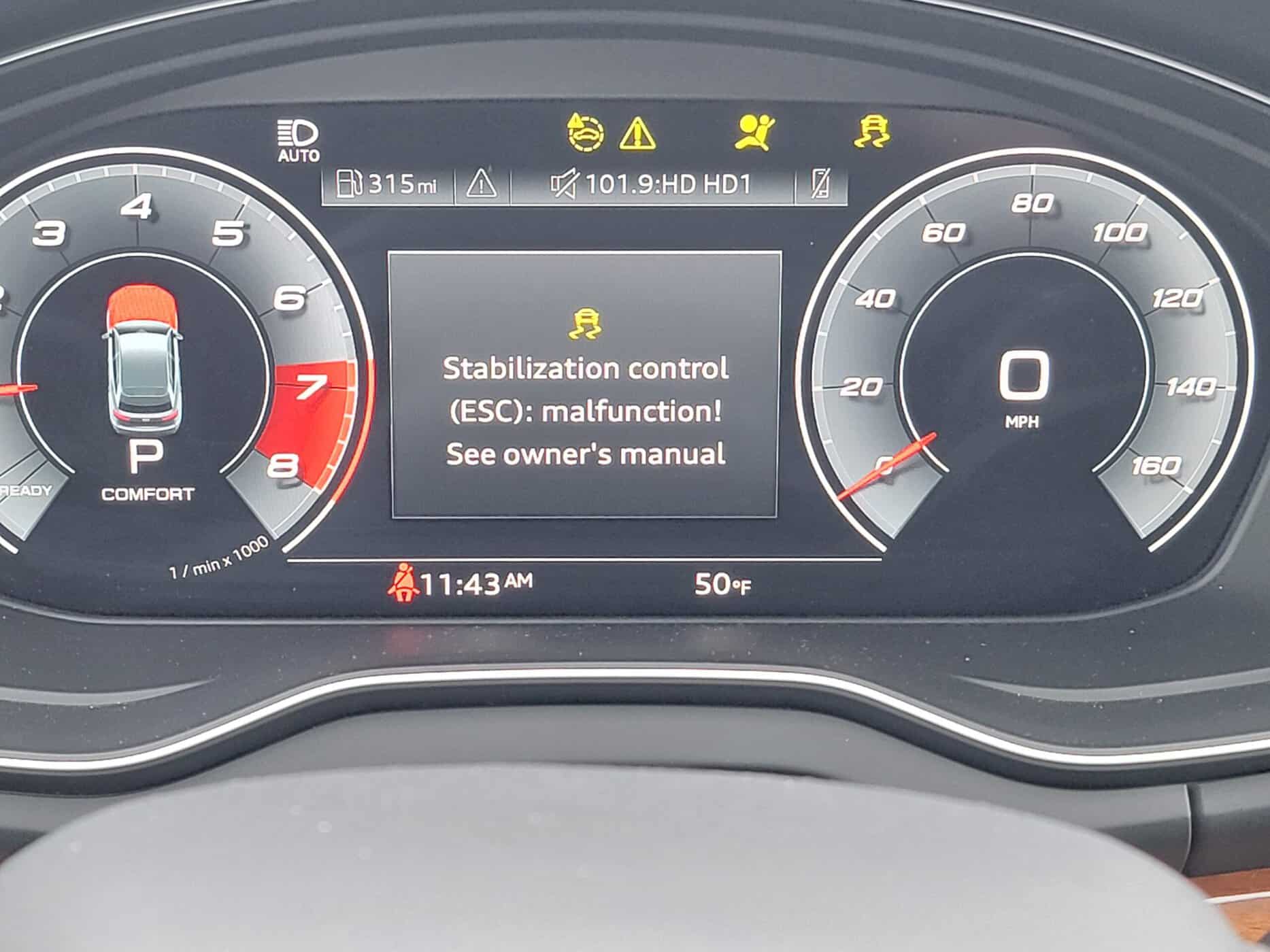
When the ESC malfunctions, the dashboard will either display a car sign with two wavy lines below it or a message telling you there is a stability control fault. The car may also feel unstable when turning corners, and it might be difficult to maneuver as the needed braking pressures applied to each wheel are not functioning. When countering oversteering, the ESC may fail to apply the required braking pressure on the outer front wheel of the car or the inner rear wheel for understeering. Working ESCs provide nice traction on the tires, making it feel like the car is glued to the road, especially when making sudden swerves at high speeds. There will be a big difference when controlling a car with a malfunctioning ESC, as there is a higher risk of skidding that the ESC should be able to correct. Sometimes, the Anti-Lock Braking System (ABS) and steering warning signs will show with the ESC sign on your dashboard, as these are related functions of the ESC. In most cases, these are commonly caused by battery issues and dirty sensors.
When you see an ESC warning light on your dashboard, you will encounter one of these three scenarios:

🔧 Stop paying the dealer for every warning light
Get dealer level diagnostics at home with the YOUCANIC Full System Scanner.
- ✔ Works with all makes and models, including most luxury brands
- ✔ Topology map view shows all vehicle modules on one screen for faster diagnostics
- ✔ Bi directional controls to test fans, pumps, actuators and more so you do not have to guess
- ✔ Special resets and calibrations such as ABS bleed, EPB service, battery registration and more
- ✔ Free lifetime updates with no recurring fees
- The ignition is on, but the engine is not running. In this scenario, the vehicle’s warning lights, including the ESC light, will be lit on the dashboard. At this rate, all systems are live and performing self-diagnostics.
- The engine is running, but the ESC is turned off: When the driver intentionally turns off the vehicle’s ESC, the ESC warning light flashes, signaling to the driver that the ESC is turned off.
- ESC system failure: The warning light will remain illuminated. When scenarios 1 and 2 are not the reason your ESC error light is on, you may be dealing with this third scenario. Luckily, the situation may not be as severe as it sounds.
Common Causes

The error signal could simply be a battery issue or one of the following problems:
- Wheel speed sensor issues: This is one component of an ESC and is one of the more common causes if the ESC light is on. These sensors are usually attached to the wheel hub or drive shaft of each wheel and record the rotational speed of that wheel. Usually, when wheel speed sensors are the problem, the ABS light will also be turned on because ESC and ABS modules usually share the same wheel speed sensors.
- Steering angle sensor problems: The steering angle sensor determines the angle of the steer and sends this data to the ESC to determine which direction the driver intends to go so that it can counter any opposing skidding through the applied brake pressure and traction control. The ESC cannot properly function with a faulty steering angle sensor; thus, it causes the ESC light to turn on.
- ABS module failures: ESC operates alongside the ABS. ABS prevents the wheels from locking up during hard brakes, which reduces the risk of skidding, making it easier for the driver to steer and control the vehicle. If something is wrong with the ABS, it will also affect the ESC.

- Wiring and connection issues: Wiring and connection issues can trigger false faults in the ESC. For example, when the wire insulation is damaged, this can lead to corrosion over time, causing restricted functions with the ESC.
- Other potential causes: Other causes include an old battery that needs to be replaced, loose battery connections on terminal lugs, incorrect aftermarket rim and tire specifications, low tire pressure, wheel misalignment, low brake fluid levels, and dirty sensors.
Troubleshooting
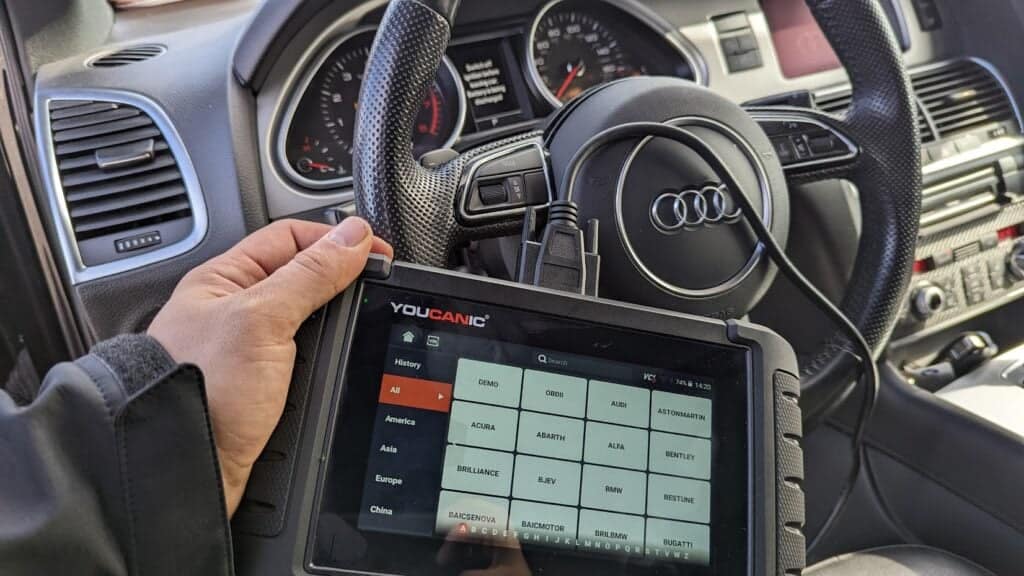
To fully determine the problem, plugging an On-Board diagnostics device (OBD-II) into your Audi is the first step you should take. An OBD–II scanner is a device that connects to your car’s electronic computer unit to read and display fault codes, better known as Diagnostic Trouble Codes (DTCs).
Below are some procedures you can do at home to troubleshoot ESC fault codes as they may appear on your scanner. These may not be directly related to the ESC system but can potentially contribute to some of the ESC fault codes.
Some factors that you may check are the following:
- Your car battery’s performance (This may fix the most electrical faults and sensor-related issues like 00778 steering angle sensor, wheel speed sensors 00285 front right, 00283 front left, 00287 rear right, 00290 rear left.)
The ESC relies on electrical power. A weak battery can disrupt its functionality. Your multimeter tool may also come in handy.
- Use your multimeter to measure the battery voltage. Make sure you plug the probes of your multimeter correctly, with the red probe on the positive port and the black probe on the negative port of the battery.
- A healthy battery should read around 12.6 volts when the engine is off. If the voltage drops below 12 volts, your battery is weak and may need to be replaced.
- Start the engine. When the engine is cranked, the battery voltage will drop. It should not drop below 10 volts. If it does, the battery may need to be recharged or may require replacement.
- When the engine is already running, the multimeter should be able to read a voltage of at least 14 volts.
- Test the alternator’s charging capability. While the engine is still running, turn on all the car’s lights, such as headlights and interior lights, and the AC. The reading should not be below 13.5 volts. If it drops below 13.5 volts, and the alternator struggles to properly charge the battery, you may have to consider replacing it.
- Loose connections on battery’s terminal – may fix most electrical faults and sensor-related issues like the 00778 steering angle sensor, wheel speed sensors 00285 front right, 00283 front left, 00287 rear right, 00290 rear left.
A loose or corroded battery connection can interrupt the power supply to the ESC system.
- Open the hood and find the battery.
- Look for the terminal lugs; these clamps connect the wires to the battery. You may see a red and black terminal in your battery, marking the positive terminal (red) from the negative terminal (black). Ensure the lugs are tight. If they are loose, tighten them with a wrench. Always remember a clockwise turn is for tightening, and counterclockwise is for loosening.
- Verify Rim and Tire Compatibility – The wheel speed sensors 00285 front right, 00283 front left, 00287 rear right, 00290 rear left.
Aftermarket rims and tires that do not follow the manufacturer’s recommendations can affect the ESC system by altering the car’s balance and sensor readings.
- Compare your rims and tires to the specifications in your owner’s manual.
- You can see the rim and tire size printed on your tires. You may see figures that may not be as similar as this but should follow a similar pattern: 205/55 R16
205 is the tire width
55 is the aspect ratio(width/height)
R is radial
16 is the rim diameter.
- Check the owner’s manual to see if the rim and tire size match the ones on the car. You can also check the nameplate attached to the driver’s side door frame when you open the car door. The details of the correct rim and tires should also be included.
- Check tire pressure – This may fix wheel speed sensors 00285 front right, 00283 front left, 00287 rear right, 00290 rear left, and 01325 control module for tire pressure monitoring.
Uneven or low tire pressure can trigger ESC warnings because it affects wheel rotation and traction.
- Your Audi car may be equipped with a Tire Pressure Monitoring System (TPMS) that will display on your dashboard once tire pressure falls below the required tire pressure. If your car does not have one, you may use a pressure gauge to measure the pressure of each tire. Check your owner’s manual for the recommended tire pressure, or it may be printed on the nameplate found on the driver’s side door frame.
- Assess wheel alignment (00778 Steering angle sensor)
Misaligned wheels can lead to improper sensor readings and hinder the ESC system.
- Visually inspect if the tires are straight and aligned.
- Drive the car on a straight path. If the car pulls to one side, it may need professional alignment. Visit your trusted repair shop to have your wheels aligned.
- Check brake fluid level (This may solve ABS fault codes causing ESC problems and wheel speed sensor fault codes.)
Low brake fluid can affect the ABS, which is closely linked to the ESC system. Low brake fluid will affect the right amount of brake pressure applied to the wheels, meaning that the ESC cannot function properly.
- Locate the brake fluid reservoir under the hood. It is usually located on the driver’s side, where the brake pedal aligns with the brake master.
- Ensure the fluid level is stable between the Min and Max marks.
- Make sure you are using the right fluid. Check your owner’s manual to see if the system uses DOT 3 or DOT 4 brake fluids. In most cases, the brake fluid type for the car is printed on the cap of your brake fluid tank.

Clearing the fault codes through your OBD-II scanner will sometimes fix the problem. After clearing the fault codes, test your car to see if the problem or the warning light returns. You can also reset the ESC through your scanner to see if the problem has been resolved. If you don’t have a scanner and want to reset the ESC, unplug your battery from your car’s electrical circuit for at least 30 minutes and plug it back in to reset the whole car system.
Sometimes, ESC warning lights come on after a repair or maintenance, directly affecting your vehicle’s stability and handling. Suspension system repairs, steering wheel repairs and modifications, and changing or cleaning your brakes and calipers are just some of the repair and maintenance activities that can cause your ESC warning light to come on. You may need to reset your ESC to check if the problem persists.
Also, when an ESC warning light suddenly flashes on your dashboard, turning the engine off and restarting it can do the trick. This will allow the system to run its self-checks and diagnostics. The system will realize it was just a glitch, not a component failure, and the warning signs will not appear on your next engine start-up.
Frequently Asked Questions
- Can I drive Audi with ESC malfunction?
While driving an Audi with an ESC light on is possible, it is not recommended. Imagine driving your car at a high speed down the highway, and suddenly, a bear pops out on the road. You do not want to hit a cute fluffy bear, so quickly swerve to the next lane.
Scenario A: You are driving a car with a working ESC. You went into the left lane, steered it back to the right, gained control, and kept the vehicle on the road, and back to your lane. No bears were harmed.
Scenario B: You are driving a car with an ESC that does not work. You avoided the bear and went to the left, but when steering the vehicle to the right, it continued to skid straight off the road. No bears were harmed, but the whole experience has left you rattled.
While driving a car with a malfunctioning ESC is possible, it is much more difficult. You would not want to want to hit the bear in scenario B. Thus, we do not recommend driving a car with a defective ESC.
- How much would it cost to repair a malfunctioning ESC?
You do not want to ignore a malfunctioning ESC warning, so you must have your ESC serviced. The cost of repairing a damaged ESC is typically between $200-$3000, depending on what needs to be done. Replacing defective steering wheel angle sensors might cost you around $200 to $300 for each piece, including labor costs. Still, that price varies by location, as other variables that can affect prices should be considered. More expensive repairs are expected for major component failures, such as wheel hub assemblies, suspension, and under-chassis repairs. If this is the reason your wheel speed sensor fault code, the rack and pinion assembly of your steering mechanisms will need to be replaced. Should this be the reason for your steering angle fault code, repairs will typically cost $3000, including labor costs, depending on your region.
- I have ABS, and I don’t need ESC.
It’s a misconception that ABS and ESC function the same. While ABS and ESC control brake pressure to keep the wheels rotating to maintain vehicle control on hard brakes, the ESC also detects traction loss on each wheel, keeping the vehicle glued to the ground. For example, the front right wheel turns much faster during skidding than the front left and rear wheels. ESC will detect the front right wheel is losing traction with the ground, so it will apply more brake pressure to that wheel and reduce brake pressure to the other wheels, maintaining traction and stability. Apart from these functions, ESC has extra sensors- aside from the wheel speed sensors that the ABS also has- to keep the vehicle completely stable, preventing possible rollover. The steering angle sensor, lateral acceleration sensor, yaw, and brake pedal position sensors communicate to the ESC system.