Mechanic’s Guide: Fixing a 2023 Jeep Grand Cherokee A/C That Blows Hot
Contributed by:

Reviewed/Verified by:

Our tale begins on a hot and humid midwestern summer day. The heroine of the story, Callie, arrived at the shop in her 2023 Jeep Grand Cherokee. She and her SUV were in rough shape. The climate control was stuck blowing warm air: the sweltering outside temperature and the heat from the vents made driving this Jeep a real problem.

A problem further compounded by the black leather interior. With no break in the heat for the extended forecast, this problem needed to be fixed.
Diagnostic Process & Tools Used

The diagnosis started in typical fashion, by verifying the client’s concern. The HVAC controls all worked, but no matter what selection was made on the touchscreen controls, there was heat coming out of only the defrost vents. A complete scan of the vehicle’s modules was the next step. After gaining scan tool access through the Secure Gateway Module with AutoAuth, the scan results showed one lone fault code in the HVAC control module: U1008 LIN 1 Bus.

🔧 Find out what is actually wrong before you pay someone to guess
Dealer level diagnostics at home with the YOUCANIC UCAN-II Pro.
- ✔ Covers most makes and models, including many luxury brands. Send us your VIN and we will confirm your car before you order
- ✔ Reads every module, not just the engine, so you find the faults a basic reader says are not there
- ✔ Commands the car: test a fan or pump, bleed ABS, retract an electronic parking brake, register a battery
- ✔ No subscriptions. Free lifetime updates, so the price you pay is the whole price
- ✔ Backed by real mechanics in the USA you can email before and after you buy
Featured in The Wall Street Journal
What is LIN Bus?
This may be a good time to pause briefly and discuss LIN bus. LIN, which is an acronym for Local Interconnect Network, is a single-wire communication network used to connect multiple components, or nodes, together with a master controller. Many auto manufacturers have adopted LIN because of its low implementation cost and easy integration with other data networks. LIN operates at slower speeds than many other communication protocols, which makes LIN a great option for non-critical systems windows, wipers, and climate control.
Root Cause of the Issue
The next step was to review the wiring diagram for the Automatic Quad Zone HVAC system on this Grand Cherokee Laredo. Several important details were gleaned from the wiring diagram. First, this Jeep used LIN bus to control the temperature and mode door actuators. The bus consisted of the climate control module as the LIN master, with 14 HVAC actuators as nodes on the bus. Secondly, all the actuators were daisy-chained together with the LIN bus going in the first actuator, then passing on through to the next one, and so on. This design significantly reduces the necessary wiring, but there is one major drawback: a short or open circuit can knock out all communication on the network. And this is exactly what the U1008 fault code indicated: no communication on the LIN bus.
With this knowledge in hand, it was time to start testing, but where to begin? In a case like this, it is best to deploy the test method of ‘half-splitting’. Begin testing as near to the center of the circuit as possible, thus splitting the system in half. Continue testing by half-splitting the section of the circuit that contains the fault and so on until the root cause is pinpointed. There is one caveat to this method, though: ease of access. When selecting the test point to split the circuit, be sure to take into account the difficulty of accessing that location.

In the case of our Jeep, the center of the LIN bus was the Second-Row Blend Door Actuator, which was readily accessible by removing the left-side plastic kick panel.
Repair Performed / Solution
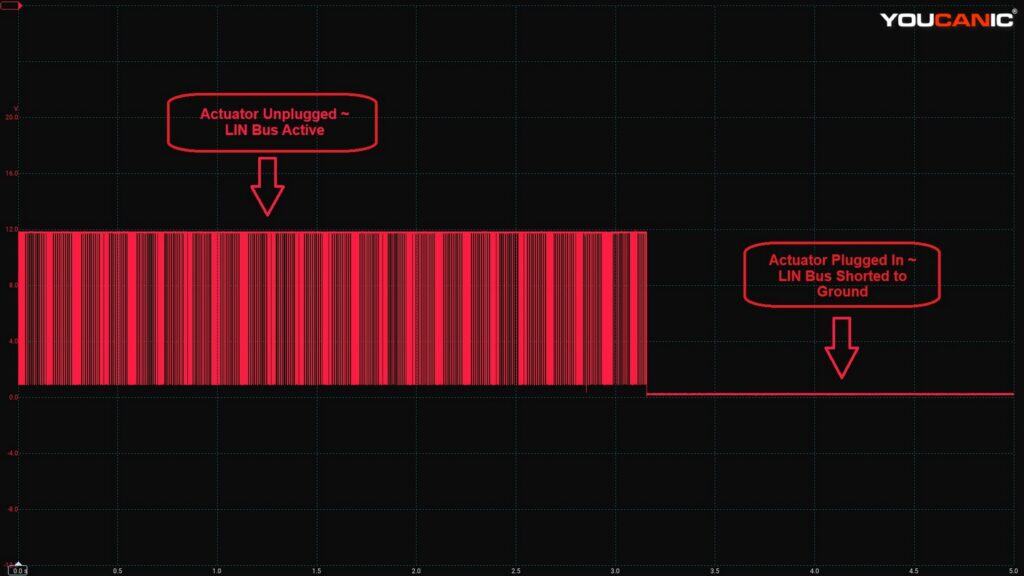
The shop’s Picoscope came out of its carrying case and was connected to the HVAC LIN bus at the Second-Row Blend Door Actuator. Each actuator had 4 wires connected to it: a ground on Pin 1, the LIN bus passing in and out on Pins 2 and 3, and power supplied on Pin 4. With the ignition switched on and the scope lead back probed on Pin 2, the screen showed a 0-volt flatline, indicating a short to ground on the bus. Normal resting state voltage should be around 12 volts. The voltage will be rapidly pulsed down to about 1 volt when data is being transmitted. LIN bus uses 1 and 12 volts as dominant and recessive states corresponding to computer logic bits 0 and 1.

With the scope still connected, the blend actuator was unplugged, and the LIN bus came back online, but only partially. Due to the daisy chain wiring, pins 2 & 3 need to be jumpered together to complete the LIN circuit. When the pins were jumpered, the LIN voltage went back to 0 volts, indicating the short was further down the line in the circuit. Now it was a process of working through the actuator on the back half of the LIN bus. As luck would have it, the third time was the charm; with the Right Blend Actuator disconnected and the connector jumped, the LIN bus was back online and fully communicating (except for a new fault code: B11C8 Right Front Temperature Door Control Missing Message). The climate control functions were also restored (except for the passenger side blend air).
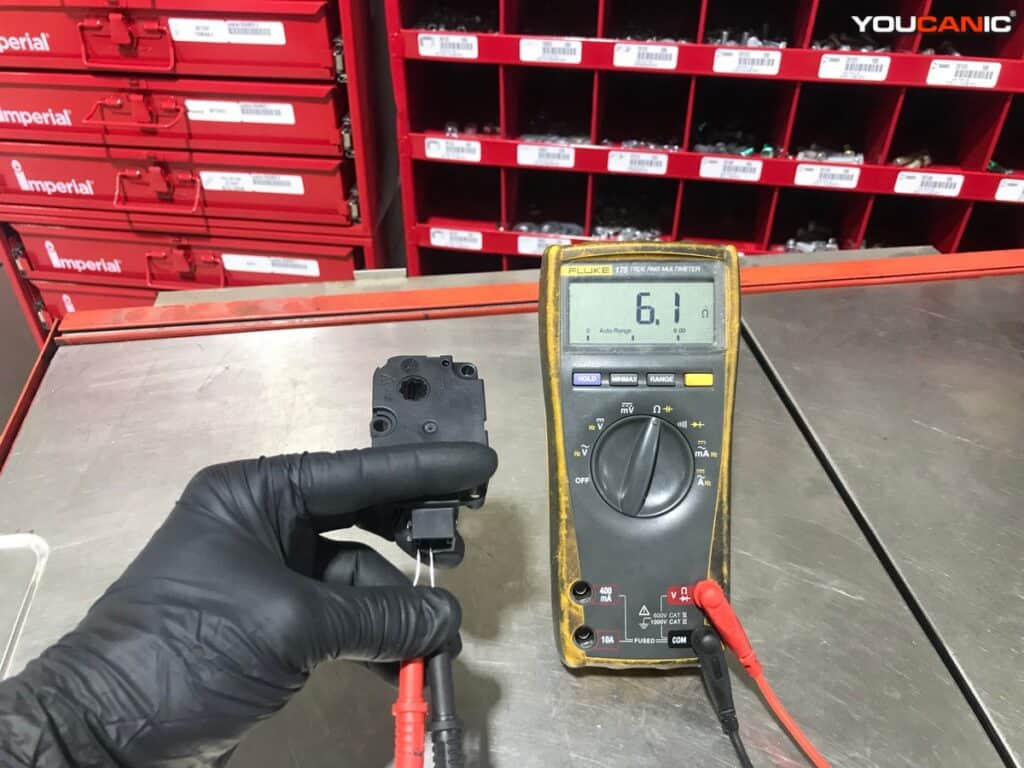
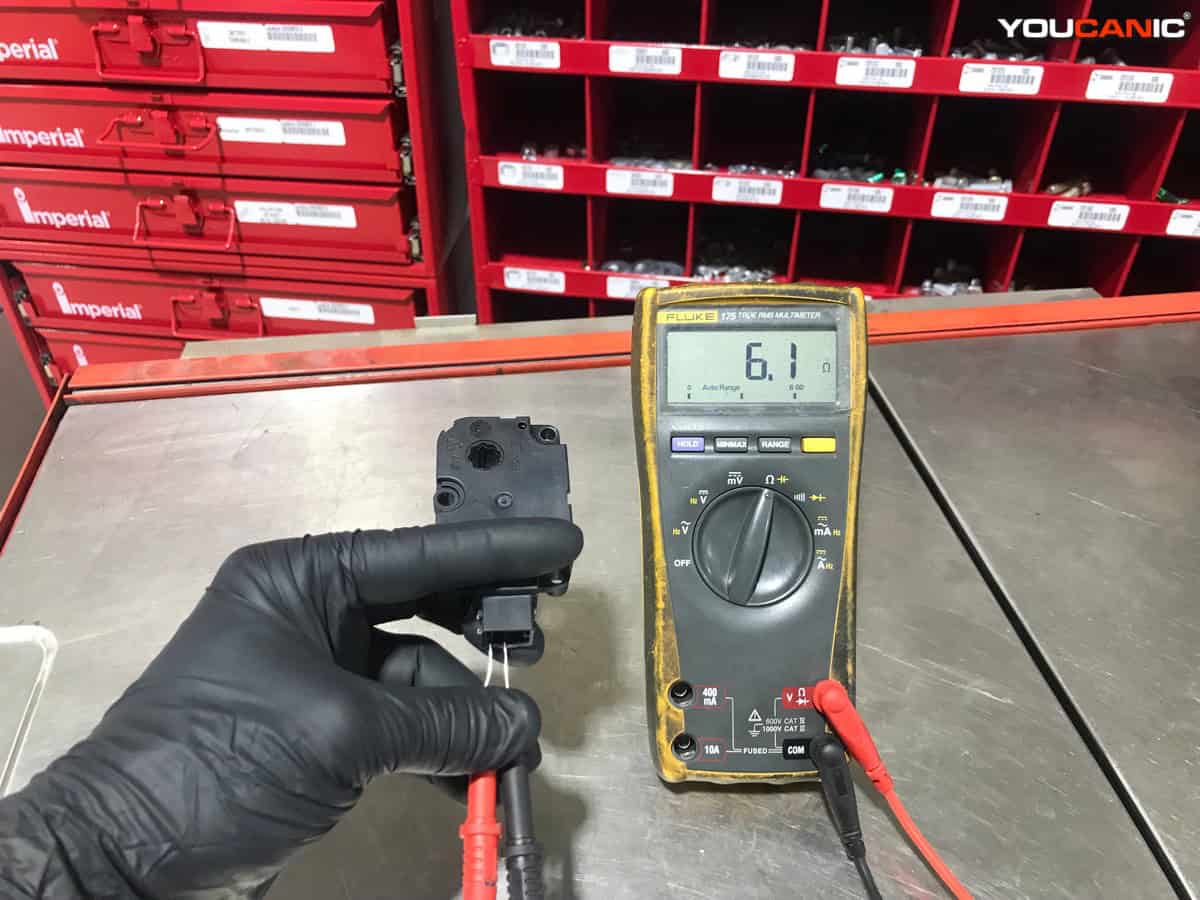
The faulty actuator was removed and a DVOM was used to further prove that the LIN chip inside the actuator was shorted to ground. Pins 1 and 2 had very little resistance, showing a short to the ground circuit.
Any Other Tips?

The diagnosis was complete; the left blend actuator needed to be replaced. One was sourced from the local Jeep dealer, and it arrived the next morning.
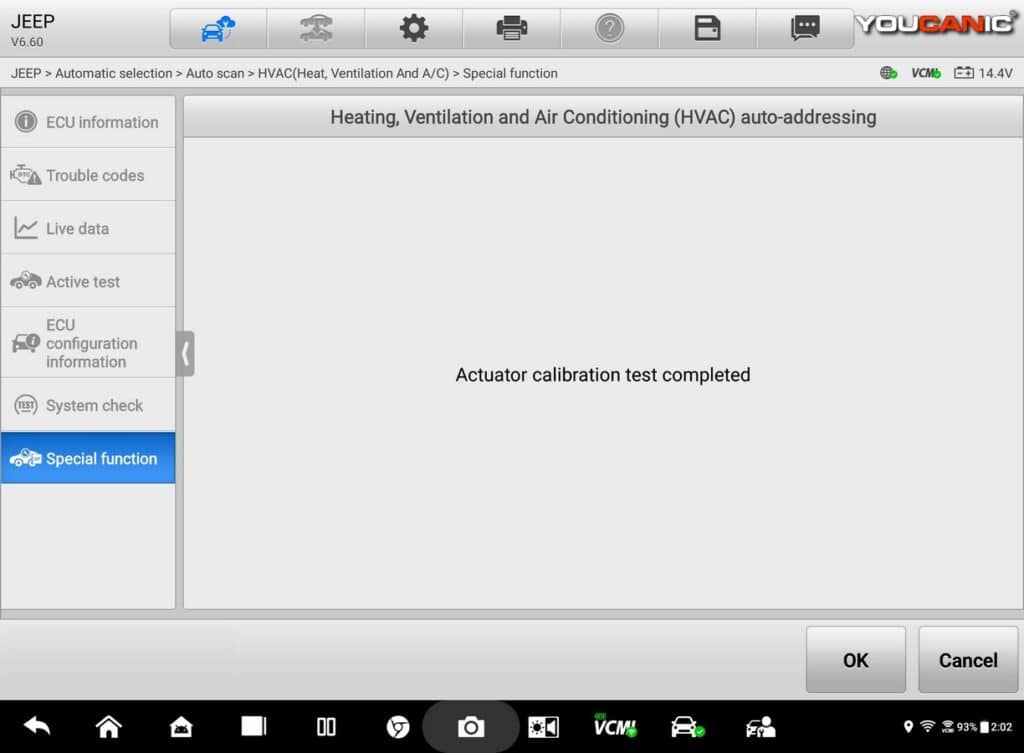
After installation, the scan tool was required to run the Auto-Addressing function, which allows the new actuator to communicate on the LIN network. The final step was to run the actuator calibration function, which was also performed with the scan tool. The Jeep’s owner, Callie, was happy to have her vehicle back with working air conditioning.
More guides: browse all of our Jeep repair and troubleshooting guides.