
Audi Check Brake Fluid Level & Add Brake Fluid
Reviewed/Verified by:

Audi does not take ordinary DOT 4. It specifies a low viscosity DOT 4 meeting Volkswagen standard TL 766 Z, usually sold as DOT 4 LV. Two things to be clear about before you top up: adding fluid does not fix a soft or spongy pedal, and a gradual drop over months is normal, caused by the caliper pistons extending as the pads wear.
At a Glance
- Check the level on the side of the reservoir near the driver’s side wiper area. It should sit between MIN and MAX.
- Add only the fluid printed on the cap. Audi specifies a low viscosity DOT 4 meeting VW TL 766 Z. Never use DOT 5.
- A slowly dropping level is normal as the pads wear. A fast drop or repeated top ups means a leak.
- A soft pedal is not fixed by adding fluid. It points to air, a leak or the master cylinder.
- Change the fluid by time, commonly every two years, because it absorbs water.
What you will need
- OEM Audi Brake Fluid
- Only use the brake fluid type printed on top of your particular brake fluid reservoir. The recommended brake fluid type is also listed in your owner’s manual.
Procedure
- Pull the hood release under the dashboard of your Audi. Open the hood and secure it in the open position.
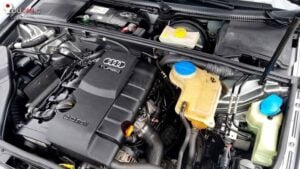
- Locate the brake fluid reservoir in the engine bay near the wiper arm on the driver’s side.
 On newer Audi vehicles, the brake fluid reservoir is covered with a black plastic cover that needs to be removed to reveal the brake fluid reservoir.

- Look at the side of the reservoir. Check if the level is between the maximum and minimum marks on the side of the reservoir. Add brake fluid if the brake fluid is below the minimum level.

- Look at the brake fluid reservoir cap and determine the correct brake fluid type.
- Remove the cap by turning it counterclockwise.
- Add brake fluid up to, but not above, the MAX/Full mark. Do not fill the Audi brake reservoir above the maximum mark.
 On newer Audi vehicles, the brake fluid reservoir is covered with a black plastic cover that needs to be removed to reveal the brake fluid reservoir.


Note that an Audi brake light staying on at startup can indicate a problem with the brake system, but it can sometimes be an issue with the charging system or battery. If the voltage from the alternator or battery is too low, it can trigger the brake light to stay on.
A gradual drop in the reservoir over months is normal and is caused by brake pad wear, because the caliper pistons extend as the pads thin and hold more fluid behind them. A level that falls quickly, or that needs topping up repeatedly, is a leak. Check the inside of each wheel for wet patches on the calipers and hoses, and look for dampness around the master cylinder and on the carpet beneath the brake pedal. Do not keep topping up and driving, because a system losing fluid can fail without warning.

🔧 Find out what is actually wrong before you pay someone to guess
Dealer level diagnostics at home with the YOUCANIC UCAN-II Pro.
- ✔ Covers most makes and models, including many luxury brands. Send us your VIN and we will confirm your car before you order
- ✔ Reads every module, not just the engine, so you find the faults a basic reader says are not there
- ✔ Commands the car: test a fan or pump, bleed ABS, retract an electronic parking brake, register a battery
- ✔ No subscriptions. Free lifetime updates, so the price you pay is the whole price
- ✔ Backed by real mechanics in the USA you can email before and after you buy
Featured in The Wall Street Journal
If your Audi brake warning light (or ABS light) is flashing while driving or at startup, stop and check the brake fluid level. Driving with the brake light on can put you, your passenger, and others at risk.
Symptoms
- Low Brake Fluid Warning
- Brake Light On
- The brake pedal is soft.
- The brake pedal can be pressed all the way.
- ABS light stays on or flashing
Audi requires a specific brake fluid, not just DOT 4
This catches people out because the bottle on the shelf says DOT 4 and that looks like a match. Audi specifies a low viscosity DOT 4 fluid meeting the Volkswagen Group standard, usually quoted as VW TL 766 Z and sold as DOT 4 LV. The reason is the ABS and stability control pump, which has to move fluid through very fine passages quickly in freezing conditions. A thicker conventional DOT 4 flows too slowly when cold and blunts how fast the stability system can intervene.
Ordinary DOT 4 will not destroy anything and is acceptable as an emergency top up to get you home, but have the system flushed and filled with the correct specification afterwards. Never use DOT 5. Despite the sequential numbering it is silicone based, it does not mix with glycol fluids, and putting it into an Audi can cause a soft pedal and poor braking. If it goes in by mistake, the whole system has to be flushed. DOT 5.1 is a different product again, it is glycol based, and it is compatible.
Change it on time, not on mileage
Brake fluid absorbs moisture from the air continuously, whether the car is driven or parked. Water in the fluid lowers its boiling point, and fluid that boils under sustained braking turns to vapor, which compresses. The pedal goes long or to the floor at the exact moment you need it. Audi specifies a fluid change by time rather than distance for this reason, commonly every two years, so check the service schedule for your model and year.
Fluid that has gone dark brown in the reservoir is well overdue. Use only a freshly opened container when topping up, because a bottle that has been open in the garage has already absorbed water and defeats the purpose.
If your Audi has an electronic parking brake
This is worth knowing before anyone touches the rear brakes. On models with an electromechanical parking brake, the rear caliper pistons are driven by small motors and cannot be wound or pushed back by hand. The car has to be put into a service or transport mode with diagnostic software first, the pistons retracted electronically, and the system reactivated afterwards.
Forcing those pistons back mechanically will strip the actuator and turn a brake pad job into a caliper replacement. It is also the reason the reservoir level can jump suddenly during a rear brake service, so check it again once the work is finished rather than before. A full system scanner that supports Audi can enter and exit that service mode as well as read the ABS and brake system codes.
If the warning light stays on with the fluid at maximum, the cause is usually elsewhere: a faulty fluid level switch at the reservoir or its connector, or a fault stored in the ABS module. Both are identified by reading the codes, and none of them are fixed by adding more fluid.
Wash off any spill straight away with plenty of water. Brake fluid lifts paint within minutes and Audi engine bays have a great deal of painted metal close to the reservoir.
Handle Brake Fluid Safely
- Brake fluid strips paint. Cover the fender and wipe up any drips right away with water.
- Keep the cap off for as little time as possible; brake fluid absorbs moisture from the air.
- Use fluid from a sealed bottle. An opened bottle that has sat for months has already absorbed water.
- Never reuse fluid you have drained or siphoned out.
Which Brake Warning Is On?
- Red brake symbol: low brake fluid, the parking brake applied, or a hydraulic fault. Check the level and do not drive if the pedal feels soft.
- Yellow pad wear symbol: the brake pad wear sensor has been reached. The fluid level will also have dropped a little; replace the pads and do not overfill the reservoir.
- ABS or ESC light with the brake light: often a wheel speed sensor or ABS module fault. Read the codes before replacing parts.
If the reservoir ever ran dry, air may have reached the ABS unit. A normal bleed may not clear it; many cars need an ABS pump bleed routine run from a scanner with ABS service functions, such as the YOUCANIC UCAN-II Pro on supported models.
Frequently Asked Questions
How often should I change brake fluid on an Audi?
Audi commonly calls for a brake fluid change every two years regardless of mileage, because the fluid absorbs moisture over time. Check your service schedule for your model.
Can I use DOT 3 in my Audi?
No. Use the DOT 4 low viscosity fluid specified on the cap. DOT 3 has a lower boiling point, and DOT 5 silicone fluid must never be used.
Why is my brake fluid low but there is no leak?
A slow drop is normal as the pads wear, because the caliper pistons move out and hold more fluid. If the level drops quickly or the pads are new, look for a leak.
Related Guides
- How to Add Windshield Washer Fluid to Your Audi
- Audi Check Add Power Steering Fluid
- Brake Lights Stuck Always On in Your VW or Audi? Here’s How I Fixed It Without the Dealer
- Audi Check Engine Oil Level Add