How to Check and Add Engine Coolant | 2012 to 2017 Toyota Camry
Reviewed/Verified by:

Is your Toyota Camry running warm, or is the coolant reservoir low? Check your engine coolant level. If your coolant is low, your car will have a hard time keeping cool. If your coolant is low, you will need to top it off! This guide will walk you through checking and adding engine coolant on a 2012 to 2017 Toyota Camry XV50. Are you more of a visual learner? Watch our video guide below!
At a Glance
- Fits: 2012 to 2017 Toyota Camry (XV50).
- Coolant: Toyota Super Long Life Coolant (pink, premixed) or an equivalent that meets Toyota’s spec.
- Only open the radiator cap on a cold engine.
- Keep the reservoir between the L (MIN) and F (MAX) marks.
- A level that keeps dropping means a leak; have the system pressure tested.

What you will need
- Engine Coolant: See notes at the end of this article.
Procedure
- Open the hood by pulling the hood release switch under the dashboard. Go to the front of the vehicle, unlock the hood latch, and pull the hood up until the hood struts are in the hold position.


- If you have recently replaced the radiator hoses or drained the radiator, you will need to add more coolant.
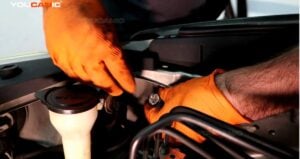
- Locate the radiator cap on the front side of the engine compartment, behind the bumper support bracket. The side of the coolant reservoir will have an L and F or MIN and MAX line. When the reservoir is cool, engine coolant should be between these lines. If it is below the L or MIN line, add more coolant.

- Open the radiator cap by pushing the cap in and twisting it counterclockwise.
 Do not open the radiator cap when the engine is hot; let the vehicle cool down before opening the radiator cap. Contents in the coolant reservoir is under a lot of pressure when it is hot.
- Pour the engine coolant into the radiator. Check the radiator cap to see if it needs to be replaced by checking the rubber gasket on the lid.
- Close the cap by pushing it back to the radiator and twisting it clockwise.

- Locate the coolant reservoir on the front side of the engine compartment near the radiator cap.

- Check the fluid level on the indicator on the backside of the reservoir. A line indicates the full and low levels.

- Open the cap of the coolant reservoir by pulling it up.
- Pour more coolant into the reservoir.
- Close the cap by pushing it back to the reservoir.


 Do not open the radiator cap when the engine is hot; let the vehicle cool down before opening the radiator cap. Contents in the coolant reservoir is under a lot of pressure when it is hot.
 Check the radiator cap to see if it needs to be replaced by checking the rubber gasket on the lid.


What coolant type does your Toyota Camry need?
“Toyota Super Long Life Coolant” is a high-quality ethylene glycol-based non-silicate, nonamine, non-nitrite, and non-borate coolant with long-life hybrid
organic acid technology. Toyota Super Long Life Coolant is pink and comes premixed, so do not dilute it further.
- U.S.A.: “Toyota Super Long Life Coolant” is pre-mixed with 50% coolant and 50% deionized water.
- Canada: “Toyota Super Long Life Coolant” is pre-mixed with 55% coolant and 45% deionized water.
Check out our other troubleshooting and repair guides for more help on your Toyota.

🔧 Find out what is actually wrong before you pay someone to guess
Dealer level diagnostics at home with the YOUCANIC UCAN-II Pro.
- ✔ Covers most makes and models, including many luxury brands. Send us your VIN and we will confirm your car before you order
- ✔ Reads every module, not just the engine, so you find the faults a basic reader says are not there
- ✔ Commands the car: test a fan or pump, bleed ABS, retract an electronic parking brake, register a battery
- ✔ No subscriptions. Free lifetime updates, so the price you pay is the whole price
- ✔ Backed by real mechanics in the USA you can email before and after you buy
Featured in The Wall Street Journal
If the Coolant Keeps Dropping or the Engine Overheats
- Coolant is not used up. A level that keeps falling means a leak: check the radiator, hoses, water pump and reservoir for wet spots or dried crust.
- A sweet smell or white steam from the engine bay points to an external leak; coolant loss with no visible leak can mean a head gasket problem.
- If the temperature gauge climbs or a coolant warning appears, pull over and let the engine cool before checking anything.
- Overheating with a full system can come from a stuck thermostat, a failed cooling fan or a weak water pump.
A scan tool such as the YOUCANIC UCAN-II Pro shows live coolant temperature and cooling fan status on supported models, which helps pinpoint the cause.
Frequently Asked Questions
What coolant does a 2012 to 2017 Camry use?
Toyota Super Long Life Coolant, the pink premixed coolant, or an equivalent that meets Toyota’s specification. Do not mix in green coolant.
Where do I add coolant on a Camry?
Add coolant to the reservoir tank, keeping it between the L and F marks. Only open the radiator cap when the engine is completely cold.
Why does my Camry keep losing coolant?
Coolant is not consumed, so a dropping level means a leak. Check the radiator, hoses, water pump and reservoir, or have the system pressure tested.