Starter Replacement Toyota Camry 2012 to 2017 XV50
Reviewed/Verified by:

Can’t start your Toyota Camry due to a faulty starter? Learn how to fix the problem by replacing your vehicle’s starter. This step-by-step procedure replaces the 2012 to 2017 Toyota Camry XV50 starter.
At a Glance
- Fits: 2012 to 2017 Toyota Camry (XV50)
- Signs of a bad starter: a single click, grinding, or nothing while the dash lights stay bright
- Prove it first: test the battery and connections before removing the starter
- Tools: 10mm, 12mm and 14mm sockets and wrenches, torque wrench
- Safety: disconnect the battery before touching the starter cable
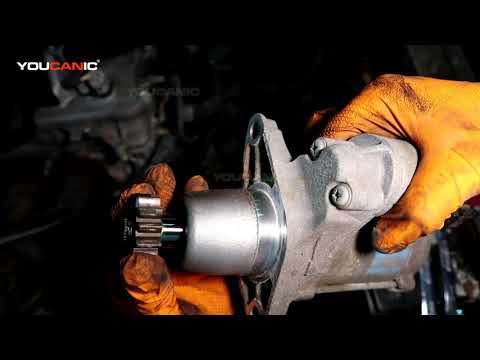
Prove it is the starter before you remove it
A starter is a reasonable amount of work to reach, so it is worth spending ten minutes confirming the diagnosis. Several much cheaper faults produce an identical no start.
Start with the battery, because a battery that cranks the engine slowly or not at all is by far the most common cause of a car that people assume needs a starter. A single rapid clicking sound almost always means insufficient current rather than a failed starter, and that is a battery, a corroded terminal or a bad ground strap. Have the battery load tested rather than reading its voltage, and clean both terminals and the engine to body ground connection before going further.

🔧 Find out what is actually wrong before you pay someone to guess
Dealer level diagnostics at home with the YOUCANIC UCAN-II Pro.
- ✔ Covers most makes and models, including many luxury brands. Send us your VIN and we will confirm your car before you order
- ✔ Reads every module, not just the engine, so you find the faults a basic reader says are not there
- ✔ Commands the car: test a fan or pump, bleed ABS, retract an electronic parking brake, register a battery
- ✔ No subscriptions. Free lifetime updates, so the price you pay is the whole price
- ✔ Backed by real mechanics in the USA you can email before and after you buy
Featured in The Wall Street Journal
A single solid click with a healthy battery is different. That is the solenoid pulling in while the motor fails to turn, and it points at the starter itself. Complete silence with the dash lit normally points elsewhere again, usually at the neutral safety or park position switch, the clutch switch on a manual, the immobilizer or the ignition switch. On an automatic, try starting in neutral: if it cranks in neutral but not in park, the fault is the park position switch and the starter is fine.
One useful field test. With the car safely supported and in park with the parking brake on, have someone turn the key while you listen at the starter. If you hear the solenoid click but no motor, that confirms it. Tapping the starter body with a mallet while someone cranks will sometimes free worn brushes and give you one more start, which is a diagnosis rather than a repair but it tells you what to buy.
What you will need
- Metric Mechanic Toolset
- 10mm socket wrench
- 12mm wrench
- 14mm wrench
- Toyota Camry Engine Starter
- Torque Wrench
Procedure
- Open the hood. Pull the hood release under the dashboard, go to the vehicle’s front, unlock the hood latch, and pull the hood up until the hood struts keep the hood open.


- Disconnect the positive and negative terminals of the battery by loosening the 10mm bolts.


- Remove the air cleaner and air filter housing to access the starter.

- Pop the push clips out on the bumper support bracket and put the bumper support bracket aside.

- Pull the air cleaner out by removing the 10mm bolts on the front bumper. Use a 10mm socket wrench to remove the bolts.

- Remove the two 10mm bolts holding the airbox, disconnect the hose by loosening the clamp, disconnecting the electrical connector on the back of the airbox, and set the air filter housing aside. This procedure helps to make access to the starter easier.


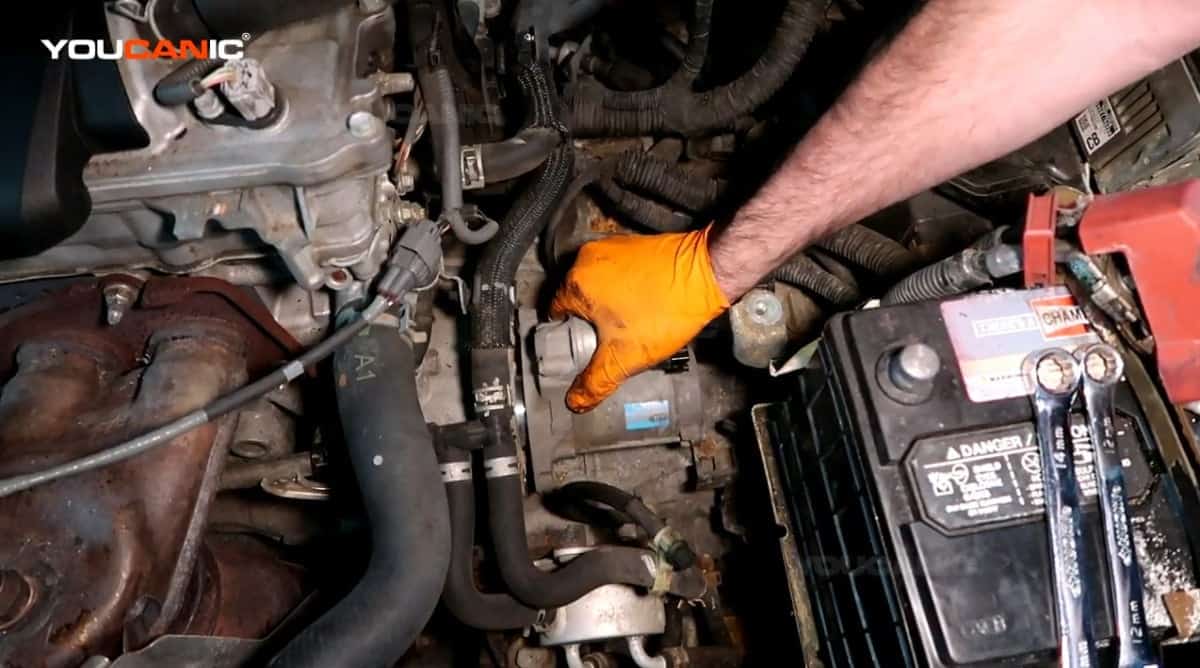
- Disconnect the starter’s electrical connector by pressing and pulling it out.

- Remove the 12mm bolt holding the cable and pull it out to disconnect it from the starter.

- Remove the 14mm bolts on the starter and pull the starter out from the vehicle.

- Get the new/replacement starter, return it to the vehicle, and reinstall the 14mm bolts.


- Hook the cable back to the starter and reinstall the 12mm bolt.

- Reconnect the connector of the starter.

- Line up the air filter housing back to the vehicle, connect the hose for the air filter housing, and reinstall the two 10mm bolts.

- Put back the air cleaner and reinstall the 10mm bolts on the front bumper.
- Reconnect the positive and negative terminals of the battery.


Torque Specifications
- Starter bolts: 39 N·m (398 kgf·cm, 29 ft·lbf)
- Power cable nuts: 13 N·m (130 kgf·cm, 9 ft·lbf)
Safety and reassembly
The large terminal on the starter is connected straight to the battery positive and is live whether or not the key is in the ignition. If a wrench bridges that terminal and anything earthed, it will arc hard enough to weld itself in place and can set the harness alight. Disconnect the negative battery terminal before you touch the starter, and cover it so it cannot spring back onto the post while you work.
Never work under a vehicle supported only by a jack. Use jack stands on the manufacturer’s jacking points, chock the wheels and leave the jack in place as a secondary support.
On reassembly, torque the mounting bolts to the figures listed above rather than guessing. The starter has to sit square to the bellhousing so the pinion meets the ring gear at the correct depth; a starter pulled up unevenly or left loose will grind, chew the ring gear teeth and fail again quickly. Make sure the heavy cable terminal is clean and properly tightened, and that its insulating boot is refitted over the connection.
When it still will not start afterwards
If the new starter does nothing, check that the battery is still connected and charged, since it will have been off the car for a while and a marginal battery often fails to recover. Then check the small trigger wire at the solenoid, which is easy to leave unplugged or to knock off during reassembly.
Beyond that, the problem was probably never the starter. Read the codes rather than guessing again: an immobilizer fault, a park position switch or a failed starter relay all produce the same symptom, and a full system scanner that accesses the Toyota body and engine modules will name which one rather than leaving you to work through them by elimination.
Frequently Asked Questions
How do I know if my Camry starter is bad?
If the battery tests good, the dash lights stay bright, and you get a single click or nothing when you turn the key, the starter or its solenoid is the likely cause.
Can a bad battery look like a bad starter?
Yes. A weak battery or corroded cable gives slow cranking or clicking. Test the battery and clean the terminals first.
How long does a Camry starter replacement take?
About 1 to 2 hours for a DIYer with basic tools, since the air filter housing must come off for access.
Related Guides
- Fuse List and How to Locate the Fuse Box, Replace Fuses Relays on a 2012 to 2017 Toyota Camry XV50
- Replace High Beam Bulb Toyota Camry 2012 to 2017 XV50
- Hood Won’t Stay Open Fix Toyota Camry 2012 to 2017 XV50
- Bleed Brake Line Toyota Camry 2012 to 2017 XV50