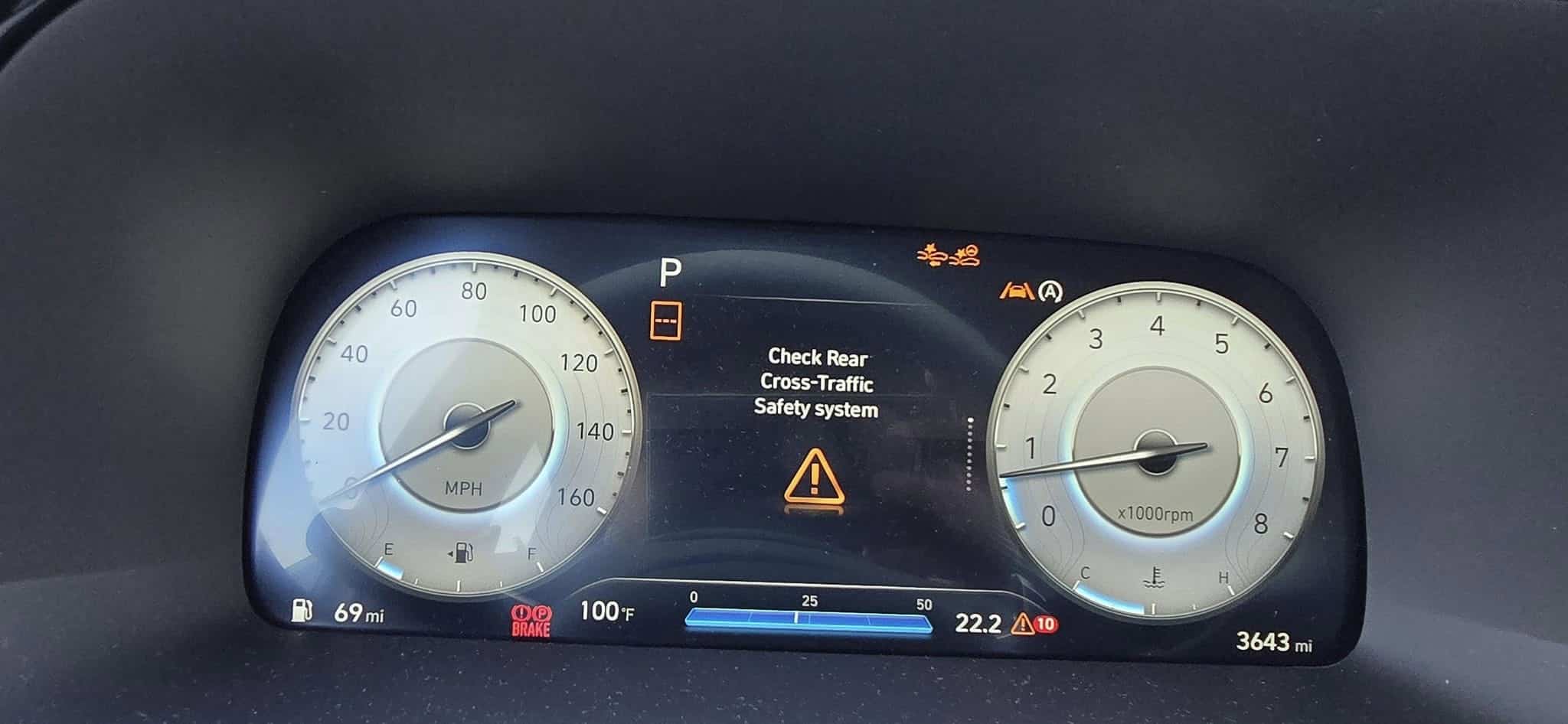
When the “Check Rear Cross Traffic Safety System” warning message comes on in your Hyundai, it means there is an issue with the Rear Cross-Traffic Collision-Avoidance Assist (RCCA). Ignoring this warning can lead to reduced safety when reversing due to an increased risk of collisions with vehicles or pedestrians, and can result in higher repair costs as RCCA issues may impact other vehicle systems. It is important to diagnose and fix it as soon as possible.
What Does the Check Rear Cross-Traffic Safety System Mean?
The Rear Cross-Traffic Safety System is one of your Hyundai’s driver-assistance features. It provides a warning and vehicle control when a risk of rear cross-traffic collision is detected while reversing. When the warning message “Check Rear Cross-Traffic Safety System” appears on your dashboard, the system is malfunctioning.
⚠️ Why You Should Fix It As Soon As Possible:
Safety Risk: The risk of colliding with vehicles while reversing increases. A malfunctioning Rear Cross-Traffic Safety System may not only fail on its own; it can also disrupt other systems that depend on the same rear radar sensors, like the Blind-Spot Safety System. If you don’t fix it, you will never know what other components and systems are affected by it, compromising their functions and your safety.
Performance Issues: A faulty rear cross-traffic safety system can unexpectedly cause brakes to be applied while reversing, even when nothing is behind your vehicle.
Costly Repairs if Ignored: The Rear Cross-Traffic Safety System shares key components with the Blind-Spot Safety System, so a malfunction can affect both safety features. Ignoring the issue can lead to further damage, increasing repair costs. A wiring harness replacement costs around $450, while a new radar sensor can exceed $1,000.
Common Causes of the Check Rear Cross-Traffic Safety System
Here are the most common reasons this light appears:
✅ Weak Battery: Low voltage can cause system errors and unexpected warning lights.
✅ Faulty Sensor: The rear radar sensor could be blocked. Dirt, mud, rainwater, or snow on these sensors can prevent them from correctly reading data. When misaligned, it can also trigger the warning message on the dashboard.
✅ Low Fluid Levels: The rear cross-traffic safety system uses emergency braking to avoid collisions. The brake control may not operate properly depending on the status of ESC (Electronic Stability Control) and ABS (Anti-lock Braking System). Low brake fluid levels can cause a warning message to appear.
✅ Malfunctioning Module: A malfunctioning ECU or ABS control modulecould trigger false alerts.
✅Software Update: Sometimes, the warning message is caused by a system glitch, which can be resolved with a software update at the dealership.
✅Faulty Wheel Speed Sensor: A faulty wheel speed sensor can send wrong signals to the control modules, causing false dashboard warnings. It may also trigger unnecessary braking while reversing, slamming the brakes even when nothing is behind the vehicle.
🛠️ Pro Tip: Use an OBD-II scanner to check for error codes related to the issue.
Troubleshooting & Fixes for Check Rear Cross-Traffic Safety System
Before taking your car to a mechanic, try these DIY fixes:
Check Battery Health: Use a battery tester, multimeter, or scanner to check for low voltage. Voltage levels under 12.4 volts are considered too low, indicating that your battery needs to be replaced or recharged.
Inspect Wiring & Connections: Check for loose or frayed wires around the rear radar sensors, which are typically located in the corners inside the rear bumper. Also, inspect the wiring harnesses connected to these sensors for any damage.
Inspect Fuses: look for damaged or melted fuses in your vehicle’s fuse box. This could be an indicator of an electrical issue in your car. ONLY REPLACE OLD FUSES WITH NEW ONES OF THE SAME AMPERAGE.
Inspect sensors for dirt and damage: Sensors can become damaged or dirty over time. Check the rear radar sensors for dirt, water damage, or loose wiring, as this might be the reason for the problem. Check for signs of damage, like dents or scratches on your rear bumper. This can indicate that the rear radar sensors might be misaligned or damaged, causing the warning message to appear.
Top-Off Fluids: Check if your brake fluid is at the correct level, and top it off if it is near or below the “MIN” line. DO NOT MIX BRAKE FLUIDS. REFER TO YOUR OWNER’S MANUAL FOR THE CORRECT FLUID TYPE.
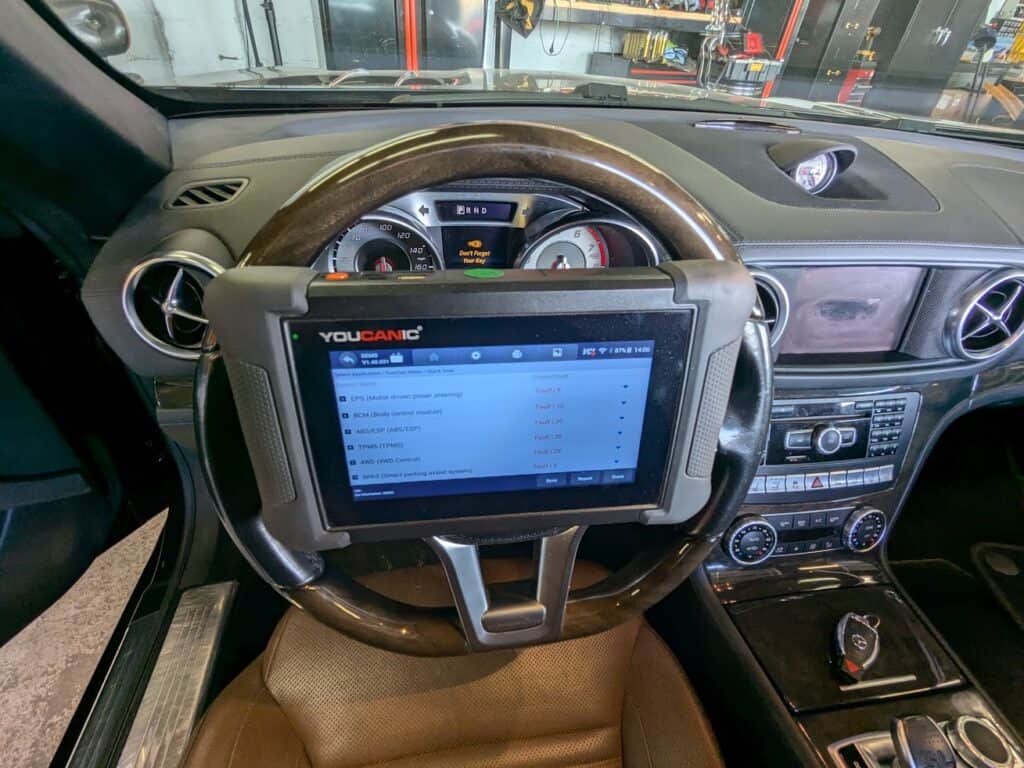
Use an OBD-II Scanner: Read and clear error codes to see if the issue is temporary. Use a high-quality scanner like the YOUCANIC Scanner because cheap ones may not be able to access key modules needed for diagnosing wheel speed sensor issues. To find a faulty wheel speed sensor, use your scanner’s live data monitoring while the vehicle is running.
Reset the System: If the warning light/error message was caused by a glitch in the system, it can be cleared by disconnecting the battery for 30 minutes or using a scan tool.
Common OBD-II Fault Codes
If you scan your vehicle with an OBD-II scan tool, you may see one of these codes:
C120001 – Wheel speed sensor, front LH (Open/Short)
C270354 – Control Module Slave: Missing Calibration
C1642-81 – CAN Message failure – Brake
C1675-81 – Signal of the wheel (FLR/FR/RL/RR) Invalid
C1862-86 – Invalid signal of smart cruise control (SCC)
FAQs
Can I still drive with the Check Rear Cross Traffic Safety System warning message on?
➡️Yes, you can still drive with the Check Rear Cross-Traffic Safety System warning on, but you will lose the safety feature of your vehicle when reversing. This system helps prevent collisions when reversing, and a malfunction means it may not work properly. Because the Rear Cross Traffic Safety System is also linked with the functions of the other systems like the Blind Spot Safety System, Lane Safety System, ABS, and ESC, getting it checked immediately is important. There could be other underlying issues, more serious than just the Check Rear Cross-Traffic Safety System warning. could be present, putting your safety and your vehicle’s health at risk.
How do I reset the Check Rear Cross Traffic Safety System?
➡️To reset the Check Rear Cross-Traffic Safety System warning, you can try these methods. First, disconnect the battery’s negative terminal for about 30 minutes, then reconnect it. This may reset the system, but it could also erase other car settings. Another option is using a high-quality OBD-II scanner to check for trouble codes and clear them if the issue has been resolved. In some cases, simply driving the car for a few miles and restarting it a few times can reset the warning if the problem is triggered by a temporary glitch.
What happens if I ignore this warning?
➡️Ignoring the Check Rear Cross-Traffic Alert system warning can lead to false braking and loss of rear traffic alerts due to system failure, increasing the risk of accidents, including backing into a pedestrian. Since it shares components with the Blind-Spot Safety System, Lane Safety System, ABS, and ESC, other safety features may also be linked to the warning message, leaving you vulnerable to a more serious problem.
Do I need a mechanic, or can I fix this myself?
➡️You can try to fix the issue yourself using the troubleshooting tips in this article, but if the problem goes beyond that or requires specialized tools, like radar sensor alignment and calibration or brake system issues, it is best to let a professional handle it.
Final Thoughts
The Check Rear Cross Traffic Safety System should never be ignored, as it could indicate a serious issue with your vehicle’s safety system. By following these troubleshooting steps and scanning for fault codes, you can save time and money while ensuring your car remains safe and reliable.
Tools Required
OBD-II Scanner
Experts Who Contributed to This Article
rhila, ASE Certified
Diagnostic Specialist15+ years of experience
Rushit Hila is a dedicated automotive engineer with ASE G1 certification and specialized training from an esteemed Automotive Specialty School. His hands-on experience and technical expertise in advanced diagnostics, system integration, and performance optimization make him a trusted voice in the industry.
Antonie Labasan
Diagnostic Specialist
Antonie Labasan is a Registered Mechanical Engineer and Lean Six Sigma Blackbelt who brings practical automotive expertise to our diagnostic guides. With specialized training at VOLVO and years of experience managing diverse vehicle fleets including Toyota, Hyundai, and Kia models, Antonie understands common failure points across different manufacturers. His systematic approach to diagnostics helps readers identify and fix the true source of automotive problems, making his YOUCANIC scanner guides exceptionally effective for DIY mechanics.
Searching...
33% OFFFlash Sale — Ends Soon
⭐⭐⭐⭐⭐ 4.8 stars · 247 Verified Reviews
Stop paying $150 every time a warning light comes on.
The UCAN-II-D gives you full system diagnostics, bidirectional controls, and lifetime free updates. One scanner. Own it forever.
Was
$750
→
Now
$499
Save $251
+ Free shipping · No subscription ever
Free lifetime updates included — no annual fees ever