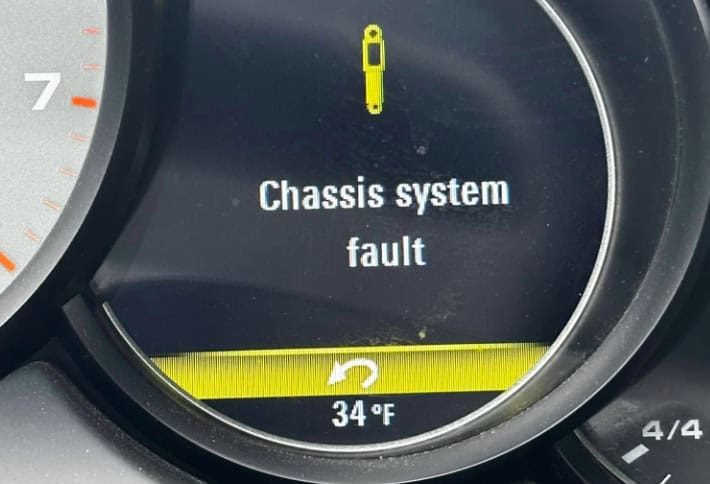
Porsche Chassis System Fault: What It Means & How to Fix It

Medium
1-6 hr
$500
If you are seeing a Chassis System Fault on your Porsche, it means there is an issue with the chassis system that includes your suspension and Porsche Dynamic Chassis Control System, if equipped. Ignoring this warning can lead to suspension failure, uneven ride height, poor handling and stability, excessive tire wear, and total chassis failure, so it is important to diagnose and fix it as soon as possible.
Here are the most common reasons this light appears:
⚠️ Weak Battery: Low voltage can cause erroneous system errors and unexpected warning lights.
⚠️ Fuse breaking: The most commonly reported reason for the warning message is a blown 40-amp fuse found in the cabin fuse box. This fuse runs the chassis system and often fails during extremely cold weather conditions.
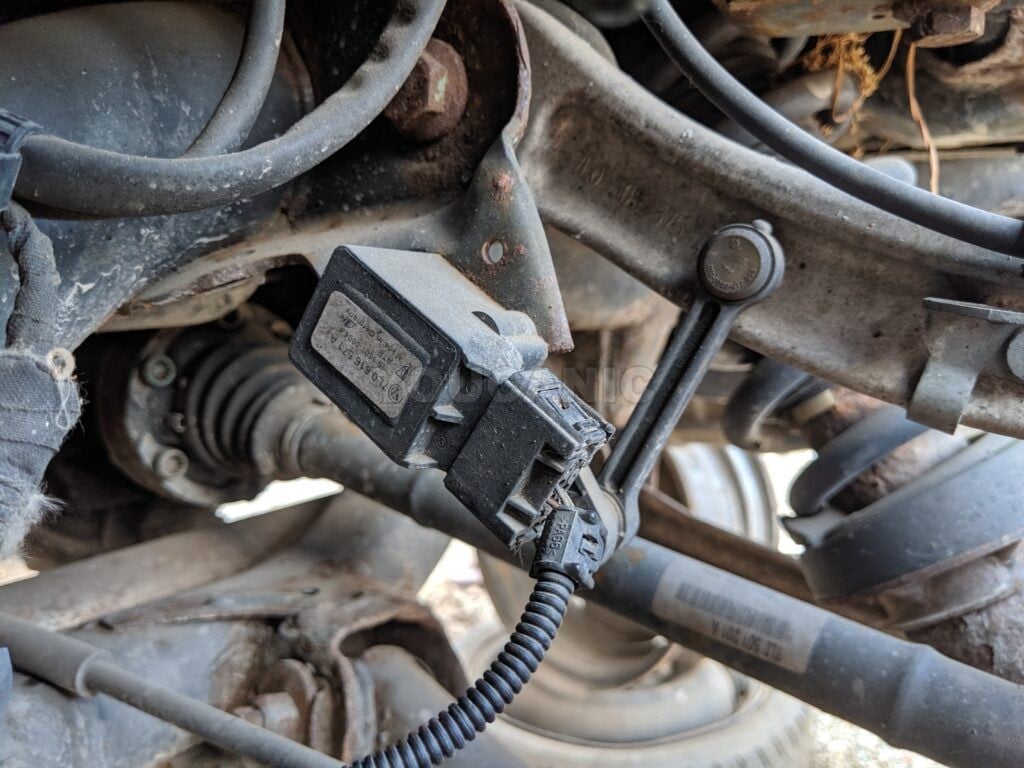
⚠️ Faulty Sensor: A wheel speed sensor, suspension level sensor or steering angle position sensor may be dirty, failing, or misreading data. Wheel speed sensors and suspension level sensors work in coordination with your vehicle’s suspension and stability. For instance, your Porsche will automatically lower itself if it exceeds 60 km/h, an operation where these sensors work together. The steering angle position sensor provides steering data to your PDCC module, allowing it to counter body roll caused by quick turns and cornering. The warning message may appear on your dashboard if one of these sensors fails.
⚠️ Loose or Corroded Wires: Bad connections can cause intermittent faults.
⚠️ Malfunctioning Module: A bad ECU, air suspension module or PDCC module could trigger false alerts.
⚠️ Low Fluid Levels: Low fluid levels in the PDCC reservoir. It relies on hydraulic pressure generated by an electric pump to activate the actuators. It’s a fully active system, not passive like traditional sway bars. PDCC is often combined with PASM (Porsche Active Suspension Management) for even more advanced suspension control.
⚠️ Defective Air Compressor: Your air compressor produces compressed air and feeds into the air tank. It ensures that the tank has its predefined air pressure. If this component fails, the entire air suspension system will become inoperable.
⚠️ Leaking Air tank: Your tank stores and supplies compressed air to your air suspension system. If the tank leaks, it can lower the air pressure, leading to continuous pumping of the air compressor, which then causes the warning message.
⚠️ Air Struts– Your car’s air struts have bladders or bellows to store compressed air needed to raise or lower your car’s suspension. Over time, these rubbers will deteriorate and can start leaking.
⚠️ Leaking Valve Body: The valve body regulates the airflow within the system, directing it to each air strut and enabling adjustments to the ride height, thereby enhancing suspension and stability. However, this crucial component can experience leaks through its pressure fittings or become clogged, leading to potential failures in airflow and pressure.
⚠️ Worn-out Suspension Components: Over time, your suspension components such as the shock absorbers, springs, upper and lower control arms, stabilizers, ball joints, and bushings will wear out.
⚠️ Underinflated or wrong-size tires: Tires not having the right pressure can affect how your suspension and PDCC work. For example, having either low or excessively high tire pressure can affect the accuracy of the level sensors and decrease the vehicle’s handling and stability.
⚠️ Hydraulic Pump with reservoir: The hydraulic pump provides fluids to operate the sway bars for better handling. Your car’s ability to reduce body roll will be compromised if this component malfunctions.
⚠️ Worn-out serpentine belt: A worn-out serpentine belt can’t drive your hydraulic pump enough, leading your pump to generate low fluid pressure to the PDCC system.
⚠️ Sway bar/Anti-roll bar: If a sway bar fails due to fluid leaks or mechanical damage, the ability to counteract body roll is lost, affecting the vehicle’s stability and handling.
Before taking your car to a mechanic, try these DIY fixes:

If you scan your vehicle with an OBD-II scan tool, you may see one of these codes:
🚗 Need help decoding a fault code? Use the YOUCANIC Scanner to read and clear trouble codes instantly.
➡️ It is not recommended. While the car may still be operable, the loss of critical functions, such as suspension, stability, and handling control, can lead to a rough, uncomfortable ride, unstable handling, especially during tight cornering at high speeds, and increased body roll.
➡️ To reset the warning message. you can try to use an OBD2 scanner to detect and clear fault codes, disconnect the negative terminal of your battery for at least 30 minutes, or drive your car for a few miles, then switch it off and on, to allow the system to assess itself.
➡️ Continuous driving with the warning message on leads to compounding damages like uneven tire wear, misaligned wheels, compromised vehicle stability, errors appearing due to misaligned sensors, severe suspension damage, and total chassis collapse.
➡️ You can try the basic troubleshooting procedures indicated in this article, like checking for leaks, checking for tire pressures, and doing basic resets. If your initial diagnosis leads to a more complex issue, such as a failing air compressor, suspension leaks, and faulty modules, bring your Porsche to your trusted mechanic or dealership.
The Chassis System Fault should never be ignored, as it could indicate a serious issue with your vehicle’s suspension and Porsche Dynamic Chassis Control system. By following these troubleshooting steps and scanning for fault codes, you can save time and money while ensuring your car remains safe and reliable.
👉 Get the YOUCANIC Scanner to Diagnose & Fix Your Car Instantly!
Antonie Labasan is a Registered Mechanical Engineer and Lean Six Sigma Blackbelt who brings practical automotive expertise to our diagnostic guides. With specialized training at VOLVO and years of experience managing diverse vehicle fleets including Toyota, Hyundai, and Kia models, Antonie understands common failure points across different manufacturers. His systematic approach to diagnostics helps readers identify and fix the true source of automotive problems, making his YOUCANIC scanner guides exceptionally effective for DIY mechanics.

Rushit Hila is a dedicated automotive engineer with ASE G1 certification and specialized training from an esteemed Automotive Specialty School. His hands-on experience and technical expertise in advanced diagnostics, system integration, and performance optimization make him a trusted voice in the industry.
Searching...
⭐⭐⭐⭐⭐ 4.8 stars · 247 Verified Reviews
The UCAN-II-D gives you full system diagnostics, bidirectional controls, and lifetime free updates. One scanner. Own it forever.
+ Free shipping · No subscription ever