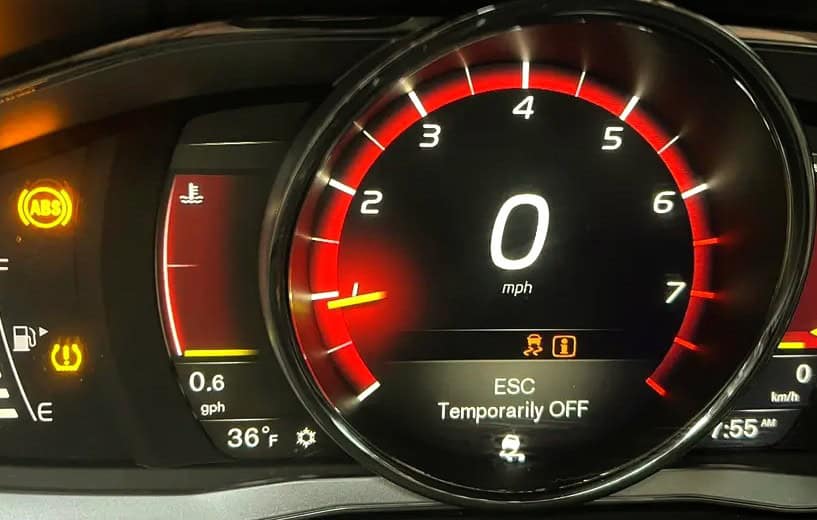
When the “ESC Temporarily OFF” warning message appears on the dashboard of your Volvo, it means there is an issue with the stability control system that requires attention. Ignoring this warning will disable the functions of your electronic stability control (ESC) safety features, possibly leading to an accident. It is important to diagnose and address the issue as soon as possible to keep everyone safe on the road.
What Does Volvo Electronic Stability Control (ESC) Temporarily Off Message Mean?
The ESC system is a safety feature in your vehicle that helps maintain stability and control, preventing excessive tire spin and skidding during hard braking and sharp turning. If the “ESC temporarily off” message appears, your ESC system has either been turned off or is malfunctioning.
⚠️ Why You Should Fix It As Soon As Possible:
Safety Risk – It can cause the vehicle to lose control while driving.
Performance Issues – It prevents the ABS from functioning properly, reducing braking performance and traction control.
Costly Repairs if Ignored – Ignoring the issue can increase the risk of an accident.
Estimated Repair Cost – The estimated repair cost is approximately $100–$1,500, excluding towing services, body repairs, and other damaged parts if an accident occurs.
Common Causes
Blown Fuse or Faulty Relay – Fuses and relays are electrical safety devices designed to protect components from short circuits. If one fails, the system may stop functioning.
Faulty Wiring – Loose, corroded, burned, or damaged wires or connectors can cause electrical components to fail.
ESC is turned off. – Users may accidentally press the ESC button, triggering a message or warning light notifying them that Esc is turned off.
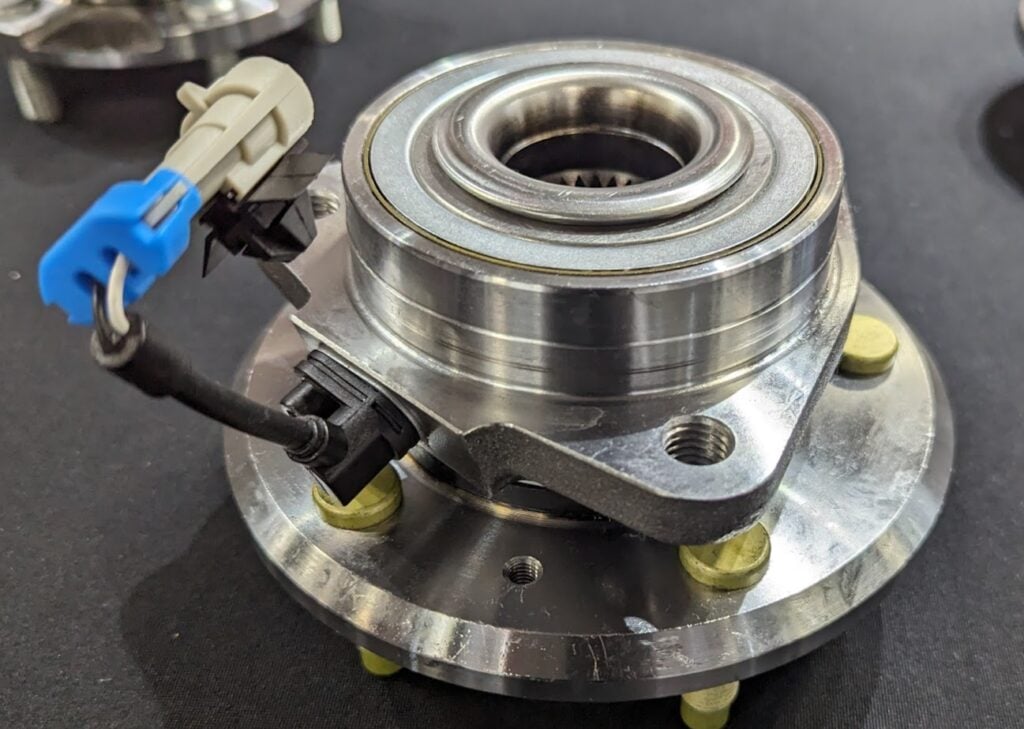
Faulty Wheel Speed Sensor – A dirty or faulty wheel speed sensor triggers an ESC warning message.
Faulty ABS Modulator – A faulty modulator may malfunction due to a leak or the use of non-recommended brake fluid.
Faulty ABS/ESC module – Outdated software or broken electronic circuits can cause the system to fail.
Faulty Wheel Steering Slip Ring(Clock Spring)— Clock springs wear out over time due to regular use. The clock spring is located in your steering wheel and protects the wires in your steering wheel when turning.
Faulty Brake Pedal Position Sensor – A brake pedal position sensor may fail due to aging or circuit failure.
🛠️ Pro Tip: Use an OBD-II scanner to check for error codes related to the issue.
Common Symptoms
ESC Warning Message or ESC Indicator Light On – If the system detects a fault in any component, it will send a warning message or activate the malfunction indicator light on the dashboard.
Insufficient Braking Performance – The brake system is unresponsive.
Vehicle Tire Skidding – You may feel the tires slip or skid while accelerating from slow to fast.
Unstable Driving When Applying Brakes While Cornering – This can be experienced when driving at high speeds and making slight turns.
Troubleshooting & Fixes
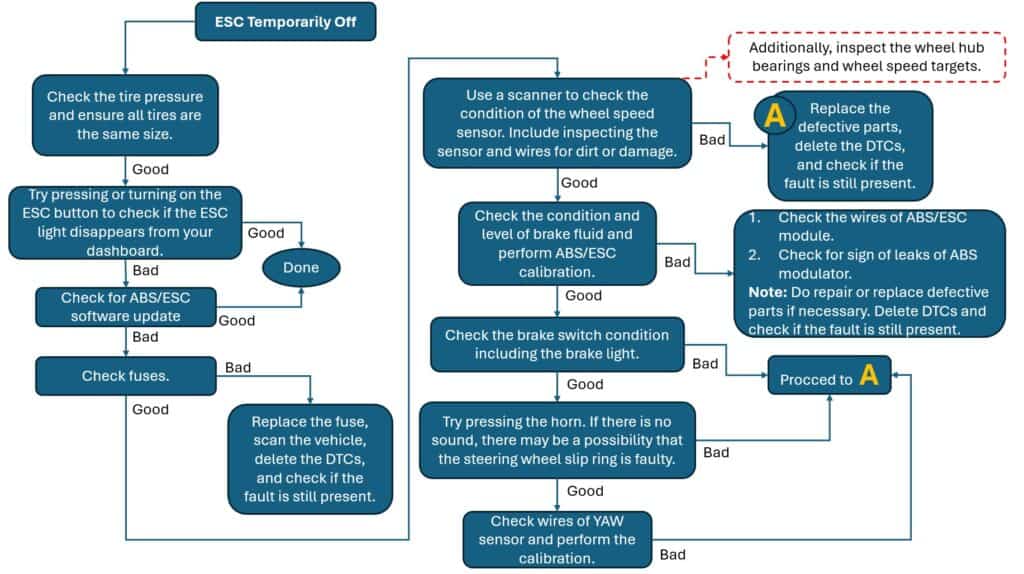
Before taking your car to a mechanic, try these DIY fixes:
Check Battery Health – Use a battery tester, multimeter, or scanner to check for low voltage. Many features in modern cars require electricity, and a weak battery or failing alternator will not supply the energy needed for these systems to function.
Inspect Wiring & Connections – Look for loose or frayed wires around the battery and alternator, as these may disrupt the flow of electricity, causing the system to be in an error state.
Inspect fuses– look for damaged or melted fuses in your vehicle’s fuse box. This could be an indicator of an electrical issue in your car. ONLY REPLACE OLD FUSES WITH NEW ONES OF THE SAME AMPERAGE.
Inspect sensors for dirt and damage. – Sensors can become damaged or dirty over time. Check your wheel speed sensors around your vehicle for dirt, water damage, or loose wiring, as this might be the reason for the problem.
Use an OBD-II scanner – Read and clear error codes to see if the issue is temporary.
Reset the System – If the warning light was caused by a glitch in the system, it can be cleared by disconnecting the battery for 30 minutes or using a scan tool.
Seek professional help if you can’t solve the issue.
➡️Yes. If the system has no fault. Users may sometimes accidentally press the ESC button, causing a warning message or indicator light to notify them that the ESC is turned off.
Can I still drive the vehicle with a faulty ESC?
➡️Yes, but drive carefully. We recommend you visit a repair shop as soon as possible.
Can braking performance be affected by a faulty ESC?
➡️Yes, as the ABS is a key component of the system.
Why is there an option to turn off Esc?
➡️Turning off ESC allows for more wheel spin, which is sometimes needed when driving on rough terrains like sand, mud, or deep snow.
Do all vehicles have ESC?
➡️No, older models do not have this feature. The adoption of ESC by some car manufacturers began around 2010 and later became mandatory for all manufacturers.
Final Thoughts
The faulty Electronic Stability Control (ESC) system should never be ignored, as it could indicate a serious issue with your vehicle’s driving safety. By following these troubleshooting steps and scanning for fault codes, you can save time and money while ensuring your car remains safe and reliable.
Tools Required
OBD-II Scan Tool
Experts Who Contributed to This Article
rhila, ASE Certified
Diagnostic Specialist15+ years of experience
Rushit Hila is a dedicated automotive engineer with ASE G1 certification and specialized training from an esteemed Automotive Specialty School. His hands-on experience and technical expertise in advanced diagnostics, system integration, and performance optimization make him a trusted voice in the industry.
Elbert Nonog, Automotive National Cert., BS Mechanical Eng.
Diagnostic Specialist13+ years of experience
Elbert G. Nonog is an Automotive Technical Writer and Training Manager with over 10 years of experience across major brands including Chevy, MG, Ford, Volkswagen, and Toyota. Rising from technician to leadership roles, Elbert excels at transforming complex automotive concepts into accessible training materials and documentation. His expertise spans conventional and electric vehicle systems, nationwide dealership training, and aftersales operations management. With TESDA certification and pursuing further education from the Technological University of Philippines, Elbert effectively bridges the gap between automotive engineering and practical application for industry professionals and enthusiasts.