
Mercedes-Benz Jump Start GLA-Class with Dead Battery
Reviewed/Verified by:

You do not need to reach the battery on a GLA. Mercedes provides a positive jump post under the hood with a ground point to go with it, and that is where the leads belong. Connect positive first, leave the donor car idling, remove the clamps in reverse order, then drive for at least thirty minutes so the alternator can put the charge back.
At a Glance
- Use the jump points under the hood; you don’t need to reach the battery itself.
- Red clamp to the positive jump point, black to the marked ground point.
- Start the donor car or jump pack first, then start the GLA.
- Remove clamps in reverse order and drive at least 30 minutes.
- Frequent dead batteries: test the battery and charging system.
- A scanner such as the YOUCANIC UCAN-II Pro shows live charging voltage and runs battery registration on supported Mercedes models.

What you will need
- 12V Jump Starter
or - Jumper Cables: Requires a running car
Procedure
- Remove the metal blade/key from your Mercedes-Benz key fob. A release button in the key fob will pop out the metal key. Use the metal key to unlock the driver’s door.

- Open the hood by pulling the hood release lever under the dashboard.
- Press the yellow release under the hood towards the passenger side and raise the hood.
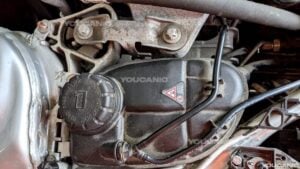
- Locate the terminals in the engine bay designed to jump-start your Mercedes-Benz. Pull/open the RED plastic cover with the + symbol to locate the positive port. The terminals are on the driver’s side.
- Connect the red (positive) jumper cable to the positive terminal.

- Connect the black (negative) jumper cable to the ground terminal on the vehicle frame.
- Ensure that the red cable (positive) is connected to the positive terminal and the black cable (negative) is connected to the negative terminal if another vehicle is used to jump-start the vehicle.
- Get inside the car and start the engine. If the car does not start away, let the battery charge for at least ten to fifteen minutes and then start it again.
-
Once the engine starts, drive or let it idle for at least twenty minutes to charge the battery. If the battery is completely discharged or has a bad cell, the battery may not have enough power to restart the engine.
-
The ABS and other lights may be on when you start the engine. As long as there are no other issues, these reset automatically after driving for a few minutes. If the ABS, airbag, or traction control light doesn’t reset, follow this guide to read Mercedes-Benz fault codes.


Where is the negative terminal on a Mercedes GLA?

The negative terminal is on the driver’s side near the strut tower.
Car Won’t Jump Start.
If all you hear is a click, check the jump starter clamps are making good contact. Ensure the jump box is fully charged. The battery in the car may be completely discharged or bad. Keep the jumper cables connected for at least fifteen minutes, then try again.

🔧 Find out what is actually wrong before you pay someone to guess
Dealer level diagnostics at home with the YOUCANIC UCAN-II Pro.
- ✔ Covers most makes and models, including many luxury brands. Send us your VIN and we will confirm your car before you order
- ✔ Reads every module, not just the engine, so you find the faults a basic reader says are not there
- ✔ Commands the car: test a fan or pump, bleed ABS, retract an electronic parking brake, register a battery
- ✔ No subscriptions. Free lifetime updates, so the price you pay is the whole price
- ✔ Backed by real mechanics in the USA you can email before and after you buy
Featured in The Wall Street Journal
Use the jump start posts, not the battery itself
Mercedes provides dedicated jump start terminals in the engine bay precisely so that nobody has to work across the battery, and on the GLA that is what the positive post under the cover and the ground point described above are for. Use them.
The ground connection matters more than people realize. Do not clamp the negative lead onto the battery negative post. These cars have a battery monitoring sensor on that terminal which tracks every amp going in and out so the charging system can manage the battery correctly, and clamping past it both hides the current from it and risks damaging it. Making the final connection away from the battery also keeps the inevitable spark away from the hydrogen a charging battery gives off.
Connect positive to positive first, then the ground lead to the donor battery negative, then the final clamp to the ground point on the GLA. Disconnect in exactly the reverse order. Keep the leads clear of belts and the cooling fan throughout.
Give it a few minutes before cranking
Rather than trying to start immediately, leave the donor car running for about five minutes with the leads connected. A deeply discharged battery on a car with this much electronics has a great deal to wake up, and those few minutes of surface charge are frequently the difference between a start and a series of clicks.
If it has not started after two or three attempts of a few seconds each, stop rather than continuing. Further cranking flattens the donor battery too and can overheat the starter. And do not attempt to jump a battery that is visibly swollen, leaking, cracked or frozen solid, since any of those can rupture under charge.
Once it runs, the job is not done
Drive it for a decent run rather than switching off at the end of the road. An alternator needs sustained running to replace what a dead battery has lost, and twenty to thirty minutes at steady speed achieves far more than idling on the driveway. Switching off too soon is the usual reason a car that jump started fine will not start the next morning.
Expect some stored faults afterwards. Modules log low voltage events during the episode and those do not always clear themselves, so a warning message that appeared after the jump is usually a leftover code rather than a new problem. A full system scanner that supports Mercedes will clear them and tell you whether anything genuine was left behind.
Most importantly, find out why it went dead. Once, after leaving the lights on, is unremarkable. A battery that flattens on its own points at one of three things: a battery at the end of its life, an alternator not keeping up, or a parasitic drain from something that will not go to sleep. On models fitted with an auxiliary battery, test that one too, since a failing auxiliary produces a scatter of odd warnings while the engine still starts normally.
Frequently Asked Questions
Can jump starting damage my Mercedes electronics?
It can if the cables are reversed or the clamps spark against each other. Connect positive first, use the jump start posts under the hood, and keep the donor car engine at idle.
How long should I drive after a jump start?
At least 30 minutes of steady driving helps, but an alternator is not a battery charger. If the battery was fully flat, put it on a proper charger afterward.
Why does my Mercedes show warnings after a jump start?
Low voltage can leave stored codes and messages in several modules. Many clear after a drive cycle; any warning that stays should be scanned.