Porsche Cayenne, VW Touareg, Audi Q7 Replace Coolant Overflow Reservoir
Reviewed/Verified by:

Is your Porsche coolant reservoir having cracks and already leaking, making your engine overheat? Following the procedures below, you learn how to remove and replace the coolant overflow reservoir (coolant expansion tank) on the Porsche Cayenne. This guide also applies to Volkswagen TOUAREG 2004 to 2010 and Audi Q7 2007 to 2015 as these cars are built on the same platform.
At a Glance
- Fits: 2003 to 2010 Cayenne, 2004 to 2010 Touareg and 2007 to 2015 Q7.
- Signs: coolant loss, a sweet smell, a wet tank seam, or a false low coolant warning from the sensor.
- Work only on a cold engine; never open a hot cooling system.
- Access: remove the trim, intake pipe, air box and torque arm bracket; Turbo models also need the vacuum pump moved.
- Refill with the specified coolant and bleed the air out.
The common problem is that the coolant reservoir cracks and develops a leak, leading to coolant loss and engine overheating. Another problem with these units is that the level sensor may fail and require replacing the whole coolant tank assembly.
How to Replace Coolant Overflow Reservoir on Porsche Cayenne, VW Touareg, and Audi Q7
Procedure
- Park the vehicle, turn off the engine, and let it cool down. Allow the engine to cool down for a few hours.

2. Pull the hood release under the dashboard and open the hood.

🔧 Find out what is actually wrong before you pay someone to guess
Dealer level diagnostics at home with the YOUCANIC UCAN-II Pro.
- ✔ Covers most makes and models, including many luxury brands. Send us your VIN and we will confirm your car before you order
- ✔ Reads every module, not just the engine, so you find the faults a basic reader says are not there
- ✔ Commands the car: test a fan or pump, bleed ABS, retract an electronic parking brake, register a battery
- ✔ No subscriptions. Free lifetime updates, so the price you pay is the whole price
- ✔ Backed by real mechanics in the USA you can email before and after you buy
Featured in The Wall Street Journal

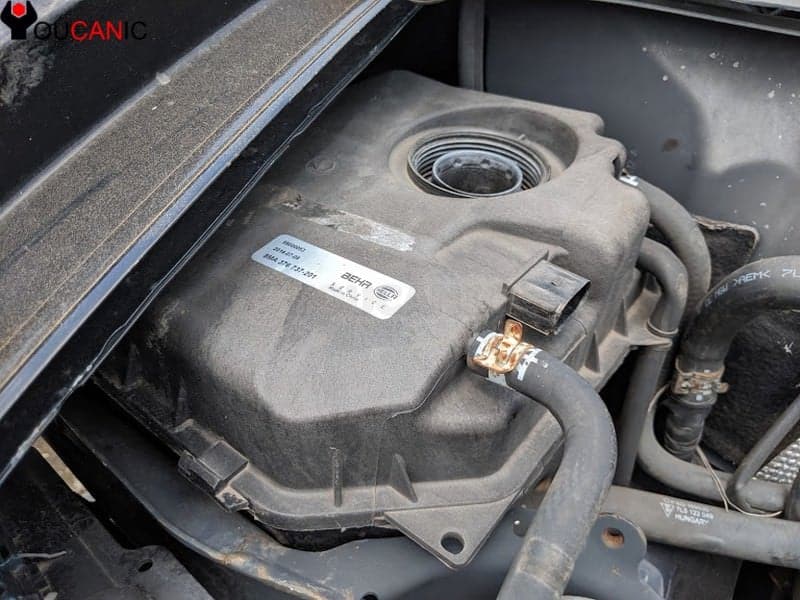
3. Locate the coolant reservoir on the passenger side of the engine. The coolant expansion tank is black.

4. Remove the black plastic trim that goes around the engine. There is a T25 Torx screw below the windshield washer fluid cap. Open the cap to access this bolt.

5. Remove the air intake pipe. Align the screw notch with the small channel. Next, pull out the screws. Once you remove both screws, you can disconnect the air inlet.

6. Unclip the metal retainers for the air filter housing.

7. Remove the air filter housing completely. There is a 10mm bolt that holds the housing to the frame

8. Use a 16mm socket to remove the torque arm bolt.

Next, remove two 16mm bolts that secure the torque arm bracket to the frame. One bolt is towards the back of the bracket.

Once you remove the torque arm bracket, you will see an exposed T30 bolt that secures the overflow tank to the frame.
9. Locate the connector that plugs into the temperature sensor. Press on the connector clip, then pull it off.

10. Disconnect all the hoses from the overflow tank. Use needle-nose pliers to release the clamps.

As you disconnect one hose at a time, keep a container nearby to collect all the coolant that comes out of the coolant tank.

On Turbo models, there is a power brake vacuum pump next to the reservoir. You will need to remove this as well. To remove the brake vacuum pump, you will need to disconnect the hose that goes to it, the electrical connector, and two 10mm bolts
11. Remove the T30 Torx screw that secures the tank to the frame

12. Disconnect the hose on the bottom of the tank.

13. Install the new coolant reservoir in reverse order. Pay close attention to the bracket on the bottom side of the tank. The new coolant tank must slide into the bracket on top of the frame.
14. Reconnect the rest of the hoses.
15. Fill with the coolant type specified for your vehicle, then bleed the air out of the system as described in your service manual. These engines trap air easily, and a vacuum fill tool makes the job much easier. Check for leaks and recheck the level after the first drive once the engine has cooled.
Applications
- 2003 Porsche Cayenne
- 2004 Porsche Cayenne
- 2005 Porsche Cayenne
- 2006 Porsche Cayenne
- 2007 Porsche Cayenne
- 2008 Porsche Cayenne
- 2009 Porsche Cayenne
- 2010 Porsche Cayenne
- 2004 to 2010 VW Touareg
- 2007 to 2015 Audi Q7 (confirm the part number for your engine)
Frequently Asked Questions
What are signs of a leaking coolant tank on a Cayenne, Touareg or Q7?
Coolant loss, a sweet smell, a wet seam on the tank, or a coolant warning are common signs.
Can I drive with a leaking coolant expansion tank?
Only short distances while keeping the level topped up. If the tank splits, coolant loss can overheat the engine quickly.
Why do these coolant tanks crack?
The plastic gets brittle with heat cycles over the years, and the seams and hose necks are the usual failure points.
Check these troubleshooting and repair guides for more help on your Porsche.