2013 to 2020 Ford Fusion Check Level & Add Brake Fluid
Reviewed/Verified by:

Need to check the fluid level and add brake fluid to your Ford Fusion? This guide is a step-by-step procedure for checking and adding brake fluid on a Ford Fusion 2013 to 2020.
At a Glance
- Vehicle: 2013 to 2020 Ford Fusion
- Fluid: The type printed on the reservoir cap
- Correct level: Between MIN and MAX with the car level
- Manual transmission: The clutch shares this reservoir
- Soft pedal: Topping up will not fix it; look for air or a leak
- Slow drop: Normal pad wear; fast drop means a leak

What you will need
- Brake fluid (DOT 4)
Procedure
Open the hood. Click here to see the step-by-step procedure for opening the hood of the Ford Fusion 2013 to 2020.

Locate the brake fluid reservoir on the driver’s side of the engine compartment near the battery.

🔧 Find out what is actually wrong before you pay someone to guess
Dealer level diagnostics at home with the YOUCANIC UCAN-II Pro.
- ✔ Covers most makes and models, including many luxury brands. Send us your VIN and we will confirm your car before you order
- ✔ Reads every module, not just the engine, so you find the faults a basic reader says are not there
- ✔ Commands the car: test a fan or pump, bleed ABS, retract an electronic parking brake, register a battery
- ✔ No subscriptions. Free lifetime updates, so the price you pay is the whole price
- ✔ Backed by real mechanics in the USA you can email before and after you buy
Featured in The Wall Street Journal
Check the fluid level in the reservoir or use a light to locate the brake fluid level. There’s an indicator written on the reservoir.

Open the cap by twisting it counterclockwise.
Before adding brake fluid, make sure that the brake fluid is completely sealed and never opened.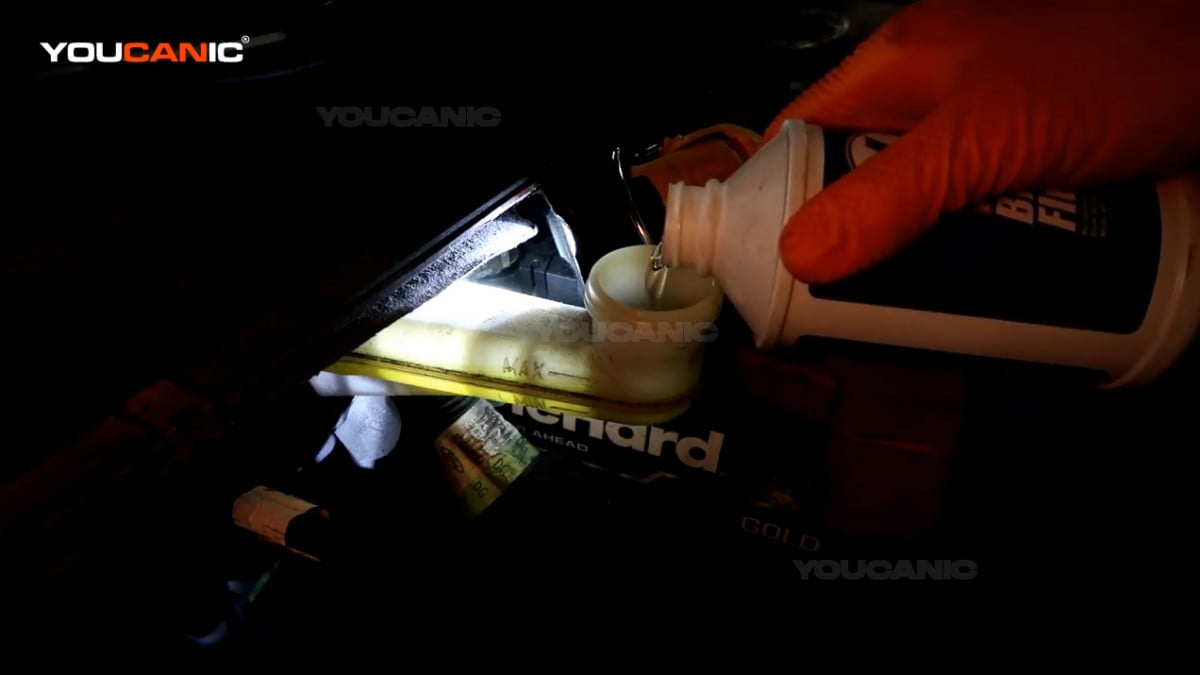
Close the cap by twisting it clockwise.
Get inside the vehicle. Start the engine and pump the brakes a few times. Do not drive if the brake pedal does not feel stiff or if the brake pedal pushes to the floor do not drive the vehicle.
Check the cap for the fluid specification
Do not assume. Ford changed specification during this model run, so earlier cars and later cars do not necessarily take the same fluid. The requirement is printed on the reservoir cap, and that is the authority rather than what a parts counter assumes from the model year. Later vehicles commonly call for a low viscosity DOT 4, sold as DOT 4 LV, which flows faster in cold weather so the stability control pump can react quickly.
DOT 3, DOT 4 and DOT 5.1 are all glycol based and mix with each other, so using a conventional DOT 4 as an emergency top up on a car specified for DOT 4 LV will get you home safely. DOT 5 is not one of them. It is silicone based, it does not mix, and putting it into this system will damage the seals. The similar numbering catches people out constantly, so read the cap and read the bottle.
Buy the smallest bottle that will do the job and use it from sealed. Brake fluid absorbs moisture from the air, and a bottle that has stood open in the garage has already taken on water, which lowers the boiling point and defeats the purpose of topping up with fresh fluid.
On a manual, the clutch shares this reservoir
This catches people out and it is worth knowing before you go looking for a brake leak that does not exist. If your Fusion has a manual gearbox, the clutch hydraulic system draws its fluid from the same reservoir as the brakes. A level that keeps dropping with plenty of pad material left can therefore be a leaking clutch slave or master cylinder rather than anything to do with the brakes at all.
The giveaway is a clutch pedal that has gone soft, sits lower than it used to, or occasionally goes to the floor, usually alongside difficulty selecting gears. Look for dampness around the clutch master cylinder on the bulkhead and on the carpet under the clutch pedal. On automatic models this does not apply, and a dropping level is either pad wear or a genuine brake leak.
A soft pedal is not fixed by topping up
Adding fluid raises the level in the reservoir. It does not remove air that is already in the lines, and air is what makes a pedal feel spongy or travel further than it should. If the pedal has gone soft, something let air in, and that something needs finding rather than topping up.
Bleeding this car properly is where it gets more involved than on an older vehicle. Air trapped inside the ABS hydraulic unit will not come out by pumping the pedal and opening bleed nipples in the usual way, because the valves and chambers inside the unit are closed during normal operation. The pump and valves have to be cycled deliberately while bleeding, and that is commanded with a scan tool.
A full system scanner that supports Ford can run the ABS bleed routine and read the brake system codes, which is the difference between a pedal that feels right afterwards and one that never quite does. The same tool is needed for the rear brakes on cars with the electronic parking brake, since those caliper pistons are motor driven and have to be retracted in service mode rather than wound back by hand.
One last thing. Brake fluid needs replacing on time rather than on mileage, typically every two to three years, because it absorbs water whether the car is driven or parked. Fluid that has gone dark brown in the reservoir is overdue regardless of how full it is, and that is a safety item rather than a maintenance nicety.
Why the level drops, and when not to top it up
Brake fluid sits in a sealed hydraulic system and is not consumed, so the level in the reservoir falls for only two reasons, and they call for opposite responses.
The normal one is pad wear. As the friction material wears down, the caliper pistons sit further out and the fluid filling the space behind them comes from the reservoir. A level falling slowly over months with no other symptom is this. Do not top it up. When new pads are fitted and the pistons are pushed back, that fluid returns to the reservoir, and one filled to maximum will overflow.
The one that matters is a leak. If the level has dropped quickly, if it keeps dropping after a top up, or if the pedal feels soft, travels further than it used to or sinks slowly toward the floor, the system is losing fluid or has air in it. Topping up hides the warning without fixing anything and the system will empty again. Find the cause before driving the car.
Frequently Asked Questions
What brake fluid does a Ford Fusion use?
Use the fluid type printed on the reservoir cap. Do not mix fluid types.
Where is the brake fluid reservoir on a Ford Fusion?
On top of the brake master cylinder near the firewall on the driver’s side of the engine bay.
Why is my Fusion brake fluid low?
A slow drop is normal as pads wear. A fast drop or wet spots near a wheel mean a leak that needs repair.
Will adding brake fluid fix a soft pedal?
No. A soft pedal comes from air in the system or a leak, which must be found and fixed.