
Nissan Intelligent Forward Collision Radar Sensor Replacement
Reviewed/Verified by:

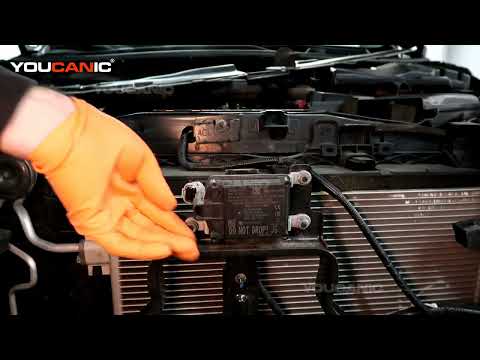
Budget for the calibration before you buy the sensor. A forward collision radar has to be aimed after fitting, and a badly aimed radar is worse than a missing one, because the car will brake on what it thinks it sees. The sensor sits at the front of the radiator behind the grille, held by three 10 mm bolts, and reaching it means removing the bumper or the grille.
At a Glance
- Fits: 2017 to 2023 Nissan Rogue Sport with Intelligent Emergency Braking.
- Access: remove the front bumper or grille; the sensor is held by three 10 mm bolts.
- The new sensor must be programmed and aimed with proper targets and a scan tool.
- Until it is aimed, emergency braking and radar cruise may not work or may act wrongly.
- Check first for a dirty or blocked sensor cover; that also sets this warning.
- A scanner such as the YOUCANIC UCAN-II Pro reads Nissan driver assist codes; check its coverage for radar aiming on your model.
What you will need
- Nissan Rogue Sport Intelligent Forward Collision Sensor
- Mechanic Metric Toolset
- 10mm Socket
Procedure
- Remove the front bumper or the front bumper grille to access the intelligent forward collision sensor. If you need help with this step, follow this tutorial for removing and installing the front bumper.

Disconnect the sensor’s electrical connector by pressing the clip and pulling the connector out.
Remove the three 10mm bolts holding the sensor by turning them counter-clockwise using a 10mm socket.

🔧 Find out what is actually wrong before you pay someone to guess
Dealer level diagnostics at home with the YOUCANIC UCAN-II Pro.
- ✔ Covers most makes and models, including many luxury brands. Send us your VIN and we will confirm your car before you order
- ✔ Reads every module, not just the engine, so you find the faults a basic reader says are not there
- ✔ Commands the car: test a fan or pump, bleed ABS, retract an electronic parking brake, register a battery
- ✔ No subscriptions. Free lifetime updates, so the price you pay is the whole price
- ✔ Backed by real mechanics in the USA you can email before and after you buy
Featured in The Wall Street Journal
Remove the sensor by pulling it out from the vehicle.

Line up the new intelligent forward collision sensor and install the three 10mm bolts by turning them clockwise using the 10mm socket.

Reconnect the sensor’s electrical connector by pushing it towards its connection port.
The radar sensor mounted at the front of the radiator (behind the grill) will require programming and calibration to work correctly.
The sensor must be aimed after fitting
This is the part the job lives or dies on. A forward collision radar has to be aimed with the correct target at a measured distance and height, using diagnostic equipment that puts the module into its alignment routine. Bolting a new one on and driving away leaves it pointing slightly wrong, and a radar that is a fraction of a degree out either misses a car ahead or reads a roadside object as an obstacle and applies the brakes when nothing is there. If you do not have access to alignment equipment, fit the sensor and have the aiming done before relying on the system.
Plan for the calibration before you buy the part
Calibration needs a level floor, specific clearance around the car and a correctly positioned target, which is why most independent shops subcontract it. Find out what that costs locally before deciding whether this is a job worth doing yourself, because on some cars the alignment is a larger share of the bill than the sensor.
Check it is really the sensor first
These radars are expensive and frequently replaced when nothing was wrong with them. A blocked radar is by far the most common fault: packed snow, ice, mud, a thick coat of road salt, or an aftermarket number plate, badge or bumper trim sitting in front of it will all trigger the warning. So will a bumper repaired with metallic filler over the radar area. Clean the grille area and read the fault code before ordering, because blockage detected and misalignment both read very differently from a failed sensor.
Bumper work means recalibration too
If the front bumper has been removed, repaired or replaced at any point, the radar behind it needs aiming again even though the sensor itself was never changed. A collision warning fault that appeared right after body repair is usually this, and it is worth raising with the shop that did the work rather than buying parts.
The calibration decides whether this is yours to do
The page above says to plan for the calibration before you buy the part, and that is the whole decision in one sentence. A radar unit that is fitted but not correctly aimed is worse than one that was left alone, because the car will trust a sensor that is pointing at the wrong place. Aiming these often requires specific target equipment and a measured setup, not just a tool plugged into the port.
So establish the calibration route first. Email support with your VIN and tell us the sensor you are replacing, and we will tell you honestly whether this ends with a handheld tool or with a shop that has the targets. We would rather lose the sale than have you fit a safety sensor that cannot be aimed. And before any of that, confirm it really is the sensor, since a dirty or misaligned emblem area and a wiring fault both mimic a failed radar.
Frequently Asked Questions
Can I drive with the forward collision warning unavailable?
Yes, the car drives normally, but automatic emergency braking and the warning will not work. Keep a longer following distance until it is repaired.
Why does the warning come on in snow or heavy rain?
Snow, ice, mud or heavy rain on the radar cover can block the sensor. The warning usually clears once the cover is clean and the weather improves.
Does a used radar sensor work?
Only if it is the correct part number, and it still needs aiming and often programming to your car. An unaimed sensor can brake for the wrong objects or miss real ones.


