
Brake Light Switch | Symptoms | Diagnostics
Reviewed/Verified by:

The brake light switch on modern vehicles is no longer a simple switch for turning on the brake lights. It is connected to many different systems in your car, meaning that a bad brake light switch can trigger the ABS and traction control lights, and can also prevent the engine from starting or the transmission from shifting.
At a Glance
- Brake lights stuck on or never on are the classic sign.
- It also feeds the shift interlock, push button start, cruise control and stability systems.
- A bad switch can turn on ABS and traction control lights or stop the car leaving Park.
- Most are above the brake pedal arm; some VW and Audi models use a sensor on the master cylinder.
- Check the switch fuse and live data before replacing it.
This article reviews and tests the symptoms of a bad brake light switch. One of the switch’s key functions is to turn the brake lights on and off when the brake pedal is pressed. A faulty brake light switch can also cause the ABS and traction control lights to turn on.

What does the brake switch do?

In modern vehicles, the brake switch signal is also used to:

🔧 Stop paying the dealer for every warning light
Get dealer level diagnostics at home with the YOUCANIC Full System Scanner.
- ✔ Works with all makes and models, including most luxury brands
- ✔ Topology map view shows all vehicle modules on one screen for faster diagnostics
- ✔ Bi directional controls to test fans, pumps, actuators and more so you do not have to guess
- ✔ Special resets and calibrations such as ABS bleed, EPB service, battery registration and more
- ✔ Free lifetime updates with no recurring fees
- Release the automatic transmission shifter from park.
- Allow the engine to start.
- Use the brake system to assist in emergency braking.
On most vehicles the brake light switch is mounted above the brake pedal arm, which makes it easy to reach. Some newer Volkswagen and Audi models use a Hall effect sensor on the brake master cylinder in the engine bay instead.
What are the symptoms of a bad brake light switch?

Problems and symptoms that a bad brake light switch can cause include:
- The brake lights stay on when the car is off.
- The gear selector cannot be moved out of Park into R, N, or D.
- The brake lights are not working.
- The car cannot be started. The brake pedal must be pressed to start the engine.
- Cruise control doesn’t work.
- The ABS or Traction Control light comes on when driving
A faulty brake light switch could cause one or more of these issues.
How to check if the brake light switch is bad?
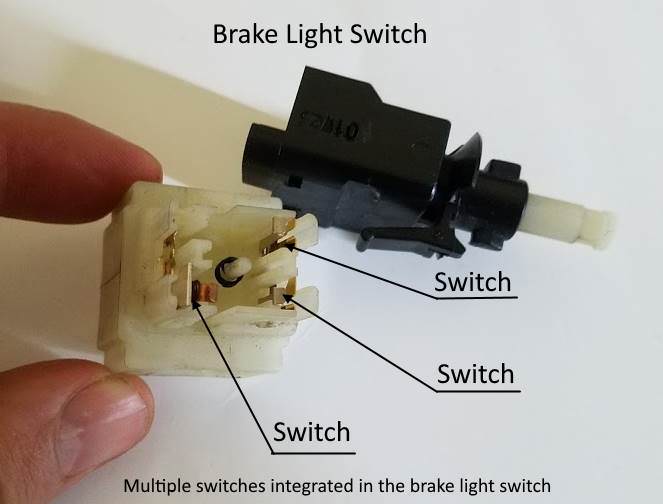
By only pressing the brake pedal and checking the brake lights, you won’t be able to determine if the brake light switch is defective in modern vehicles. This test can be misleading. The brake light switch has several contacts, as shown in the picture above. The brake lights may still work properly, but the brake light switch may still be defective, requiring replacement.
A better way to check for a faulty brake light switch is to remove it from the brake pedal and check for continuity. Sometimes, you will need the brake light switch diagram, which may be printed on the switch itself. Most brake light switches could have up to six pins.
Use a multimeter and set it to ohms. Probe one of the pins with the multimeter’s negative and positive sides touching each pin on the brake light switch. At least one of the pins should have a continuity reading of zero. If there is no reading, the brake light switch is open and is faulty.
If the brake lights are working properly, test the brake light switch power. Find the wire connector that connects to the brake light switch. Use a voltmeter and probe the area of the power source. The brake pedal stopper can also contribute to the brake lights staying on. There is a brake light stopper that prevents the switch from turning the brake light on when the pedal is not pressed.
Over time, this stopper can wear out or become loose. When this happens, the brake light will be on at all times. This problem can often be fixed by adjusting the position of the brake light switch. Most brake light switches allow for slight adjustments to accommodate normal wear.
When you adjust the brake light switch, ensure it is pressed against the brake light stopper. If the stopper is missing, replace it before replacing the entire switch.
How do you replace a brake light switch yourself?

Replacing a brake light switch is an easy job that can be done by almost anyone, whether you have experience fixing cars or not. The brake light switch is mounted above the brake pedal, close to the pivot area. Battery power is fed to the brake light switch from the ignition switch or the Engine Control Unit (ECU). When the brake pedal is pressed, it closes the switch, allowing electricity to flow through the wiring to the brake lights.
This turns on the rear brake lights. The brake light switch can also be located on the master cylinder. Hydraulic pressure from the master cylinder brake light switch system can close the switch to turn on the brake lights. For example, a Honda brake light switch is held in place by a nut. First, start by disconnecting the connector.
Next, remove the nut and turn the brake light switch counterclockwise. This should remove the brake light switch. On GMC vehicles, the brake light switch is normally held in by a “c” clip. Disconnect the battery for safety, disconnect the brake light switch connector, and remove the “c” clip. Be careful not to break the “c” clip.
If you replaced the brake light switch and are still experiencing problems, here is what you should do next:
- Adjust the Brake Light Switch (if there is room.)
- Brake Light Fuse
- Brake Light Stopper / Bumper Pad
- Brake Light Wire Harness
Please note that a bad brake light switch can drain your battery if the light stays on, and also decrease your rear brake light’s lifespan.

Check for a Brake Light Switch Recall
Before you buy a switch, run your VIN at nhtsa.gov/recalls. Two of the largest brake light switch recalls ever cover millions of Hyundai and Kia vehicles, and the dealer replaces the switch free:
| Recall | Vehicles | Size |
|---|---|---|
| 13V113 | 2006 to 2011 Hyundai Accent, Azera, Elantra, Elantra Touring, Entourage, Genesis, Genesis Coupe, Santa Fe, Sonata, Tiburon, Tucson and Veracruz | About 1.71 million vehicles |
| 13V114 | 2007 to 2011 Kia Amanti, Borrego, Forte, Optima, Rondo, Sedona, Sorento, Soul and Sportage | About 980,000 vehicles |
A faulty switch on these cars can leave the brake lights off, keep the cruise control from disengaging, stop the shifter from leaving Park, cause intermittent push button start problems and turn on the ESC warning light.
Most brake light switches have two circuits, not one
On most vehicles built in the last twenty years the switch contains two sets of contacts that work in opposite directions. One closes when you press the pedal and the other opens at the same moment. The control modules compare the two, because a switch that could only fail in one direction would be impossible to diagnose safely.
This is why a failing switch so often sets a stored code such as a brake switch correlation fault rather than simply killing the lights. It also explains the symptoms that look unrelated to braking: with the two circuits disagreeing, the module cannot be certain whether your foot is on the pedal, so it disables cruise control, refuses to release the shifter and may switch off the traction control. Replacing the bulbs or the fuse will not touch any of that.
The fastest test is live data
Rather than removing the switch and checking continuity on the bench, watch the brake switch parameter in live data while someone presses and releases the pedal. The reading should change from off to on the moment the pedal moves and change back cleanly when it is released. A reading that flickers, lags, or stays on with the pedal up identifies the fault in under a minute and confirms the signal is actually reaching the module rather than stopping at the switch.
A full system scanner shows that parameter along with any stored brake switch codes in the engine, transmission and ABS modules, which is useful when the only symptom is a warning light and the brake lights themselves work normally.
What it costs and when to just adjust it
The switch itself is one of the cheaper parts on the car, typically in the region of fifteen to fifty dollars depending on the make, and a shop will usually charge around half an hour of labor because it is reached from under the dash without removing anything major. Luxury models with an integrated pedal position sensor cost considerably more, so check the part number before assuming.
Before spending anything, check the adjustment and the rubber stopper on the pedal bracket. That stopper crumbles with age on a great many cars, and when it falls out the pedal rests a few millimeters further back than it should, leaving the switch permanently closed and the brake lights permanently on. A replacement stopper costs a few dollars and fixes a fault that is frequently misdiagnosed as a failed switch.
Do not leave this one for later. Brake lights are the only warning the driver behind you gets, and a car whose brake lights never come on, or never go off, is a collision risk as well as a failed inspection.
Related Guides
- Volvo Bad Brake Light Switch Symptoms Replacement
- How to Test your Brake Light Switch using a YOUCANIC UCAN-II Pro scanner
- BMW Brake Light Switch Replacement Guide
Frequently Asked Questions
How do you know if the brake light switch is bad?
A brake light switch may be faulty if your brake lights don’t work. Suppose the automatic transmission lever is stuck in park. The car may also not start because, in automatic transmission vehicles, the car needs to detect that the brake pedal is pressed. If the brake light switch is bad, the Engine Control Unit (ECU) will think you are not pressing the brake pedal, not allowing you to start the car. All cars have a manual Park release for the automatic transmission. If the brake light switch is bad, you may experience one or more of these symptoms. Pressing the brake pedal and looking if the brake lights turn on and off is not a good test to determine if the brake light switch is bad, especially on newer vehicles.
I replaced the brake light switch, but my lights keep burning out or staying on.
This problem is often caused by a short in the tail light assembly. The shorts may also be in the wire harness. Shorts can develop inside the tail light, or the wire harness has a short where the trunk hinges to the car. Another possibility is the brake light housing (typically negative) shorting to any metal parts in the trunk.
How much does it cost to replace the brake light switch?
Normally, the brake light switch does not cost much. Usually, it ranges from $30 to $100 for most vehicles, and the labor usually ranges from $50 to $300 depending on the shop rate, flat rate, and job difficulty.
How long does it take to fix a brake light switch?
The job usually takes 10 minutes to 2 hours to replace on most vehicles. However, in some vehicles, the brake light switch can be placed in an inconvenient location, requiring removing several components. This will increase the cost of the job. Be sure to replace the brake switch as soon as possible.