Death Wobble on a Ford Super Duty F550: Big Fix Tips
Contributed by:

Today, our shop’s rollback tow truck started doing the death wobble. If you have never heard of the death wobble, it happens when a big bump or pothole knocks something loose in a vehicle’s suspension, making the wheels shake back and forth until you come to a stop or very close to it. One moment, you’ll be driving down that road, and the next, the steering wheel is shaking you around like a rag doll until the vehicle gradually slows down. To visualize what is going on in the suspension, picture a Newton’s cradle.

The same effect that knocks the ball on the other side echoes back and forth between the sides of your suspension until you take all the energy out of the system by slowing down. Imagine a little bit of looseness in one of these connections in your suspension that gets reverberated across the track and steering bars from side to side.

The first step in finding the cause of a death wobble (on Jeeps and other trucks as well) is to look for any loose components in the suspension. You can do this a couple of different ways.

🔧 Stop paying the dealer for every warning light
Get dealer level diagnostics at home with the YOUCANIC Full System Scanner.
- ✔ Works with all makes and models, including most luxury brands
- ✔ Topology map view shows all vehicle modules on one screen for faster diagnostics
- ✔ Bi directional controls to test fans, pumps, actuators and more so you do not have to guess
- ✔ Special resets and calibrations such as ABS bleed, EPB service, battery registration and more
- ✔ Free lifetime updates with no recurring fees

Jack up one side of the car, and with your hands on the 3 and 9 o’clock positions of the tire, move it back and forth. If you feel any wiggling or play, have an assistant move the tire back and forth while you look at the tie rod end on the inside. If you can see the knuckle moving independently of the tie rod, you know the ball joint in the tire rod end is loose and needs to be replaced. Do this to both sides.

In addition to looking at the tie rods, you need to look at all the joints in the steering system, like the pitman arm. If you notice anything loose, it needs to be replaced to eliminate all play from your steering system.
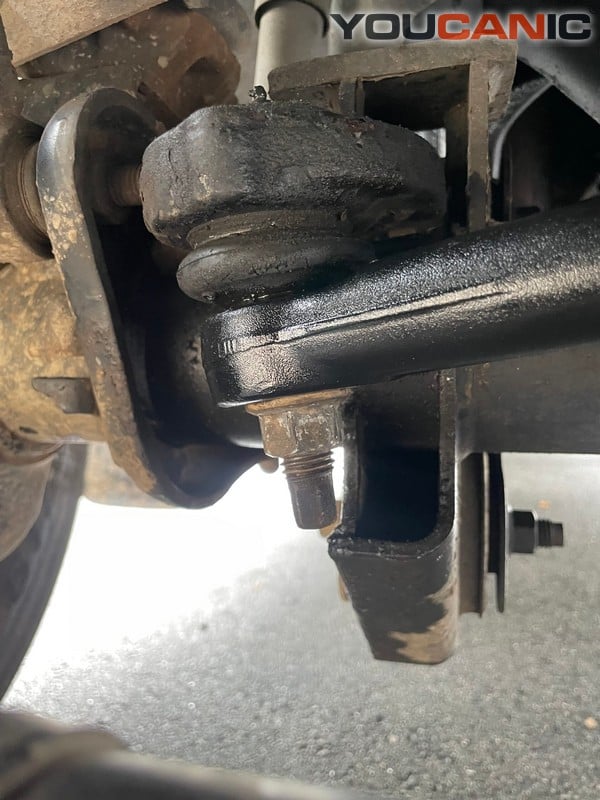
Another way to find anything loose is with both wheels on the ground. Have an assistant slowly turn the steering wheel back and forth. While they are turning the wheel, look under the truck for any bushings or connections in the suspension.

This is how I figured out my problem. While someone was turning the wheel, whenever he reversed directions, I could see that the bushing where the track bar connects to the frame would move slightly in its mounting bracket. We also had a loose tie rod end. We replaced the tie rod end, and the track bar got it aligned, and boom. Problem solved.


A couple of additional notes:
1) Alignment is key after doing any repairs in the suspension. The first step is to identify any loose components and replace them, and then align the system. You may feel that you lined everything back up perfectly, but a truck that is out of alignment is a time bomb for the death wobble. Even if you don’t find anything loose, it is important to get your truck aligned. That will either fix the problem or the shop might be able to find something loose as they were trying to make adjustments.

2) Always check the steering damper. It’s normally just two fasteners on either end that can be easily removed. Verify that it closes and opens smoothly, with the appropriate resistance. It’s somewhat unlikely that this causes the death wobble, but if a truck has been experiencing the death wobble often, it can damage the damper.