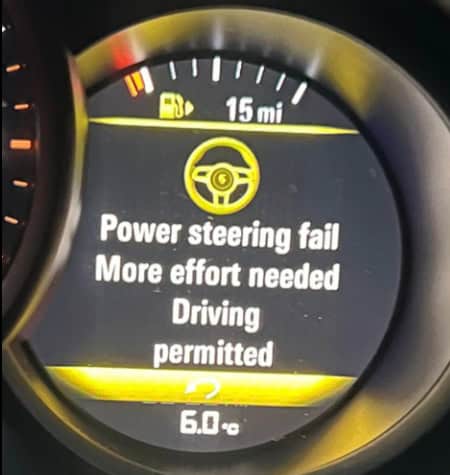
When the “Power Steering Fail Increased Effort Driving Permitted” warning message appears on your Porsche, it means there is an issue with the Power Steering System, which can lead to steering failure, making it harder to steer, increasing the risk of accidents.
What Does the Power Steering Fail More Effort Needed Driving Permitted Mean?
The Power Steering System is designed to make steering easier. Modern Porsches are equipped with either hydraulic or electric power steering systems, with most vehicles using the latter. When a Power Steering Failure warning message appears on your dashboard, the power steering system is faulty.
⚠️ Why You Should Fix It As Soon As Possible:
Safety Risk – When the power steering system is in an error state, it can make it harder to steer, especially on sharp turns. If not addressed as soon as possible, this problem could result in an accident.
Performance Issues – The steering wheel will feel heavy, or the car may pull to one side when driving.
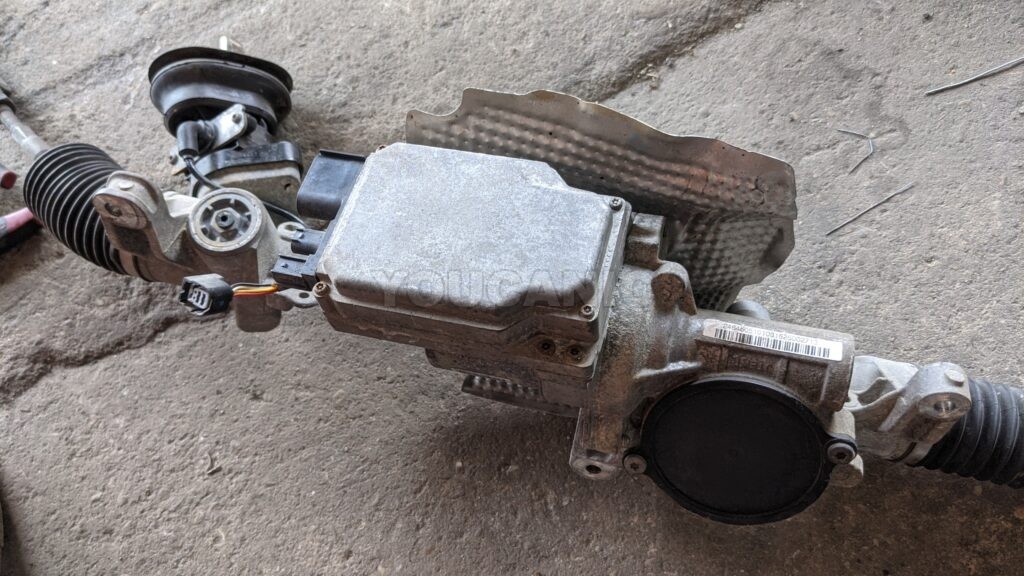
Costly Repairs if Ignored – The warning message may indicate a potential failure in one or more components of the Power Steering System. This could involve the Electronic Power Steering Motor, Steering Control Module, Steering Rack and Pinion, Steering Column, or, in the case of Porsches with hydraulic power steering, the Power Steering Pump. Repairing the steering module or motor can cost approximately $3,000, while replacing the steering rack, including labor and diagnostic fees, may range from $5,000 to $7,000.
Common Causes
Here are the most common reasons this light appears:
⚠️ Weak Battery: Low voltage can cause odd system errors and unexpected warning lights. There are many Porsche owners, especially those who own Cayman and Macan models, who have had warning messages appear after their batteries have drained.
⚠️ Faulty Steering Wheel Angle Sensor: The steering wheel control module may disable power steering if it receives system errors and inaccurate data from a failing steering wheel angle sensor.
⚠️ Loose or Corroded Wires: Bad connections, peeling harnesses, and corroded wires to your sensors and modules can cause intermittent faults.
⚠️ Software glitch: Outdated software, software glitches, and bugs can cause errors in the system. Newly replaced steering racks and other system components that are not coded and calibrated will throw errors.
⚠️ Defective Clock Spring: A defective clock spring affects the steering wheel controls and the communication between the steering angle sensor and the steering module.
⚠️ Low Fluid Levels: If your Porsche has a hydraulic power steering system, low power steering fluid may make your steering feel stiff, as it cannot produce enough pressure to move the steering racks through your tie rods, moving your front wheels.
⚠️ Malfunctioning Module: A bad ECU or Steering Wheel Control Module could trigger false alerts, disabling your Power Steering System.
⚠️ Defective Steering Rack: The steering rack is a mechanism that translates steering inputs to directional outputs given to the front wheels. If this mechanism experiences a malfunction, such as internal wear or leaks, it can lead to system resistance, resulting in inconsistencies with the steering angle sensor. This failure may prompt a warning message to be displayed on the dashboard.
⚠️ Misaligned Front Wheels: The steering angle sensor may detect incorrect wheel positioning in accordance with the steering input, disabling power steering.
⚠️ Under-inflated tires: Under-inflated tires can impact your vehicle’s steering capabilities. Low pressure increases friction and can make turning more challenging.
⚠️ Defective Steering Column: The issue can sometimes originate from the steering column. Factors like wear and tear or insufficient lubrication within the steering column mechanism can result in a stiff steering wheel.
⚠️ Defective Electronic Power Steering (EPS): A failure in the EPS causes a loss of power steering, resulting in stiff steering that is hard to turn, particularly at low speeds or when stationary.
⚠️ Defective Power Steering Pump: For Hydraulic Power Steering Systems, the power steering pump circulates fluid throughout the system. If the component is damaged or malfunctioning, it may not produce enough pressure, resulting in a stiff steering wheel.
⚠️ Not using the Porsche enough: Leaving your Porsche parked for an extended period of time without running the engine can drain the battery when you use your Porsche, the alternator charges and keeps the battery at a healthy voltage. The battery also consumes power while parked, especially with Porsches equipped with the Operational Readiness feature. Batteries can also quickly lose their charge when the vehicle is only used for short trips or when the engine is run for only a few minutes. This will not charge the batteries enough and cause the battery to be at a low voltage level.
🛠️ Pro Tip: Use an OBD-II scanner to check for error codes related to the issue.
Troubleshooting & Fixes for Power Steering Fail Increased Effort Driving Permitted
Before taking your car to a mechanic, try these DIY fixes:
Check Battery Health—Use a battery tester, multimeter, or scanner to check for low voltage (below 12.4V). If your Porsche’s voltage is low, it could be a sign that it is time for a battery change. Batteries degrade over time and need to be replaced every 3-5 years. If your car is still struggling to keep a charge after a battery change, your alternator could be the problem.
Top-Off Fluids – For systems with hydraulic power steering, check the power steering fluid level and quality. If the level is low, top it off using the correct power steering fluid. Check with your owner’s manual to make sure you are using the correct fluid type. If the fluid looks dirty, take your Porsche to a dealership or trusted mechanic to have the power steering reservoir flushed.
Look for leaks: Inspect your vehicle for any signs of fluid leaks. For a system with hydraulic power steering, check for leaks beneath the steering pump, around the power steering tank, and around the steering racks.
Check the tire pressure: To find tire pressure specifications for your vehicle, check the tire pressure label on the inside of the driver’s door or your owner’s manual.
Reset the System – If the warning light or error message was caused by a glitch in the system, it can be cleared by disconnecting the battery for 30 minutes or using a scan tool. The steering wheel inputs can also be reset by turning the steering wheel to the right, then holding for three seconds, and turning all the way to the left, then holding for three seconds.
Use an OBD-II Scanner – Read and clear error codes to see if the issue is temporary.
Common OBD-II Fault Codes for the “Power Steering Fail Increased Effort Driving Permitted” warning message
If you scan your vehicle with an OBD-II scan tool, you may see one of these codes:
C10AD29 – power steering control unit faulty
B2000049 – power steering control unit faulty
B116854 – Steering-angle sensor not calibrated
FAQs
Can I still drive with the Power Steering Fail Increased Effort Driving Permitted warning on?
➡️ It is risky to Operate the vehicle without power steering, especially on slippery roads. Defective power steering can also affect other vital systems, such as the Lane Keep Assist and the ESC. The risk of collision increases because power steering issues typically make it incredibly hard to steer, making quick reactions and sudden swerving difficult. If you want a better and safer driving experience, consider addressing the issue immediately.
How do I reset the Error Message?
➡️ Disconnecting the negative terminal for 30 minutes, using an OBD-II scanner to erase fault codes due to temporary glitches, or driving the vehicle for a few minutes and switching it off and on might solve the warning message. You can also try turning the steering wheel to the right, holding it for three seconds, and then turning it entirely to the left and holding it for another three seconds. This will recalibrate the steering angle sensor.
What happens if I ignore this warning?
➡️ Ignoring the warning message can lead to power steering failure and excessive component wear, leading to costly repairs. Other systems that rely on the Electronic Power Steering (EPS) may be affected, such as the Lane Keep Assist and Adaptive Cruise Control, adding to the cost of repairing the Power Steering System.
Do I need a mechanic, or can I fix this myself?
➡️ You can first try the troubleshooting procedures stated in this article. These procedures, like resetting the system and performing visual checks, are easy for most owners and mechanics to follow. If the warning message persists, your trusted mechanic or dealership can perform the job, especially if your Porsche is still under warranty, as repairing Porsche’s Power Steering System can be very expensive.
Final Thoughts
Problems with the power steering system should never be ignored, as reduced steering power could lead to an accident. Following these troubleshooting steps and scanning for fault codes can save time and money while ensuring your car remains safe and reliable.
Experts Who Contributed to This Article
Antonie Labasan
Diagnostic Specialist
Antonie Labasan is a Registered Mechanical Engineer and Lean Six Sigma Blackbelt who brings practical automotive expertise to our diagnostic guides. With specialized training at VOLVO and years of experience managing diverse vehicle fleets including Toyota, Hyundai, and Kia models, Antonie understands common failure points across different manufacturers. His systematic approach to diagnostics helps readers identify and fix the true source of automotive problems, making his YOUCANIC scanner guides exceptionally effective for DIY mechanics.
rhila, ASE Certified
Diagnostic Specialist15+ years of experience
Rushit Hila is a dedicated automotive engineer with ASE G1 certification and specialized training from an esteemed Automotive Specialty School. His hands-on experience and technical expertise in advanced diagnostics, system integration, and performance optimization make him a trusted voice in the industry.
Searching...
33% OFFFlash Sale — Ends Soon
⭐⭐⭐⭐⭐ 4.8 stars · 247 Verified Reviews
Stop paying $150 every time a warning light comes on.
The UCAN-II-D gives you full system diagnostics, bidirectional controls, and lifetime free updates. One scanner. Own it forever.
Was
$750
→
Now
$499
Save $251
+ Free shipping · No subscription ever
Free lifetime updates included — no annual fees ever