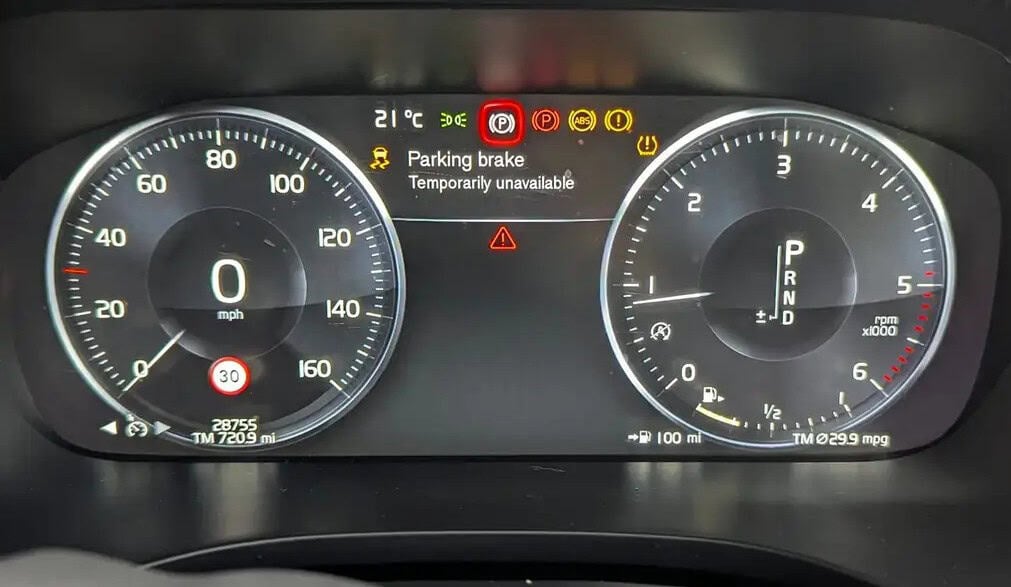
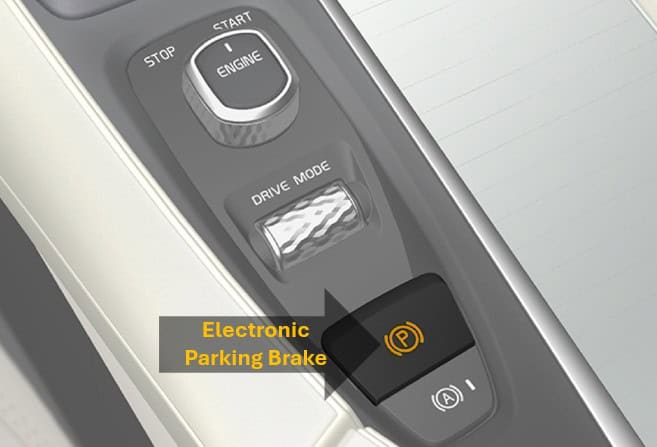
When the “Parking Brake Temporarily Unavailable” warning message comes on in your Volvo, it means there is an issue with the Electronic Parking Brake (EPB) system that requires attention. Ignoring this warning will increase the risk of accidents when parked, especially in sloped areas. It is essential to diagnose and address the issue as soon as possible.
What Does the Parking Brake Temporarily Unavailable Message Mean?
The Electronic Parking Brake (EPB) is one of your vehicle’s safety features and is responsible for keeping it stationary when it is not running. If an error message appears, it means there is an issue with the Electronic Parking Brake (EPB) or the systems connected to it, and it will not function properly, putting your vehicle at higher risk of an accident.
⚠️ Why You Should Fix It As Soon As Possible:
Safety Risk -A faulty EPB can increase the risk of an accident when parking or while the vehicle is parked.
Performance Issues – A malfunctioning EPB may cause reduced power output, as the brakes could remain partially engaged.
Costly Repairs if Ignored – Ignoring the issue may lead to premature brake wear, damage to the braking system, and potential harm to other components. In severe cases, it can result in a vehicle breakdown, preventing it from moving.
Estimated Repair Cost – Repair costs range from $750 to $1,500, excluding towing fees.
Common Causes
Low Battery – A weak battery cannot provide enough energy for the vehicle’s electrical components to operate correctly, leading to several possible electrical problems. Test the 12-volt battery if it is over 3 years old and replace it if necessary.
Blown Fuse or Faulty Relay – Fuses and relays are electrical safety devices that protect components from short-circuiting. If one fails, the system it is connected to may stop functioning.
Faulty Wiring – Loose, corroded, burned, or damaged wires or connectors can cause electrical components to fail.
Faulty Electronic Parking Brake Motor – A malfunctioning parking brake motor may prevent the brake pads from properly engaging or releasing, compromising vehicle safety.
Worn Brake Pads and Low Brake Fluid Level – Worn brake pads and insufficient brake fluid can reduce stopping power, making it difficult to hold the vehicle in place and potentially causing unintended movement.
Faulty Electronic Parking Brake Button – A defective button may fail to signal the system, causing the brake to remain in its last position.
Faulty EPB Module – Electronic Parking Brake Module (EPB Module) – This dedicated control unit manages all electronic parking brake operations and generates warning messages.
Brake Control Module (BCM) – On many Volvo models, this module works with the EPB module to coordinate parking brake functions.
Central Electronic Module (CEM) – Communicates with the parking brake system and displays messages on the dashboard.
🛠️ Pro Tip: Use an OBD-II scanner to check for error codes related to the issue.
Common Symptoms
Electronic Parking Brake (EPB) Message or Malfunction Indicator Light On – If the system detects a fault in any component, it will display a warning message or activate the malfunction indicator light on the dashboard.
Brakes Not Engaging – The vehicle may move while parked, even after engaging the EPB button.
Brakes Stuck in the Engaged Position – A stuck brake motor may prevent the vehicle from moving or cause it to move slowly.
Unusual Noise When Braking or Driving – Strange sounds may indicate friction or issues in the braking system.
Troubleshooting
Before taking your car to a mechanic, try these DIY fixes:
Check Battery Health – Use a battery tester, multimeter, or scanner to check for low voltage. The battery must be replaced or recharged if the voltage reading is below 12.4 volts. If, after a battery replacement, you are still experiencing performance issues, check your alternator, as this may be the problem.
Inspect Wiring & Connections – Look for loose or frayed wires around the battery and alternator.
Inspect Fuses – look for damaged or melted fuses in your vehicle’s fuse box. This could be an indicator of an electrical issue in your car. ONLY REPLACE OLD FUSES WITH NEW ONES OF THE SAME AMPERAGE.
Inspect sensors for dirt and damage – Sensors can become damaged or dirty over time. Check the sensors around your vehicle, specifically your wheel speed sensors, for dirt, water damage, or loose wiring, as this might be the reason for the problem.
Use an OBD-II Scanner – Read and clear error codes to see if the issue is temporary. When diagnosing a Volvo’s “Parking Brake Temporarily Unavailable” message, you should primarily scan the Electronic Parking Brake (EPB) Module, which directly controls parking brake functions and stores the most relevant fault codes. Additionally, check the Brake Control Module (BCM) for brake-related codes and the Central Electronic Module (CEM) for system communication issues. Perform a complete system scan rather than checking individual modules, as parking brake problems can stem from issues across multiple systems.
Reset the System – If a glitch causes the warning light/error message, it often can be cleared by disconnecting the battery for 30 minutes or using a scan tool. Need a little help finding diagnostic trouble codes related to your parking brake? Watch our YouTube video, and diagnose your Volvo like a pro!
Can the vehicle still be driven with a faulty EPB button and brake motor?
➡️ Yes, but only if the brakes are stuck engaged. However, visiting a workshop as soon as possible is recommended to diagnose the issue and prevent further damage. The EPB is part of the braking system and is essential for vehicle safety.
Can I park my vehicle if the EPB is not engaging?
➡️ Yes, you can park your vehicle using wheel stoppers (e.g., large stones or sturdy wood) to secure it in place. Ensure the transmission is in the ‘P’ (Park) position.
Is there a way to release the EPB if the battery is discharged?
➡️ Yes, you can manually release the brake motor by removing the rear brake calipers or feeding 12v to the parking brake actuators for about 3 seconds. This method is typically used in emergencies, especially when towing. However, replacing a battery to release the EPB is a better option.
Why does the EPB fail?
➡️ The EPB may fail due to incorrect brake replacement procedures, improper calibration, or electronic malfunctions caused by low voltage or worn-out buttons due to aging.
Can the EPB be engaged while driving?
➡️Yes, the EPB can be engaged while driving by holding the button for 2 to 3 seconds, depending on the vehicle (refer to your owner’s manual). This is typically done in emergencies, such as when the hydraulic brake system fails.
Final Thoughts
The “Parking Brake Temporarily Unavailable” warning is more than just an inconvenience—it’s a critical alert that requires prompt attention to ensure your safety and prevent further damage. By addressing the issue early—whether through basic troubleshooting or professional diagnostics—you can avoid costly repairs and maintain the reliability of your Volvo’s advanced systems. Prioritizing the health of your Electronic Parking Brake not only safeguards your vehicle when parked but also contributes to its long-term performance and peace of mind on the road.
Experts Who Contributed to This Article
Elbert Nonog, Automotive National Cert., BS Mechanical Eng.
Diagnostic Specialist13+ years of experience
Elbert G. Nonog is an Automotive Technical Writer and Training Manager with over 10 years of experience across major brands including Chevy, MG, Ford, Volkswagen, and Toyota. Rising from technician to leadership roles, Elbert excels at transforming complex automotive concepts into accessible training materials and documentation. His expertise spans conventional and electric vehicle systems, nationwide dealership training, and aftersales operations management. With TESDA certification and pursuing further education from the Technological University of Philippines, Elbert effectively bridges the gap between automotive engineering and practical application for industry professionals and enthusiasts.
rhila, ASE Certified
Diagnostic Specialist15+ years of experience
Rushit Hila is a dedicated automotive engineer with ASE G1 certification and specialized training from an esteemed Automotive Specialty School. His hands-on experience and technical expertise in advanced diagnostics, system integration, and performance optimization make him a trusted voice in the industry.