Mercedes Airbag Module Replacement: When You Need It, Coding and Cost
Reviewed/Verified by:

The Mercedes airbag module, properly the SRS or restraint system control unit, is the computer that decides when to fire the airbags and seat belt tensioners. It rarely fails on its own. It needs replacing or resetting in three situations: after a crash that deployed airbags or tensioners (the unit stores crash data and will not arm again), when it fails internally, or when a recall calls for it. If your SRS light came on without a crash, read the codes first. A seat connector, an occupant sensor or a buckle switch is far more likely than the module.
At a Glance
- What it is: the SRS control unit. On the W211 E-Class in our photos it sits under the ashtray in the center console, held by three T30 Torx bolts.
- Replace or reset it when: airbags or tensioners deployed, the unit has an internal fault, or a recall applies (2008 to 2009 C-Class and 2010 GLK under recall 15V-711).
- Check first: most SRS lights on undamaged cars come from seat connectors, the passenger occupant sensor, buckle switches or the clockspring.
- Never fit: a module from a different model. Mercedes recalls show the wrong parameter set changes how airbags fire.
- After fitting: a new unit needs initial startup and coding with XENTRY, with a charger holding the battery above 12.5 V.
- Cost: about $280 to $530 for a genuine module at discount, plus coding. A reset of your own unit by a specialist is often cheaper because it keeps your coding.
- A scanner such as the YOUCANIC UCAN-II Pro reads and clears Mercedes airbag codes; check its coverage for coding a replacement module on your model.

What the SRS Warning Light Means
Mercedes explains the self check in the owner manual. The SRS (later “restraint system”) lamp lights when you switch the ignition on and goes out a few seconds after the engine starts. The system has found a fault if the lamp does not light at all, does not go out about 4 seconds after starting, or comes on while driving. Mercedes “strongly recommends” having it checked as soon as possible because the airbags and tensioners “may otherwise fail to activate” in a crash (2013 C-Class Coupe manual).
The same manuals state that SRS work should only be done by qualified personnel, that no modifications may be made to SRS components or wiring, and that airbags and tensioners contain perchlorate material and must be scrapped according to Mercedes instructions. Treat everything below with that in mind.

🔧 Find out what is actually wrong before you pay someone to guess
Dealer level diagnostics at home with the YOUCANIC UCAN-II Pro.
- ✔ Covers most makes and models, including many luxury brands. Send us your VIN and we will confirm your car before you order
- ✔ Reads every module, not just the engine, so you find the faults a basic reader says are not there
- ✔ Commands the car: test a fan or pump, bleed ABS, retract an electronic parking brake, register a battery
- ✔ No subscriptions. Free lifetime updates, so the price you pay is the whole price
- ✔ Backed by real mechanics in the USA you can email before and after you buy
Featured in The Wall Street Journal
Is It Really the Module?

Read the SRS codes before you buy anything. The code tells you which circuit failed. A squib (igniter) circuit, a tensioner, the clockspring or the passenger seat sensor means the module is doing its job by reporting the fault.
Seat and connector faults
Side airbag, tensioner and buckle switch connectors live under the front seats, where they get kicked, wet and stretched. Even Mercedes found connector resistance causing open circuit squib faults on the A-Class and CLA, and its fix was to inspect the wiring and unplug and replug the control unit connector five times, with no contact cleaner. The bulletin states that “not every repair requires replacement” of the control unit (Mercedes TSB LI54.21-P-070658).
Occupant classification (OCS or WSS)
The passenger seat sensor tells the module whether to arm the front passenger airbag. Mercedes has recalled it several times: kinked pressure hoses on 2017 E-Class (17V-076), cushions misreading light adults on 2018 CLA and E-Class (18V-514 and 18V-515), and calibration out of specification on 2015 to 2018 CLA (19V-892). The ML, GL and R-Class use load sensors in the seat frame instead of a mat (Mercedes TSB LI91.10-P-050164). If your car shows PASSENGER AIR BAG OFF with an adult in the seat, see Mercedes front passenger airbag disabled.
Clockspring
Driver airbag circuit faults that appear when you turn the wheel point to the clockspring in the steering column. See Mercedes clock spring removal.
Recalls That Involve the Module Itself
| NHTSA recall | Vehicles | Problem | Remedy |
|---|---|---|---|
| 15V-711 | 2008 to 2009 C-Class (W204), 2010 GLK | Internal connection can break; SRS light and possible unintended deployment | Replace module |
| 18V-724 | 2018 AMG GT Roadster | Coupe parameters loaded in Roadster units | Software update |
| 21V-639 | 2020 GLB 250 | Parameter data from a different model | Software update |
| 21V-771 | 2020 GLS 580 | Wrong parameter data set | Replace module |
| 21V-789 | 2021 S-Class | Software can switch off the passenger airbag | Software update |
Recall 15V-711 covers about 126,260 vehicles; the dealer replaces the module at no cost (NHTSA 15V-711). The other three recalls matter even if your car is not on the list: each SRS unit carries a parameter set for one model, and loading the wrong one changes belt force limiters and airbag timing (21V-639, 21V-771, 18V-724, 21V-789). That is why a used module from a different car is a bad idea. Check your VIN at the NHTSA recall lookup before paying for any SRS work.
Check for Takata Airbag Recalls Too
If you are already working on the SRS, make sure your airbags are not under the Takata recall. The driver airbag recall covers 2005 to 2011 C-Class, 2009 to 2011 M-Class, 2009 to 2012 GL and R-Class, 2007 to 2008 SLK, 2010 to 2012 GLK, 2011 to 2014 SLS, 2010 to 2011 E-Class and 2007 to 2014 Sprinter (NHTSA 16V-081). Passenger airbags on various 2008 to 2012 C-Class, E-Class coupe and cabriolet, GLK and SLS models are covered separately (NHTSA 17V-017). Remedies are free at a dealer.
After a Crash: Replace, Reset or Reuse?
After any deployment the module stores crash data. The codes turn from current to stored once the damaged parts are replaced, but crash data cannot be cleared with a scan tool, including dealer level tools. You have two legitimate choices:
- New module from Mercedes. Needs initial startup and coding to the car with XENTRY.
- Reset of your original unit by a specialist. The unit is removed, sent out to have the crash data cleared, and refitted. Because it is your own unit, its coding stays with it. Specialists such as Module Medics offer this service.
Either way, the module is only one part of the repair. Every deployed airbag, fired tensioner and damaged crash sensor is single use and must be replaced. A reset module behind deployed parts gives you a car that looks fixed and is not.
Where Is the Mercedes Airbag Module?

On most Mercedes models it sits low in the center console, under the gear selector and ashtray area. On the W211 E-Class shown here it is directly under the ashtray. On the W204 C-Class and GLK it is also in the center console, under the front console trim. Other chassis vary, so confirm the location for your model in WIS before removing trim.
Safety Before You Touch Anything
- Switch the ignition off and remove the key.
- Disconnect the battery negative cable. Mercedes bulletins list disconnecting the ground as the first step of SRS work.
- Wait at least 10 minutes before unplugging any SRS connector, as a conservative margin; the exact procedure for your car is in Mercedes WIS.
- Touch bare metal before handling the module to discharge static.
- Never probe airbag or tensioner connectors with a test light or meter.
How to Replace the Airbag Module (W211 E-Class)
The photos are from a W211 E-Class. The layout is similar on many 2000s Mercedes with the module under the ashtray.
What you will need
- T30 Torx bit, plus a short bit or universal joint for the front bolt
- Ratchet
- Gloves
- Plastic trim tool
Procedure
- Park the vehicle and engage the parking brake.

- With the key in the ignition but the engine off, move the shifter to Neutral. Once the shifter is out of Park, turn off the ignition and disconnect the main battery.

- Open the ashtray.
- Pop up the trim around the shifter. Turn the trim to the side to make room at the front of the shifter.
- Pry out the ashtray. It simply lifts; there are no screws. Move the ashtray to the side or unplug the cigarette lighter to remove it.
- Locate the airbag module.
- Remove all three T-30 Torx bolts. The front bolt is tricky to access. Use a joint socket or a short Torx bit and ratchet to access it.
- Disconnect the electrical connector. Press the back of the green piece to release it, then slide the green piece toward the driver’s side. The electrical connector will be unplugged.
- Remove the SRS module from the vehicle.
- Install the new airbag module in reverse order.


 Turn the trim to the side to make room at the front of the shifter.


 The front bolt is tricky to access. Use a joint socket or a short Torx bit and ratchet to access it.
 Press the back of the green piece to release it, then slide the green piece toward the driver’s side.
 The electrical connector will be unplugged.


After Installation: Initial Startup and Coding
A new module does not work until it is set up for the car. In the 15V-711 recall procedure, Mercedes requires initial startup with XENTRY, a battery charger keeping voltage above 12.5 V, all consumers switched off, and the instruction to “Follow the steps exactly as described” (NHTSA 15V-711 remedy). On newer models the module is also SCN coded online. Mercedes allows 1.3 to 1.6 hours of labor for the module swap on the C-Class and GLK in that recall. If a passenger seat sensor is replaced, it needs its own XENTRY initial startup (19V-892).
Then read all SRS codes, clear what is stored, cycle the ignition and confirm the lamp goes out within a few seconds of starting.
What This Costs
| Item | Typical figure |
|---|---|
| SRS module, 2008 to 2014 C-Class | $436 list, about $313 discounted |
| SRS module, 2006 to 2012 ML and GL | $735 list, about $527 discounted |
| SRS module, 2013 to 2018 E-Class and CLS | $394 list, about $283 discounted |
| SRS module, 2015 to 2018 C-Class (exchange) | $434 list, about $312 discounted |
| Passenger seat occupancy sensor (examples) | $104 to $230 list |
| Module labor (Mercedes recall time) | 1.3 to 1.6 hours plus coding |
Parts prices are from a Mercedes dealer parts catalog (SRS modules, occupant sensors), checked October 2026. Airbags, tensioners and crash sensors after a deployment are extra and usually cost more than the module itself.
Reading SRS Codes Before You Buy
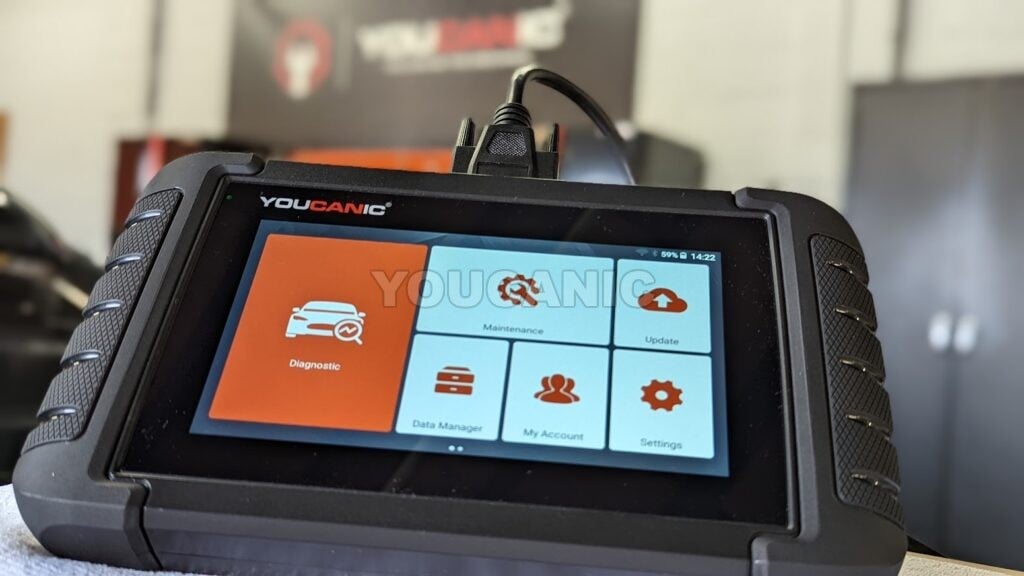
A generic OBD2 reader cannot see the airbag system, because SRS is not part of emissions diagnostics. The YOUCANIC UCAN-II Pro reads Mercedes SRS codes and clears stored codes after a repair. If the code names a squib circuit, a tensioner, the clockspring or the occupant sensor, the module is fine and replacing it would waste money. It cannot clear crash data; nothing outside a reset or a new module can.
When to Stop and Hand It Over
- Any airbag or tensioner deployed. Those parts and the crash sensors must be replaced and the structure checked.
- The module needs coding or initial startup and you do not have XENTRY access.
- A recall applies. The dealer does it free.
- You are unsure about any step. Airbags are explosive devices.
Sources
- Mercedes 2013 C-Class Coupe operator manual, SRS
- Mercedes 2015 C-Class operator manual, restraint system and OCS
- NHTSA recall 15V-711, SRS control unit
- NHTSA recall 21V-639, airbag control unit data set
- Mercedes TSB LI54.21-P-070658, SRS connector resistance
- NHTSA recall 19V-892, weight sensing system
- NHTSA 16V-081, Takata driver inflators
- Mercedes dealer parts catalog, airbag control modules
The honest cost picture before you buy a module
Read the section above on whether it is really the module, because it usually is not. Seat connectors, the occupant classification system and the clockspring account for a large share of these lights, and some of those are a reconnected plug rather than a part. That is the cheapest possible outcome and it is also the most common one.
If it genuinely is the module, there is a cost most people are not told about. A replacement often has to be coded to the vehicle, and a module carrying stored crash data will not simply clear. So before buying either a part or a tool, email support with your VIN and tell us what the code is, and we will tell you whether this ends with a tool or with a dealer visit. If it is a reading job only, rent one for seven days and keep it to one week.
Frequently Asked Questions
Can I use a used airbag module from another Mercedes?
Not safely unless it is the exact part, software level and variant for your car, has no crash data of its own, and is coded correctly. Mercedes recalls show that the wrong parameter set changes how the airbags and belt tensioners deploy. Resetting your own unit is the safer low cost route.
Will disconnecting the battery clear the SRS light?
No. SRS faults are stored in the module and must be read and cleared with a scan tool after the cause is fixed. Crash data cannot be cleared that way at all.
How long can I drive with the SRS light on?
The car drives normally, but some or all airbags and tensioners may not fire in a crash. Mercedes says to have it checked as soon as possible. Do not let passengers ride in a seat whose airbag is faulted.
Does the module need coding after replacement?
Yes, a new module needs initial startup and coding with XENTRY. A reset of your original unit keeps its coding.
Related guides: Mercedes Front Passenger Airbag Disabled: Causes and Fix · Mercedes-Benz Clock Spring Removal · Steering Wheel Airbag Replacement Mercedes-Benz W204 2008 to 2014 · Mercedes-Benz Rear Airbag Replacement GL ML R Class W164 X164 W251