Mercedes-Benz Camshaft Adjuster Magnets Replacement Guide
Reviewed/Verified by:

These solenoids usually fail because of what is around them rather than because of the part itself. Sludge from extended oil intervals, short journeys, or an oil that does not meet the required Mercedes sheet number blocks the solenoid and the oil passages feeding it. Clean oil of the correct specification is what stops the replacement going the same way. One bolt hides behind the oil cooler, which is the only awkward part of the job.
At a Glance
- Part: the camshaft adjuster magnets (solenoids) on the front of the engine
- Symptom: check engine light with cam timing codes such as P0015
- Access: the driver side magnets are tight to reach; the passenger side is easier
- Before replacing: try cleaning the magnet and check its connector for oil
- Prevention: clean oil of the right spec matters a lot for cam adjusters
This guide will explain replacing your Mercedes-Benz Camshaft Adjuster Magnets, sometimes called sensors or solenoids. The steps outlined below show how to replace the driver’s side sensors, which are harder due to limited space. On the other hand, the passenger side sensors are much more straightforward to replace.
Symptoms
A failing camshaft magnet sensor will almost always turn on the check engine light and may produce code P0015 (Camshaft Position B- Timing Over-Retarded (Bank 1).

🔧 Find out what is actually wrong before you pay someone to guess
Dealer level diagnostics at home with the YOUCANIC UCAN-II Pro.
- ✔ Covers most makes and models, including many luxury brands. Send us your VIN and we will confirm your car before you order
- ✔ Reads every module, not just the engine, so you find the faults a basic reader says are not there
- ✔ Commands the car: test a fan or pump, bleed ABS, retract an electronic parking brake, register a battery
- ✔ No subscriptions. Free lifetime updates, so the price you pay is the whole price
- ✔ Backed by real mechanics in the USA you can email before and after you buy
Featured in The Wall Street Journal
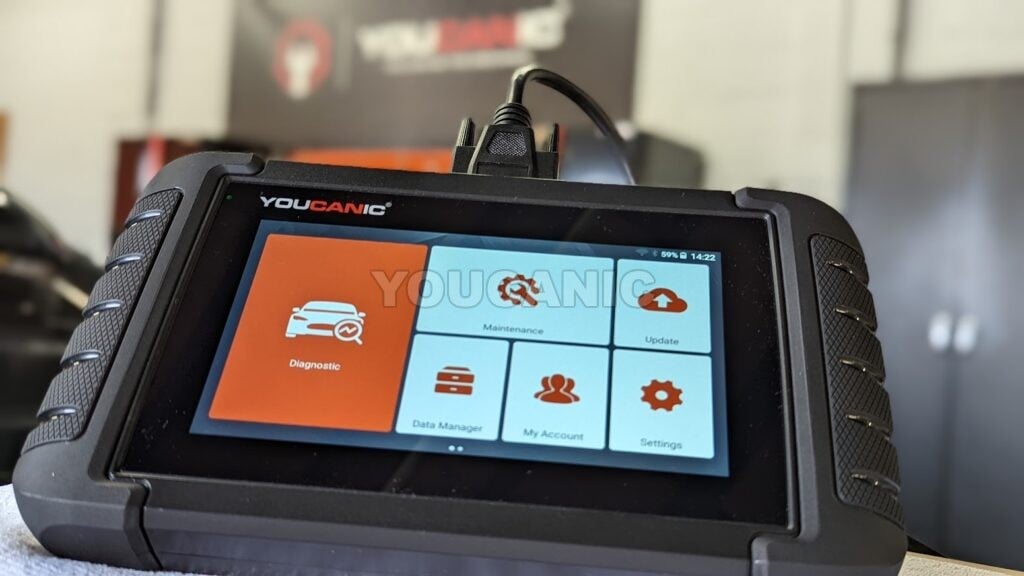
To make sure, use a Mercedes-Benz OBD-II Scanner to read the fault codes. The YOUCANIC UCAN-II Pro can read and clear engine fault codes on supported models.
The M272 and M273 engines have four Camshaft Adjuster Magnets. In addition, the check engine light may come on with codes such as P0011, P0012, P0015, and P0014.

What you will need
Parts
- Mercedes Benz magnetic cam sensor
Tools
- e-8 wrench
- Long flat-head screwdriver
- Small flat-head screwdriver
- Quarter-inch wrench
- T-handle e8-wrench
Procedure
- Place the vehicle in the park.
- Allow the engine to cool down.
- Pop the hood open by pulling the hood release under the dashboard.
- Use the suction pump to drain all power steering fluid.
- Remove the power steering reservoir. The steps are in our Mercedes-Benz power steering reservoir guide.

- Using an e-8 t-wrench, remove all bolts from the exhaust cam magnetic sensor.
- Disconnect the electrical connections of the exhaust cam magnetic sensor using a flathead screwdriver to push the tabs on the connectors.
- If it drops out of your grip, place something to catch the sensor, then pry out the exhaust cam magnetic sensor using a flathead screwdriver.Ensure that the exhaust cam magnetic sensor sealing 0-ring is removed from the hole, and include a new ring during replacement.
- Lubricate the new exhaust cam magnetic sensor before installation so it will be easy to install it.
- Position the new exhaust cam magnetic sensor in place, and install the o-ring together with it.
- Using an e-8 socket, reinstall the retaining bolts, carefully balancing the torque on three bolts.
- Reconnect the electrical connectors on the exhaust cam magnetic sensor.
- To remove the intake magnetic cam sensor, you must first remove the exhaust cam position sensor, which has two bolts.
- Move the exhaust cam position sensor out of the way.
- Using a flat head screwdriver, disconnect the intake cam position sensor connector and move it out of the way.
- Remove the intake cam position sensor by removing the e-8 bolt.
- Using an e-8 socket, remove two exposed bolts from the intake cam magnetic sensor.
- Using a quarter-inch wrench, remove the bolt hidden behind the oil cooler. The other option is to remove the oil cooler, which takes more time.
- You may use a flat-head screw and a finger to remove the bolt since the headroom would max out completely, and the wrench would no longer be usable.
- Pry the intake magnetic cam sensor out using a flat head screwdriver.
- Remove the intake cam sensor, don’t forget to take out the old o-ring.
- Lubricate the new intake magnetic cam sensor rubber o-ring.
- Install the new intake magnetic cam sensor.
- You may use a long flat head screwdriver to press the magnetic sensor in place.
- Install retaining bolts to accessible slots.
- Tighten the accessible retaining bolts.
- Install the last retaining bolt by hand first.
- Fasten the last retaining bolt using a quarter-inch wrench. Starting the first few threads will be challenging due to the limited space.
- Install the exhaust cam position sensor and tighten its bolts; ensure the O-ring is attached to the sensor. Next, make sure the old O-ring is removed. Sometimes, the old o-ring gets stuck, and you end up with two o-rings, leading to the sensor sitting flush and oil leaks developing.
- Install the intake cam position sensor and fasten its bolt to ensure the O-ring is attached to the sensor.
- Reconnect all electrical connectors for cam position sensors (intake and exhaust) and magnetic cam sensors (intake and exhaust).


Camshaft Magnetic Sensor or Camshaft adjuster solenoid

Torque Specs
- Camshaft solenoid bolts: 8Nm
Camshaft Sensors

- B6/4: Camshaft position sensor (intake left)
- B6/6: Camshaft position sensor (exhaust left)
- B6/7: Camshaft position sensor (exhaust right)
- B6/5: Camshaft position sensor (intake right)
- B11/4: Engine coolant temperature sensor
- B70: Crankshaft hall sensor
- Y49/5: Camshaft timing control solenoid (exhaust right)
- Y49/7: Camshaft timing control Solenoid (Intake right)
- Y49/4: Camshaft timing control solenoid (intake left)
- Y49/6: Camshaft timing control Solenoid (exhaust left)
Part Number
Common part numbers for Variable Valve Timing (VVT) Solenoid / Actuator, Engine Variable Timing Adjuster Magnet.
- OE NO.: 2720510177
- INTERCHANGE PART NUMBERS:
- 2720510177
- 2720510077
- A2720510177
- A2720510077
- 272 051 01 77
- 272 051 00 77
- A 272 051 01 77
- A 272 051 00 77
- OTHER PART NUMBERS:
- VVT340
- 7V9037
- VVS226
This part may also be known as Camshaft Adjuster Magnet
Applications
- 2006 to 2007 MERCEDES-BENZ C230 SPORT SEDAN 4-DOOR
- 2006 to 2007 MERCEDES-BENZ C280 SPORT SEDAN 4-DOOR
- 2008 to 2012 MERCEDES-BENZ C300 4MATIC LUXURY SEDAN 4-DOOR
- 2006 to 2011 MERCEDES-BENZ C350 4MATIC SEDAN 4-DOOR
- 2009 to 2010 MERCEDES-BENZ CL550 4MATIC COUPE 2-DOOR
- 2007 to 2008 MERCEDES-BENZ CL550 BASE COUPE 2-DOOR
- 2006 to 2009 MERCEDES-BENZ CLK350 BASE CONVERTIBLE 2-DOOR
- 2006 to 2009 MERCEDES-BENZ CLK350 BASE COUPE 2-DOOR
- 2007 to 2009 MERCEDES-BENZ CLK550 BASE CONVERTIBLE 2-DOOR
- 2007 to 2009 MERCEDES-BENZ CLK550 BASE COUPE 2-DOOR
- 2007 to 2011 MERCEDES-BENZ CLS550 BASE SEDAN 4-DOOR
- 2006 to 2011 MERCEDES-BENZ E350 4MATIC SEDAN 4-DOOR
- 2006 to 2009 MERCEDES-BENZ E350 4MATIC WAGON 4-DOOR
- 2011 to 2011 MERCEDES-BENZ E350 4MATIC WAGON 4-DOOR
- 2011 to 2011 MERCEDES-BENZ E350 BASE CONVERTIBLE 2-DOOR
- 2010 to 2011 MERCEDES-BENZ E350 BASE COUPE 2-DOOR
- 2006 to 2011 MERCEDES-BENZ E350 BASE SEDAN 4-DOOR
- 2006 to 2006 MERCEDES-BENZ E350 BASE WAGON 4-DOOR
- 2006 to 2011 MERCEDES-BENZ E350 ELEGANCE SEDAN 4-DOOR
- 2006 to 2010 MERCEDES-BENZ E350 SPORT SEDAN 4-DOOR
- 2007 to 2011 MERCEDES-BENZ E550 4MATIC SEDAN 4-DOOR
- 2011 to 2011 MERCEDES-BENZ E550 BASE CONVERTIBLE 2-DOOR
- 2010 to 2011 MERCEDES-BENZ E550 BASE COUPE 2-DOOR
- 2007 to 2011 MERCEDES-BENZ E550 BASE SEDAN 4-DOOR
- 2009 to 2015 MERCEDES-BENZ G550 BASE SPORT UTILITY 4-DOOR
- 2007 to 2012 MERCEDES-BENZ GL450 BASE SPORT UTILITY 4-DOOR
- 2012 to 2012 MERCEDES-BENZ GL550 4MATIC SPORT UTILITY 4-DOOR
- 2008 to 2012 MERCEDES-BENZ GL550 BASE SPORT UTILITY 4-DOOR
- 2010 to 2012 MERCEDES-BENZ GLK350 4MATIC SPORT UTILITY 4-DOOR
- 2010 to 2012 MERCEDES-BENZ GLK350 BASE SPORT UTILITY 4-DOOR
- 2006 to 2011 MERCEDES-BENZ ML350 4MATIC SPORT UTILITY 4-DOOR
- 2006 to 2007 MERCEDES-BENZ ML350 BASE SPORT UTILITY 4-DOOR
- 2009 to 2011 MERCEDES-BENZ ML350 BASE SPORT UTILITY 4-DOOR
- 2006 to 2006 MERCEDES-BENZ ML350 INTRODUCTION SPORT UTILITY 4-DOOR
- 2008 to 2009 MERCEDES-BENZ ML350 LUJO SPORT UTILITY 4-DOOR
- 2006 to 2006 MERCEDES-BENZ ML350 PREMIUM SPORT UTILITY 4-DOOR
- 2010 to 2011 MERCEDES-BENZ ML350 SPORT AMG SPORT UTILITY 4-DOOR
- 2010 to 2011 MERCEDES-BENZ ML450 HYBRID 4MATIC SPORT UTILITY 4-DOOR
- 2008 to 2011 MERCEDES-BENZ ML550 BASE SPORT UTILITY 4-DOOR
- 2006 to 2011 MERCEDES-BENZ R350 4MATIC WAGON 4-DOOR
- 2008 to 2009 MERCEDES-BENZ R350 BASE WAGON 4-DOOR
- 2010 to 2013 MERCEDES-BENZ S400 HYBRID SEDAN 4-DOOR
- 2007 to 2011 MERCEDES-BENZ S550 4MATIC SEDAN 4-DOOR
- 2007 to 2011 MERCEDES-BENZ S550 BASE SEDAN 4-DOOR
- 2012 to 2012 MERCEDES-BENZ SL550 AVANTGARDE CONVERTIBLE 2-DOOR
- 2007 to 2009 MERCEDES-BENZ SL550 BASE CONVERTIBLE 2-DOOR
- 2011 to 2012 MERCEDES-BENZ SL550 BASE CONVERTIBLE 2-DOOR
- 2012 to 2012 MERCEDES-BENZ SL550 GRAND EDITION CONVERTIBLE 2-DOOR
- 2006 to 2008 MERCEDES-BENZ SLK280 BASE CONVERTIBLE 2-DOOR
- 2009 to 2011 MERCEDES-BENZ SLK300 BASE CONVERTIBLE 2-DOOR
- 2005 to 2010 MERCEDES-BENZ SLK350 BASE CONVERTIBLE 2-DOOR
Try cleaning before replacing
These solenoids often set a code because the fine mesh screen in the base has clogged with oil sludge rather than because the coil has failed. Remove the magnet, clean the screen and the plunger with brake cleaner, check the plunger moves freely, and refit it with a new O ring. On an engine with a known oil change history this frequently clears the fault for nothing more than the price of a seal, and if it comes back you have lost very little.
On the M272 and M273, consider the balance shaft
These engines have a well documented balance shaft and timing gear wear problem on earlier builds, and it produces camshaft correlation codes that look very similar to a failed adjuster magnet. The distinguishing sign is a code about camshaft position correlation or timing over advanced rather than a straightforward solenoid circuit fault, often with a rattle on cold start. Replacing magnets will not touch that, so read the exact code rather than the general area before committing.
Oil condition matters more here than most places
Variable valve timing works by routing engine oil through small passages, so the system is unusually sensitive to dirty or wrong grade oil. Extended service intervals, short journeys and an oil that does not meet the required Mercedes sheet number all lead to sludge that blocks these solenoids and the passages behind them. If you are replacing magnets on a car with an unknown history, change the oil and filter at the same time.
Clear the code and confirm the repair
Once the magnet is fitted, clear the code and check live data for camshaft position, which should follow the commanded value smoothly as the engine is revved. Note the O ring on each magnet is a one use item and an oil leak from a reused seal will drip onto the exhaust and smoke, which is easy to mistake for a new fault. Torque to the figure above rather than tightening by feel, since the housings are aluminum and strip easily.
Look before you plug anything in
These solenoids usually announce themselves physically. Oil weeping around the magnet, a swollen or hardened seal, oil tracking down the side of the head. If you can see that, you already have your answer and the diagnosis is finished without a tool. Worth also checking the general oil condition, because sludge and overdue oil changes are a repeat cause here rather than a coincidence.
Live data helps in the quieter cases, where the code is stored but nothing is visibly leaking, by showing whether the solenoid is actually responding to commands. For one diagnosis that is a rental job rather than a purchase, so rent one for seven days if you need it, and keep the money for the parts.
Frequently Asked Questions
How long can I drive with the check engine light on and code P0015?
The first symptom of a failing camshaft sensor manifests as a check engine light coming on. When the check engine light illuminates, the driver has enough time to service the car and replace faulty parts. It could lead to a more expensive engine problem if you ignore this flashing light for a long period.
What is the purpose of a Mercedes Benz Magnetic Cam Sensor or camshaft adjuster Solenoid?
The camshaft adjuster solenoid’s (Magnetic Cam Sensor) primary purpose is to allow more oil to enter the system, ensuring proper lubrication under a more massive load.
How would you know that your magnetic cam sensor is bad?
The vehicle does not drive like it used to. If your vehicle idles roughly, stalls frequently, drop engine power, stumbles, reduces gas mileage, or accelerates slowly.
These are all signs your camshaft position sensor could be failing.
Check Engine Light comes on, which would produce code P0015.
The vehicle might not start.