

Mitsubishi Forward Collision Mitigation System (FCM)
Reviewed/Verified by:

Forward Collision Mitigation System (FCM) has been an optional feature on Mitsubishi vehicles since 2014. FCM applies the brakes to avoid a collision with the vehicle, objects, or pedestrians in front.
At a Glance
- What FCM does: warns you and brakes automatically when a collision ahead is likely.
- Weather and dirt are the most common reasons it switches off. Clean the camera area of the windshield and the radar behind the grille.
- A windshield replacement or minor front damage can knock the camera or radar out of alignment.
- Service required messages store codes in the ASC module, which a basic code reader will not see.
- Recall 18V620 covered FCM software on some 2017 to 2019 models. Check your VIN at NHTSA.
Depending on the model, the Forward Collision Mitigation System uses a radar sensor behind the front grille, a camera or laser sensor at the top of the windshield, or both, to automatically apply the brakes when the vehicle detects a chance of an accident due to a reduction in the distance from the vehicle in front.

FCM is part of the e-Assist suite of Mitsubishi Active Safety Technologies and typically comes with the Adaptive Cruise Control System and Lane Departure Warning System. When working, it continuously scans the road ahead and monitors other cars and pedestrians’ movement.

🔧 Find out what is actually wrong before you pay someone to guess
Dealer level diagnostics at home with the YOUCANIC UCAN-II Pro.
- ✔ Covers most makes and models, including many luxury brands. Send us your VIN and we will confirm your car before you order
- ✔ Reads every module, not just the engine, so you find the faults a basic reader says are not there
- ✔ Commands the car: test a fan or pump, bleed ABS, retract an electronic parking brake, register a battery
- ✔ No subscriptions. Free lifetime updates, so the price you pay is the whole price
- ✔ Backed by real mechanics in the USA you can email before and after you buy
Featured in The Wall Street Journal
This system will alert the driver with a loud warning sound and flashing dashboard signals in case of a possible collision. If the driver fails to react, the system will gain control over the brakes and stop the vehicle in a controlled manner. FCM cannot avoid all accidents. If an accident still happens, FCM will try to minimize the damage.
Possible Problems
- FCM temporarily not available message showing on the vehicle display
- Inoperable FCM system, meaning the vehicle will not warn the driver about potential obstructions in front or perform emergency braking if needed.
- FCM SERVICE REQUIRED
- ACC SERVICE REQUIRED
- ASC SYSTEM SERVICE REQUIRED (with DTCs C1800, C1777)
When FCM, ACC, and ASC determine abnormal acceleration, the system may enter “fail safe” mode, with ACC and FCM becoming inoperative.
Possible Causes
- Radar interference is caused by heavy rain or snow. Excessive raindrops or snowflakes in front of the vehicle result in inaccurate radar readings. Without a clear vision of the road ahead, the system will shut itself down as a preventive measure. As soon as the weather conditions improve, the FCM will be back online. Vehicle restart may be required.
- Foreign objects block the proper radar operation. This can be anything from a thick layer of mud and dirt to leaves or objects stuck at the radars’ protective casing. Removing and washing off debris will solve the issue.
- Physical damage or misalignment of the radar assembly. This can happen due to a previous collision, a small bump in the parking lot, or after performing other repairs to the vehicle’s front end (i.e., bumper removal).
- Software issues and glitches can cause issues with this system in certain situations. Checking for upgrades and potential recalls will ensure the vehicle has the latest FCM software version for example. When driving in a lane with normal traffic flow and the adjacent lane is jammed, FCM SERVICE REQUIRED, ACC SERVICE REQUIRED, and ASCSYSTEM SERVICE REQUIRED may be displayed (with DTCs C1802, C1777). The continued presence of objects creates continuous inputs that trigger FCM operation. The system determines this as an abnormal signal. The system may enter “fail safe” with ACC and FCM becoming inoperative.
Recall
Under NHTSA campaign 18V620, Mitsubishi Motors North America (MMNA) recalled about 9,200 vehicles: certain 2018 Mitsubishi Outlander PHEV, Outlander Sport, 2018 to 2019 Eclipse Cross, and 2017 to 2018 Outlander vehicles equipped with a Forward Collision Mitigation (FCM).
According to the NHTSA Safety Recall Report, the FCM may apply braking for longer than needed due to incorrect software. The error may occur when a pedestrian is registered as being in front of the vehicle, even after a pedestrian is no longer detected.
If the FCM software activates the brake longer than necessary, the driver may react by applying additional braking. The resulting rapid deceleration of the vehicle has been suspected to increase the risk of a rear-end collision or cause the driver to lose control of the vehicle. Only vehicles equipped with a forwarding Collision Mitigation (FCM) system are affected.
Troubleshoot Mitsubishi FCM Service Required
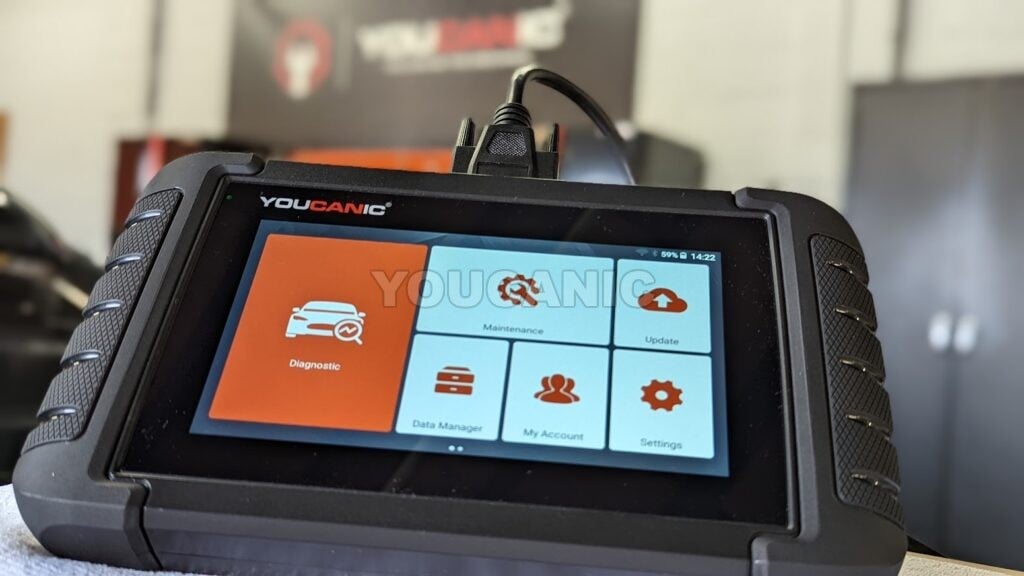
To find out why the FCM SERVICE REQUIRED has come on, you will need to read the ASC module codes using a Mitsubishi All System Scanner such as YOUCANIC UCAN-II Pro.
- Plug the scanner into the OBD-II port under the dashboard.
- Turn on the ignition.
- Turn on the scanner.
- Select Mitsubishi, then the correct model. For example, Outlander, Lancer, Mirage, etc.
- Scroll to Control Unit
- Select the ASC System
- Select Read Fault Codes
This will display the fault codes stored in the ASC module, which has disabled the FCM system. Note that the ASC system may need to be updated in some cases, which needs to be completed by the dealer.
Clean the glass and the grille before anything else
The camera looks out through a small patch of windshield just ahead of the mirror, and the radar looks out through the lower grille. Either one being dirty or obstructed will disable the system, and this accounts for a large share of warnings that owners assume are faults.
Clean the inside as well as the outside of the glass in front of the camera. A film of interior haze, which builds up slowly from plastics outgassing in the sun, scatters light enough to blind it. Outside, check for ice, caked snow, heavy road film, a chip or crack in that exact area, or a sticker, toll transponder or dashcam mounted in the camera’s field of view. At the front, clear the grille of packed snow, mud, leaves and dead insects, and look for anything bolted in front of the radar such as a bug deflector, a light bar or an aftermarket license plate bracket.
It helps to know which message you are dealing with. A warning saying the system is temporarily unavailable is the car telling you it cannot see, and it clears by itself once the obstruction is gone. A service required message means a fault has been stored and will not clear on its own.
If the windshield has been replaced, that is probably why
This is the cause most often missed, and it catches people months later. The forward camera is calibrated to the exact position of the glass it looks through. Replacing the windshield moves it, and the system must be recalibrated afterwards with the manufacturer’s procedure before it will work correctly.
Two things go wrong. Either the recalibration is never carried out, because a budget fitter is not equipped to do it, or the replacement glass is not to the correct specification. These windshields have an optically precise area in front of the camera, and cheaper aftermarket glass sometimes has enough distortion there to prevent calibration completing at all. If the warning appeared within a few days of a glass replacement, go back to the fitter before paying anyone to diagnose it.
The same applies after front end accident repair, after the bumper or grille has been off, and after a suspension or steering alignment, since the radar aim is referenced to the vehicle’s thrust line. Calibration requires marked targets at measured distances on a level floor, so it is a workshop procedure rather than a driveway one.
Read the codes to find out which sensor is complaining
As the article notes above, the fault is stored in the stability control module rather than the engine module, which is why a basic code reader returns nothing while a warning sits on the dashboard. Reading the actual code tells you whether the camera, the radar, the brake system or a supporting input such as a wheel speed sensor or the steering angle sensor is at fault.
That distinction is worth having before you book anything, because a wheel speed sensor or a steering angle calibration is an inexpensive fix, while a camera or radar replacement is not. A full system scanner that accesses the Mitsubishi chassis and safety modules will show the stored code and, on many models, the live status of each input the system depends on.
Finally, remember what the system is and is not. Forward collision mitigation is a driver assistance feature, not an autonomous braking system you can rely on. It is less effective at night, in heavy rain, fog and snow, and against pedestrians, cyclists and stationary objects. It is designed to reduce the severity of an impact the driver has not reacted to, not to prevent one on your behalf.
Frequently Asked Questions
Can I drive with the FCM warning on my Mitsubishi?
Yes, the car drives normally, but forward collision mitigation and often adaptive cruise will not work. Leave more following distance until it is fixed.
Why does FCM turn off in bad weather?
Rain, snow, fog or dirt on the radar sensor or the windshield camera area can block the system. It usually comes back once the sensors are clean and visibility improves.
Does the FCM need calibration after a windshield replacement?
On models with a windshield camera, yes. Ask the glass shop or dealer to calibrate the camera after fitting a new windshield.
Additional Resources
- ACC/FCM/ASC WARNING LAMP ILLUMINATION : Technical Service Bulletin: nhtsa.gov




Wire diagrame for the front radar (FCM/ACC system) on 2016 Mitsubishi Montero Sport