
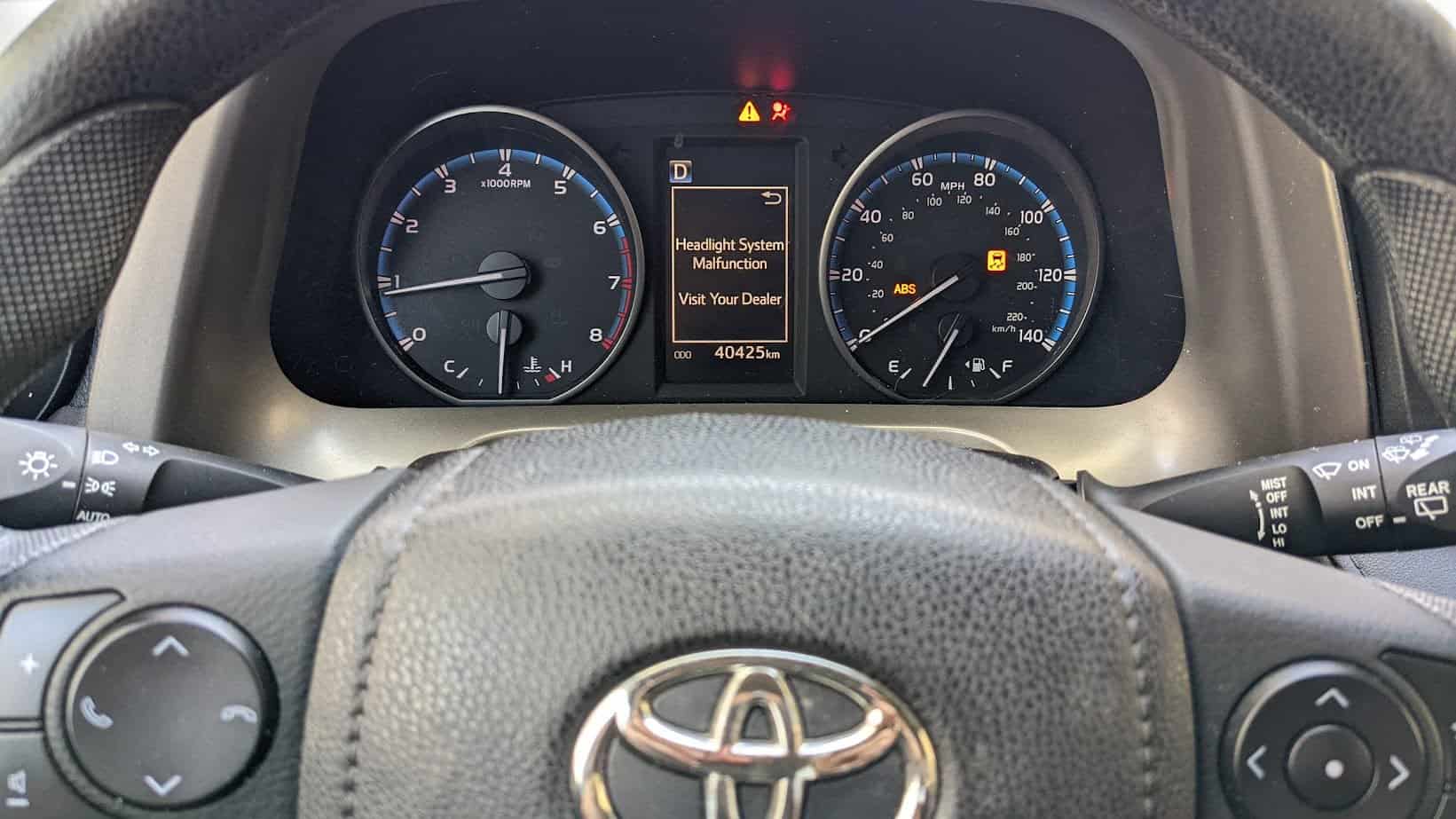
Toyota headlight system malfunction
Do you have that dreaded headlight system malfunction? Visit your dealer warning on the display of your Toyota. When something like this happens, most car owners will automatically and instinctively check light bulbs to see if they work. But given the fact that you are reading this article, it is likely this is not what is causing your problem.
The headlight system on most Toyota cars, especially newer ones, is far more elaborate and complex than one might imagine. Because of that, solving headlight-related issues can be challenging and, more importantly, quite frustrating. So, to save you from endless repair attempts, we will go through the most common causes and show you how to deal with the issue.
Common Causes
Dirty forward-facing camera or sensor

🔧 Stop paying the dealer for every warning light
Get dealer level diagnostics at home with the YOUCANIC Full System Scanner.
- ✔ Works with all makes and models, including most luxury brands
- ✔ Topology map view shows all vehicle modules on one screen for faster diagnostics
- ✔ Bi directional controls to test fans, pumps, actuators and more so you do not have to guess
- ✔ Special resets and calibrations such as ABS bleed, EPB service, battery registration and more
- ✔ Free lifetime updates with no recurring fees
On most Toyotas, the headlights will turn on and off automatically depending on the outside conditions, assuming the driver has selected this option. The vehicle constantly monitors the amount of daytime light using its forward-facing camera in the rearview mirror base. This camera is also used for features like the Pre-collision warning system or Lane Departure Assist.
Dirt and snow may accumulate on the top of the windshield, obstructing this sensor and its field of view. If this happens, all the systems that rely on it, including the Headlight system, will be affected. Once the buildups are removed, all these features should regain their function.
Automatic headlight leveling issues
Almost every Toyota has an Automatic headlight leveling feature, which adjusts the headlights’ vertical aim depending on how the car is loaded. Its purpose is to prevent drivers in oncoming vehicles from being blinded while ensuring the best possible illumination range in all situations.
The car continuously monitors where the headlights are aiming using its forward-facing camera. If it notices misalignments, the vehicle will alert the driver with the headlight warning message. In many cases, recalibrating the auto-leveling system will solve the issue. Other possible causes include broken electric motors, which move the headlight, and faulty load sensors. Lastly, lowering or lifting the vehicle will offset the function of the automatic headlight leveling feature.
Light bulbs
Obviously, a broken light bulb is one possible cause. But this warning message may keep popping up even after replacing the bulb. This is because bulbs from different manufacturers might not be identical, although they should be. Some cheaper alternatives may have slightly different running characteristics, such as internal resistance, and the vehicle will recognize them as faulty.
Ambitious offroad adventures
If these adventures involve deep water crossings, truck and SUV owners will often encounter the headlight system warning after going offroad. During such events, mud and moisture can penetrate the sensitive headlight components, affecting their operation. The warning message will usually go away after a few hours after everything dries out. Still, this can also be a tell-tale sign that some headlight components are not entirely water-proof.
Aftermarket alarms
Some Corolla owners had issues with Headlight System Warnings popping up occasionally after fitting their vehicles with an aftermarket alarm. The Headlight System in a Toyota is a delicate piece of electronics, and any non-factory component can cause interference.
Cracked headlight
As an assembly, the headlight is a sealed unit, preventing outside contaminants from entering it. However, this will not be the case if the glass or the housing gets damaged, which would allow dust and moisture could get into the headlight. Vehicles equipped with HID headlights don’t tolerate this, which usually results in a headlight system malfunction.
HID control module failure
Any Toyota vehicle with HID headlights has control units called the Headlight module, with one for each beam. This module can sometimes fail, which usually happens if moisture gets inside its housing or suffers from electrical overload. Both cases will cause electrical shorts on the circuit board, which offsets the Headlight system operation.
Automatic Headlight Initialization
After changing any of the components of the auto-leveling headlight feature or after lowering or lifting your Toyota, you will have to re-initiate its automatic headlights. This simple procedure can be done with a light switch knob.
- Start by removing any excess weight from the vehicle, which would offset its level during the initialization.
- Next, check how much fuel is in the tank, as this is something the vehicle will want to know.
- Put the lights in the OFF position and then turn on the ignition.
- Now, pull the light switch knob towards you, and while remaining in that position, turn the switch to LOW-BEAM three times.
- A message about the initialization being active should appear on the dashboard, and the vehicle will ask about the fuel level.
- Again, turn the switch to enter this value, with the number of turns representing the amount of fuel. An empty tank equates to a single click, a quarter of a tank is two clicks, and so on. If the tank is full, that will be five clicks.
- With this done, wait for five seconds and then turn off the ignition.
Frequently asked question
Can I drive my Toyota with the Headlight System Malfunction Visit Your Dealer message?
If your Toyota surprised you with the Headlight system malfunction message, you’re now probably if you can still drive it. Assuming that both the left and right headlight is working and that both high and low beams are available, your car is still safe to use. But some of the more advanced features, such as automatic headlight operation, may not be available. Because of that, you will have to manually switch on the headlights and activate or lower the high beam when needed. Still, have this problem on your Toyota fixed as soon as possible.
Do I need to reset the Headlight System Malfunction Visit Your Dealer message?
In most cases, there is no need to reset the warning message for the headlight system malfunction. After you have determined what is causing the issue and replaced the faulty part, this warning will go away. The only exceptions are components that work with the auto leveling Headlights feature. After changing any of them, you will have to re-initialize the system on your Toyota.
Summary
Headlight System warnings in your Toyota can be annoying and confusing. Still, you can usually solve this by checking the most common and easy-to-check things. This includes the forward-facing camera, which may be covered with dirt, or auto-leveling sensor issues. Another common problem is a cracked headlight, which occasionally fogs up from the inside. Lastly, aftermarket alarms cause issues with the Toyota Headlight System.