

Toyota P0013 Fault Code: Replace Camshaft Position Actuator B
Reviewed/Verified by:

Check engine light may turn on, and diagnostic trouble code (DTC) P0013 may be stored in a Toyota’s ECU. P0013 means “Exhaust “B” Camshaft Position Actuator Circuit/Open (Bank 1).
At a Glance
- Code: P0013, exhaust camshaft position actuator (B) circuit, bank 1
- Part: Exhaust camshaft oil control valve (VVT solenoid)
- Vehicle shown: 2012 to 2017 Toyota Camry XV50
- Check first: Oil level and condition, then the valve connector and wiring
- Symptoms: Check engine light, rough idle, poor acceleration
- Related codes: P0014 and P0015 relate to exhaust cam timing performance
This guide is a step-by-step procedure to replace the B camshaft position actuator on a 2012 to 2017 Toyota Camry XV50. With code P0013, the check engine light comes on and the car may idle rough or accelerate poorly.
Troubleshooting Toyota P0013 Fault Code

This fault code relates to the variable valve timing (VVT): also known as variable camshaft timing. A faulty Camshaft Position Actuator B can trigger code P0013.

🔧 Find out what is actually wrong before you pay someone to guess
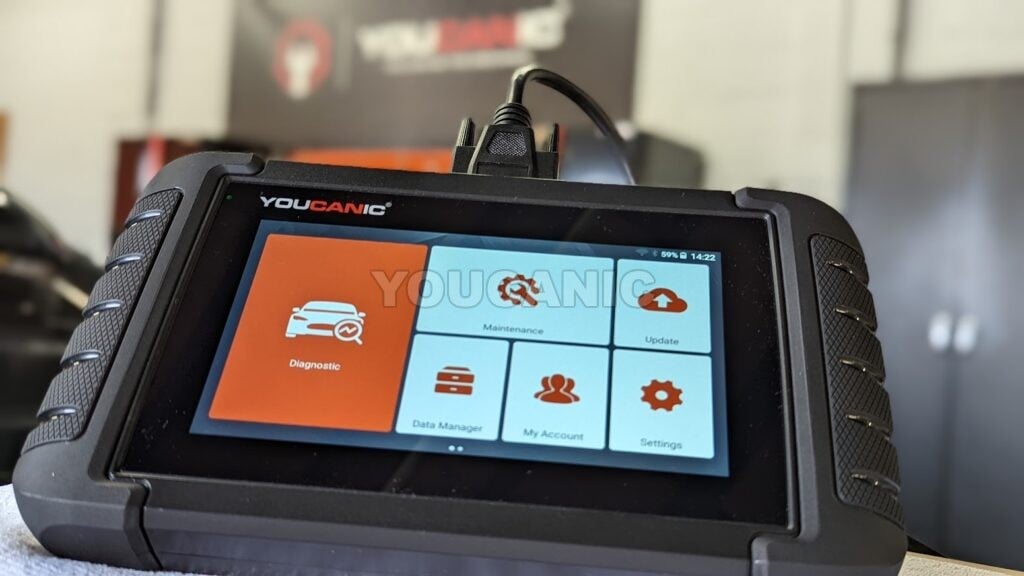
Dealer level diagnostics at home with the YOUCANIC UCAN-II Pro.
- ✔ Covers most makes and models, including many luxury brands. Send us your VIN and we will confirm your car before you order
- ✔ Reads every module, not just the engine, so you find the faults a basic reader says are not there
- ✔ Commands the car: test a fan or pump, bleed ABS, retract an electronic parking brake, register a battery
- ✔ No subscriptions. Free lifetime updates, so the price you pay is the whole price
- ✔ Backed by real mechanics in the USA you can email before and after you buy
Featured in The Wall Street Journal
What you will need
- OBD II Scanner
- 10mm wrench
- Flat screwdriver
- Toyota Camry Camshaft Position Actuator
Procedure
- Unlock the vehicle and open the driver’s door.

- Get the OBD II Scanner and connect it to the OBD II port under the dashboard.

- Insert the key into the ignition switch and turn it to the accessories menu.

- Set the OBD-II Scanner to the diagnostics menu and read codes.
- Choose the stored codes to show the code to be fixed.
- Pull the hood release under the dashboard and unlock the hood.

- Pull the hood up and secure it open.

- Remove the engine cover by pulling it up.


- Locate the camshaft position actuator B on the left side of the first ignition coil (passenger side of the engine)

- Disconnect the electrical connector of the camshaft position actuator by squeezing the connector and pulling it out.
- Remove the 10mm bolt holding the camshaft position actuator using a 10mm wrench.
- Pull out the camshaft position actuator. Use a flat screwdriver to push the camshaft actuator out easily.

- Line up the new camshaft position actuator and push it to set it in.

- Reinstall the 10mm bolt on the camshaft actuator.

- Reconnect the electrical connector of the camshaft actuator by pushing it back to place.
- Line up the engine cover back to the vehicle and push it to lock into place.
- Go back to the diagnostics menu and erase the code. Check the stored codes if there are still codes to be fixed.
- Start the vehicle a few times and check if the check engine light is still on.


There may be other issues that can trigger fault code P0013.
A generic OBD-II scanner can clear the check engine light, but if you want a more professional OBD-II scanner, use the YOUCANIC UCAN-II Pro, which can read and clear fault codes in the engine and other control modules on supported vehicles.
Make sure you are at the right end of the engine
The letter in this code is the detail that matters. On an engine with variable timing on both camshafts there are two actuators per bank, and the convention is that A is the intake camshaft and B is the exhaust camshaft. So P0013 points at the exhaust side, which sits on the opposite side of the cylinder head from the intake actuator. Bank 1 is the side containing cylinder number one, and on a four cylinder that is the only bank there is.
If you are working from a guide for code P0010, that one covers the intake actuator on the same engine. The parts look similar, they are not interchangeable, and fitting one in place of the other is an easy mistake to make when ordering.
Worth checking before you buy: not every Toyota exhaust cam phaser is oil operated. Some engines use an electrically actuated exhaust camshaft phaser rather than an oil control valve, and the diagnosis for those is entirely different because oil pressure and oil condition are no longer part of the picture. Confirm which type your engine uses before applying any oil related advice.
On oil operated engines, check the oil first
Where the actuator is operated by oil pressure, the oil itself is part of the system. The valve that controls it has a fine filter screen that clogs with sludge and varnish, and low oil level, oil well past its change interval or the wrong viscosity will all produce this code with a perfectly serviceable valve fitted.
Check the level and the service history before ordering parts. If the oil is dark and overdue, change it along with the filter, clear the code and drive the car before deciding anything else. With the valve out, inspect its screen: a blocked screen can usually be cleaned rather than replaced, which turns a parts purchase into an afternoon with some solvent.
When it is not the valve at all
Beyond the actuator itself, the common causes are a damaged connector or chafed wiring at the valve and, on higher mileage engines, a stretched timing chain. A chain that has stretched shifts the relationship between the camshaft and crankshaft signals far enough for the module to flag it, with every component in perfect working order. A rattle for a second or two on a cold start is the usual warning, and a correlation code stored alongside P0013 makes it more likely still.
Live data settles which it is. A full system scanner shows commanded against actual camshaft position while the engine runs, which tells you whether the actuator is being commanded and failing to respond, or never being commanded at all. Clear the code afterwards and drive the car through a few cold starts and a mix of town and highway running before calling the job finished, because valve timing faults are load dependent and can stay away at idle on the driveway.
Frequently Asked Questions
What does P0013 mean on a Toyota?
It means an electrical fault in the bank 1 exhaust camshaft oil control valve circuit, which controls exhaust valve timing.
What is the difference between P0010 and P0013?
P0010 is the intake camshaft valve circuit; P0013 is the exhaust camshaft valve circuit.
Is it safe to drive with P0013?
For a short time, but performance and fuel economy suffer. Fix it soon.
How do I fix P0013?
Check the oil, inspect the connector and wiring, test the valve coil, then replace the exhaust oil control valve if it has failed.


