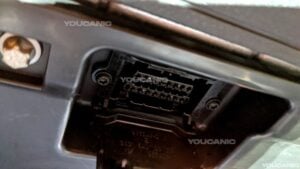

Volvo OBD-II Port Location
Reviewed/Verified by:

Need to connect your OBD-II scanner to your Volvo OBD-II diagnostic port? By following the procedures below, learn where to locate the OBD-II port on your Volvo.
At a Glance
- Where it is: under the dashboard on the driver’s side on Volvos from 1996 on in the US.
- What it reads: a basic reader sees engine emissions codes only. ABS, SRS and transmission faults need a scanner that supports Volvo.
- No communication on several systems? Suspect the CEM behind the dashboard, which is often damaged by water from blocked windshield drains.
- Older rear drive Volvos such as the 240, 740 and 940 use a diagnostic box in the engine bay instead.
Where Is the OBD-II Port Located on a Volvo

The Volvo On-Board Diagnostic (OBD) port, also known as OBD-II or OBD 2, is located under the dashboard on the driver’s side.
The Volvo diagnostic port reads and clears fault codes, runs component tests, and is used to program the various modules.

🔧 Find out what is actually wrong before you pay someone to guess
Dealer level diagnostics at home with the YOUCANIC UCAN-II Pro.
- ✔ Covers most makes and models, including many luxury brands. Send us your VIN and we will confirm your car before you order
- ✔ Reads every module, not just the engine, so you find the faults a basic reader says are not there
- ✔ Commands the car: test a fan or pump, bleed ABS, retract an electronic parking brake, register a battery
- ✔ No subscriptions. Free lifetime updates, so the price you pay is the whole price
- ✔ Backed by real mechanics in the USA you can email before and after you buy
Featured in The Wall Street Journal

Volvo OBD-II Port Location

Use the OBD-II port to diagnose all warning lights.
Check engine lights can be diagnosed with a generic OBD-II scanner, but systems such as ABS, SRS (airbags) and the transmission require a Volvo scanner, like the YOUCANIC UCAN-II Pro. This powerful scanner can also perform bi-directional tests, maintenance and repair resets, and many more.

Did you know all 1996 and newer Volvo vehicles sold in the US have an OBD-II port under the dashboard?
If the port is completely dead, suspect the CEM
This is the most useful thing to know about diagnostics on a Volvo of the late nineties through late two thousands generation, covering cars such as the S60, S80, V70 and XC90. If your scanner will not communicate at all, or the car has developed an assortment of unrelated electrical faults, the Central Electronic Module is the first thing to suspect rather than the socket.
The CEM sits behind the dashboard and acts as the gateway between the diagnostic connector and the rest of the vehicle’s networks. It is also, unfortunately, positioned where water ends up when the drain channels at the base of the windshield block with leaves and overflow. The water drips onto the module, corrodes the board and the solder joints, and the resulting faults are intermittent and seemingly unconnected: a car that will not start, central locking that works when it feels like it, wipers or lights behaving oddly, and a diagnostic port that reports no communication.
Before anything else, check for damp carpet in the footwells and clear those drain channels. A module replaced without fixing the leak will fail again. A new CEM has to be programmed to the vehicle, which is a dealer level job, whereas repairing the original avoids that because the unit coming back is already matched to your car. Specialists such as Module Medics carry out this kind of module repair by mail.
A generic reader sees only a fraction of a Volvo
As the article notes above, the OBD-II standard covers emissions related engine data and nothing else. On a Volvo that leaves a great deal out. The ABS and stability control, the SRS airbag system, the central electronic module, the climate system, the transmission and the driver information module all communicate through the same socket using Volvo specific protocols.
That is why owners regularly report that their code reader shows no faults while an airbag or anti skid warning sits illuminated on the dashboard. The reader is not broken and the car is not fine. The tool simply cannot ask those modules anything. For any warning other than the check engine light you need a full system scanner that supports Volvo specific modules.
Older Volvos use a different system entirely
If your Volvo predates the 1996 changeover in the United States, or 2001 for gasoline cars in Europe, there is no sixteen pin socket to find. The rear wheel drive models of that era, the 240, 740 and 940 among them, use a Volvo diagnostic unit in the engine bay instead: a small black box containing numbered sockets, a probe lead and an LED.
Reading codes on those cars means moving the probe to the socket for the system you want, pressing the button, and counting the sequence of LED flashes, which you then look up in a code table. It is slow and it feels archaic, but it needs no tools at all beyond the unit already fitted to the car, and it still works perfectly thirty years later.
One last practical point for any Volvo. Do not leave a Bluetooth dongle or insurance tracker permanently in the socket. Pin sixteen is live whether or not the key is in the ignition, so anything left plugged in keeps drawing current, and on these cars it can also prevent the modules from going to sleep properly, producing intermittent faults that vanish the moment the dongle is removed.
What to do next: on a Volvo, ask about the battery first
Two things send Volvo owners looking for this connector more than anything else. A battery that keeps going flat, and an anti skid or ABS message on the dash. Both have a specific next step and neither is solved by reading an engine code.
- If the complaint is electrical, load test the battery before anything else. A battery can read fine at rest and still collapse under load, and that single test settles most of these cases.
- Find out whether your car requires battery registration before you fit a replacement. Some Volvos do and some do not, and this is the most common place owners spend money unnecessarily.
- For an anti skid or ABS message, read the brake controller. The code lives there, not in the engine module, which is why a cheap reader finds nothing.
- Scan every module once before drawing conclusions. Volvo dash messages are often downstream of a fault in a completely different system.
For the first two, see Troubleshooting Volvo Low Battery Warning. For the third, Volvo ABS Anti-skid Service Required covers the usual causes.
The YOUCANIC UCAN-II Pro performs battery registration and reads all modules, with a seven day rental for a one off battery change or brake repair. Whether your car needs registration depends on model and year, so email support with your VIN and we will tell you before you order.
When you should not buy anything
If your Volvo does not require battery registration, fitting a battery is just fitting a battery. And if you only want to read an engine code, a cheap tool does that perfectly well.
Frequently Asked Questions
Where is the OBD port on most Volvos?
On most modern Volvos it is under the dashboard on the driver side, near the hood release or above the pedals.
Why will my scanner not connect to my Volvo?
Check that the ignition is on and the port has power. A blown fuse for the port, a bent pin or a reader that does not support the car are common reasons.
Can I leave an OBD device plugged in?
Some devices draw power all the time and can drain the battery if the car sits. Unplug it if you will not drive for a few days.
More guides: browse all of our Volvo repair and troubleshooting guides.