Acura OBD-II Port Location
Reviewed/Verified by:

On most Acuras the OBD-II port is under the dashboard on the driver’s side. On some TL and CL models from around 2000 and earlier it hides behind the coin tray in the centre console instead. If your scanner will not power up, check the accessory fuse first, then look into the port for pushed back pins, particularly pin 16 for power and pins 4 and 5 for ground.
At a Glance
- Where it is: under the dashboard on the driver’s side on most Acuras.
- Around 2000 and earlier: some TL and CL models hide it behind the coin tray in the center console.
- Dead port? Check the accessory fuse first, then look for pushed back pins, especially pin 16 (power) and pins 4 and 5 (ground).
- Do not leave a dongle plugged in. Pin 16 is always live and can drain the battery.
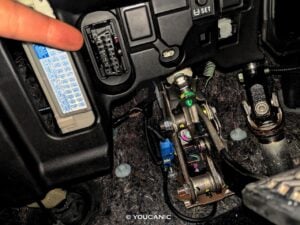
Acura OBD2 port is located under the dashboard.
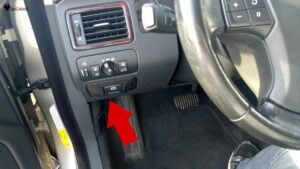
In most Acuras today, the OBD-II port is located under the dashboard on the driver’s side.

Let’s look at a few examples.

🔧 Find out what is actually wrong before you pay someone to guess
Dealer level diagnostics at home with the YOUCANIC UCAN-II Pro.
- ✔ Covers most makes and models, including many luxury brands. Send us your VIN and we will confirm your car before you order
- ✔ Reads every module, not just the engine, so you find the faults a basic reader says are not there
- ✔ Commands the car: test a fan or pump, bleed ABS, retract an electronic parking brake, register a battery
- ✔ No subscriptions. Free lifetime updates, so the price you pay is the whole price
- ✔ Backed by real mechanics in the USA you can email before and after you buy
Featured in The Wall Street Journal

Location of the OBD-II port on a 2006 Acura TL.

Location of the OBD-II port on a 2016 Acura TLX
Can’t find the Acura OBD-II port?

On older Acuras, the OBD-II port is behind the coin tray in the center console. This was a common location for Acura TL, CL, and TLS vehicles manufactured around 2000. Remove the plastic piece, and you will see the 16-pin OBD-II port.
Around 2003, the port was moved under the dashboard to the right of the steering column. Note that if coins fall behind the coin tray, the port can get jammed, and you won’t be able to access the OBD-II port without removing the loose objects first.
What is the Acura OBD-II port used for?
Not only do you need to know the location of the OBD-II port to diagnose the check engine light, ABS, or airbag, but you also need to access this port to pass state inspection and emission tests. An OBD-II scanner, like the YOUCANIC UCAN-II Pro, can read and clear fault codes within your vehicle’s whole system.
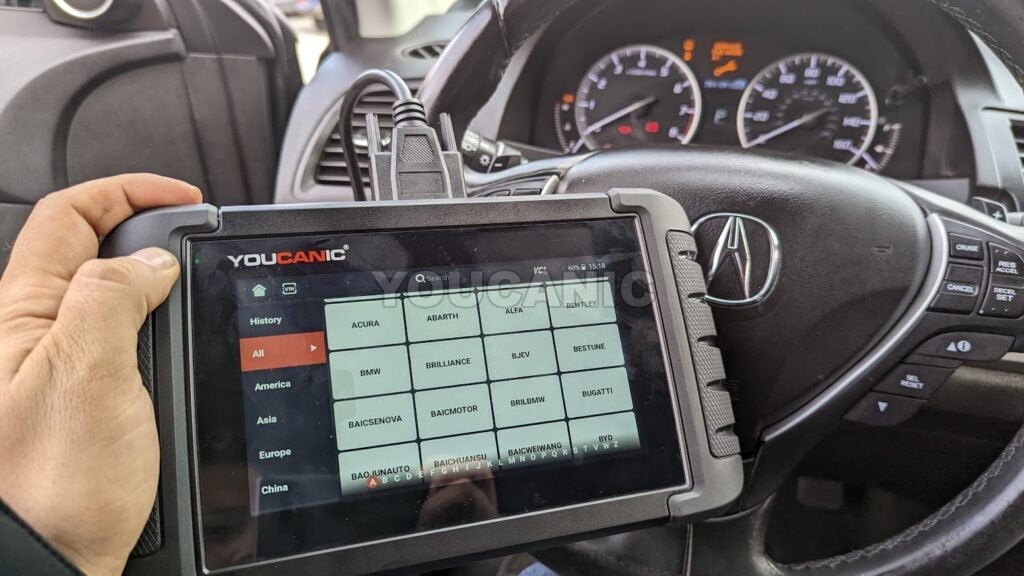
You can use an Engine Code Reader to diagnose and check the engine light. To diagnose other systems, such as ABS or airbags, you need a Multi-System OBD-II Scanner.
The under dash location applies to most Acura models, including:
- TL
- CL
- RL
- TSX
- RDS
- ILX
- TLX
- RLX
- MDX
- ZDX.
If your scanner will not power up
Assuming the plug is fully seated, the usual cause is a blown fuse rather than a faulty scanner. The diagnostic connector takes its power from a fuse in the interior fuse box, often shared with the cigarette lighter or an accessory circuit, and when that fuse goes the port is completely dead while the rest of the car behaves normally. Check the fuse chart on the fuse box lid for the accessory or back up circuit, and try the cigarette lighter socket as a quick indication.
If the fuse is good, look into the port itself with a flashlight. Terminals get pushed back into the housing by a scanner plugged in at an angle, and pins bend or corrode. The pin that matters most for power is pin 16, with pins 4 and 5 providing the grounds. A terminal that has receded into the plastic can usually be eased back into position with a small pick.
Most Acura models need the ignition switched on, with the engine not running, before the scanner will communicate. Turning the key only as far as accessory is not enough on many of them.
A generic code reader will not see most Acura systems
This is the thing worth understanding before you buy a tool. The OBD-II standard that every car has shared since 1996 only covers emissions related engine data. That is why an inexpensive code reader will happily show you a P0420 and nothing else at all.
Everything else on an Acura, the SRS airbag system, the ABS and vehicle stability assist, the transmission, the climate control, the body control module and the supplemental systems, communicates using Honda and Acura specific protocols through the same socket. A basic reader cannot ask those modules anything, which is why people conclude there is no fault stored while an airbag or VSA light sits illuminated on the dashboard.
If the warning light you are chasing is anything other than the check engine light, you need a full system scanner that supports Acura specific modules. That is the difference between reading one system and reading all of them.
Do not leave a scanner or dongle plugged in
Pin 16 is connected to the battery permanently, which means the port is live whether or not the key is in the ignition. A scan tool, a Bluetooth dongle or an insurance tracker left in the socket continues drawing current after you lock the car, and on a vehicle that sits for a week or two that is enough to flatten the battery.
It can cause stranger problems than a dead battery too. A cheap dongle that keeps the diagnostic bus awake can prevent the car’s modules from going to sleep properly, which produces intermittent electrical faults that disappear the moment the dongle is removed. If an Acura has started behaving oddly since something was plugged in down there, unplug it before investigating anything else.
What to Do After You Connect
- Write down every code and the freeze frame data before clearing.
- Acura VSA and check engine lights often come on together because an engine fault disables stability control. Start with the engine codes.
- Clear the codes only after the repair, then drive normally so the readiness monitors can complete.
What to do next: read the module behind the light, not the engine
Acura owners mostly arrive at this connector because a warning has appeared on the dash. The thing worth knowing before you buy a tool is that the engine module is usually innocent, and a reader that only speaks to it will report a clean car.
- Scan the brake and stability modules for any ABS or traction warning. That is where the code sits.
- Capture live wheel speed values. An intermittent sensor is far easier to catch watching data than guessing from a stored code.
- Check charging voltage and battery health first. These cars log scattered faults after a weak battery, and clearing the supply problem clears the codes with it.
- Clear codes after the repair, not before the diagnosis. Clearing early throws away the freeze frame that tells you what happened.
Our guide to Acura ABS Light On Common Problems runs through the likely causes in order.
The YOUCANIC UCAN-II Pro reads the full module list and performs the available service functions, with a seven day rental for single repairs. Send support your VIN to confirm what is covered on your year.
When the port location is enough
Fitting a tracker or insurance device, or reading one engine code so you can price the work. Neither needs a capable tool.
Frequently Asked Questions
How did you read codes on older Acuras?
Acuras built before OBD2 had a 2 pin service check connector (SCS) under the dash. Bridging it made the check engine light flash the codes.
Will a cheap OBD2 reader work on my Acura?
It reads engine and emissions codes. ABS, VSA, airbag and body faults need a scanner with Honda and Acura coverage.
Why will my scanner not power on?
The OBD2 port is powered by a fuse, often shared with the accessory power socket. If that socket is dead, check the fuse first.