Ford P0108 Fault Code: Manifold Pressure Sensor Replacement
Reviewed/Verified by:

A Ford vehicle may trigger fault code P0108, which means Manifold Absolute Pressure/Barometric Pressure Circuit High Input. The ECM activates this code when it receives a signal from the MAP/BARO sensor circuit, indicating it operates outside the normal range.
At a Glance
- Code: P0108, MAP/BARO sensor circuit high input
- Vehicle shown: 2013 to 2020 Ford Fusion
- Common causes: Wiring or connector fault, failed MAP sensor, vacuum or boost leak
- Quick test: Key on, engine off, MAP should read close to barometric pressure
- Related codes: P0106, P0107
- After repair: Clear the code and let the monitors run
This guide shows how to diagnose check engine light using an OBD-II Scanner and replace the manifold pressure sensor on a Ford Fusion 2013 to 2020.

Symptoms and Common Causes of P0108
Symptoms can include a check engine light, rough or unstable idle, hesitation, poor fuel economy and, on some cars, hard starting. Often the only sign is the light.

🔧 Find out what is actually wrong before you pay someone to guess
Dealer level diagnostics at home with the YOUCANIC UCAN-II Pro.
- ✔ Covers most makes and models, including many luxury brands. Send us your VIN and we will confirm your car before you order
- ✔ Reads every module, not just the engine, so you find the faults a basic reader says are not there
- ✔ Commands the car: test a fan or pump, bleed ABS, retract an electronic parking brake, register a battery
- ✔ No subscriptions. Free lifetime updates, so the price you pay is the whole price
- ✔ Backed by real mechanics in the USA you can email before and after you buy
Featured in The Wall Street Journal
- Wiring or connector: a damaged wire or corroded connector, especially an open ground or a short to voltage on the signal wire, is a common cause of a high reading.
- MAP sensor: the sensor itself can fail internally.
- Vacuum or boost leaks: a cracked hose or leak can make the reading wrong, though leaks more often set P0106.
- Related codes: P0106 (range or performance) and P0107 (circuit low) point to the same sensor circuit.
Check the connector and wiring first, and compare the live MAP reading with the engine off: it should read close to barometric pressure. A scan tool such as the YOUCANIC UCAN-II Pro shows this live data on supported models.
What you will need
- OBD-II Scanner
- 20mm socket wrench
- Ford Fusion Manifold Pressure Sensor
Procedure
- Unlock the vehicle and go to the driver’s seat.
- Connect the OBD-II Scanner to the OBD-II port located under the dashboard just above the hood release.

- Turn the ignition switch to the accessories position.

- Go to the Diagnostic Menu on the scanner and select read codes.

- Press enter on the stored codes, and the scanner will show P0108 Code: Manifold Absolute Pressure/Barometric Pressure Circuit High.
- Open the hood by pulling the hood release under the dashboard. Release the hood at the latch right above the driver’s headlight.https://youtu.be/FKRsgPELCn0
- Locate the manifold pressure sensor on the lower right side of the intake manifold.

- Disconnect the sensor’s electrical connector by pressing the clip and pulling the connector out.
- Remove the 20mm bolt on the sensor using a 20mm socket wrench.
- Pull the manifold pressure sensor out of the vehicle.
- Place the new manifold pressure sensor and reinstall the 20mm bolt.
- Reconnect the electrical connector of the sensor.
- Go back to the driver’s seat.
- Go to the diagnostic menu again and select erase codes.

- Erase the stored codes on the scanner by pressing enter.

- Start the vehicle and check if the check engine light is still on.


Check Engine Light On
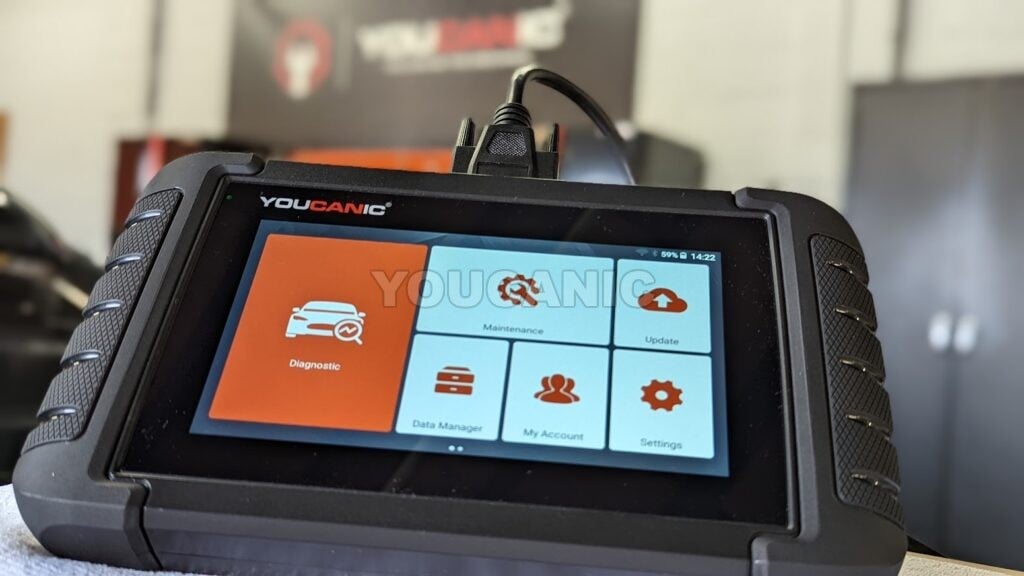
If the Check Engine Light is on after replacing the manifold pressure sensor, you can use the YOUCANIC UCAN-II Pro to reset the Check Engine Light. This scanner can also read and clear fault codes in the engine and other control modules on supported vehicles.
Make sure you are replacing the right sensor
On a naturally aspirated Ford there is usually one manifold absolute pressure sensor and the job is straightforward. On a turbocharged EcoBoost engine there is more than one pressure sensor in the induction system, and they are easy to confuse. There is typically a combined temperature and manifold absolute pressure sensor in the charge air path after the intercooler, and a separate barometric pressure sensor which may be mounted on its own or integrated elsewhere.
Check the wiring diagram or the live data labels for your specific engine before ordering, because the two look similar, sit close together and carry different part numbers. Replacing the wrong one is a common and entirely avoidable waste of an afternoon.
Remember that on many Fords this sensor also serves as the barometric reference. The module reads it at key on, before the engine starts and while the manifold is still at atmospheric pressure, and uses that figure to compensate fueling for altitude. A sensor that reads incorrectly therefore skews the mixture everywhere, not only under load, which is why the symptoms can seem out of proportion to a single sensor.
On EcoBoost engines, check for boost leaks first
A pressure reading the module rejects is often an accurate measurement of a system that is leaking. On turbocharged Ford engines the usual culprits are the couplers and clamps either side of the intercooler, which work loose or split, and the charge air pipes themselves, which crack with heat cycling. A leak there lets boost escape, so the pressure the sensor reports never matches what the module commanded.
The symptom that usually accompanies this is a sudden loss of power, sometimes described as limp mode, which clears when the engine is switched off and restarted and then returns under hard acceleration. If that pattern sounds familiar, pressure test the charge air system before buying a sensor. Condensation collecting in the intercooler is worth checking at the same time, since it is a known characteristic of these engines in cold damp weather.
On older naturally aspirated engines, look instead for a cracked plastic intake manifold, a perished vacuum hose or a failed gasket. Any of these weakens manifold vacuum, pushes the reading toward atmospheric pressure, and produces exactly the high input condition this code describes with a perfectly healthy sensor fitted.
After the repair, let the monitors run
Clearing the code also clears the keep alive memory, which holds the adaptive fuel trim values the module has learned over time. The engine may idle unevenly or feel slightly flat for the first few miles while it relearns, and that is normal rather than a sign the repair failed.
It matters more if you have an emissions test coming up. Clearing codes resets the readiness monitors to a not ready state, and a vehicle presented for testing with monitors incomplete is rejected regardless of whether any fault remains. The monitors only complete after a specific pattern of cold starts, idling, steady cruising and deceleration, which usually takes several days of ordinary driving.
A full system scanner shows readiness monitor status along with live manifold pressure, so you can confirm both that the sensor now reads sensibly and that the car is ready to be tested, rather than finding out at the testing station.
Frequently Asked Questions
What does P0108 mean on a Ford?
P0108 means the engine computer sees a voltage that is too high on the manifold absolute pressure (MAP) or barometric pressure sensor circuit.
Can I drive with code P0108?
Usually for a short time, but the engine may run poorly and use more fuel. Fix it soon to avoid further problems.
Is P0108 always a bad MAP sensor?
No. Wiring and connector problems are common causes. Check them before replacing the sensor.
How do I test the MAP sensor?
With the key on and engine off, the live MAP reading should be close to barometric pressure. At idle it should drop well below that.
Related Guides
- Ford P0340 Code: Camshaft Position Sensor Replacement
- Ford Read and Clear Fault Codes
- Check Engine Light on in your Ford? How to Fix the code P0443
- Ford ABS Wheel Speed Sensor Replacement DIY