

Volvo ABS Anti-skid Service Required
Reviewed/Verified by:

The ABS (Anti-lock Brake System) and anti-skid systems in a Volvo vehicle are designed to prevent the wheels from locking up during heavy braking and to maintain traction and stability on the road. When the ABS anti-skid service required message appears, it generally indicates an issue with one or more of the brake system’s components, and that service is needed to resolve the issue.
At a Glance
- Most common cause: a wheel speed sensor or its connector, particularly in areas that salt the roads.
- Second: low battery voltage. Volvo disables anti skid when voltage sags, with no hardware fault present.
- Third: the ABS control module, which on some Volvo models is a known failure with a repairable circuit board.
- Also check: the brake light switch and, on AWD models, whether tire sizes match.
- Safe to drive? The base brakes work. ABS, anti skid and traction control do not. Allow extra distance, especially in the wet. If the red BRAKE warning light is on as well, do not drive the car until the brakes are checked, because brake force distribution or the fluid level may be affected.
Volvo ABS uses wheel speed sensors to monitor each wheel’s rotation. If the system detects that one or more wheels are locking up during braking, it will automatically intervene by reducing brake pressure to that wheel, allowing it to continue rotating. This helps the driver maintain steering control and avoid skidding or losing control of the vehicle.

Volvo Anti-skid system, also known as electronic stability control (ESC), monitors the vehicle’s motion and compares it with the driver’s intended direction. If the system detects that the vehicle is not following the driver’s intended direction, it will automatically apply the brakes to individual wheels and reduce engine power if necessary to help the driver regain control of the vehicle.

🔧 Find out what is actually wrong before you pay someone to guess
Dealer level diagnostics at home with the YOUCANIC UCAN-II Pro.
- ✔ Covers most makes and models, including many luxury brands. Send us your VIN and we will confirm your car before you order
- ✔ Reads every module, not just the engine, so you find the faults a basic reader says are not there
- ✔ Commands the car: test a fan or pump, bleed ABS, retract an electronic parking brake, register a battery
- ✔ No subscriptions. Free lifetime updates, so the price you pay is the whole price
- ✔ Backed by real mechanics in the USA you can email before and after you buy
Featured in The Wall Street Journal
When the ABS anti-skid service required message appears, it could indicate a problem with one or more of the components of the brake system, such as a malfunctioning wheel speed sensor, a problem with the brake control module, or a problem with the brake pads or rotors. It may also indicate a problem with the anti-skid system, such as a malfunctioning yaw rate sensor or a problem with the control module.
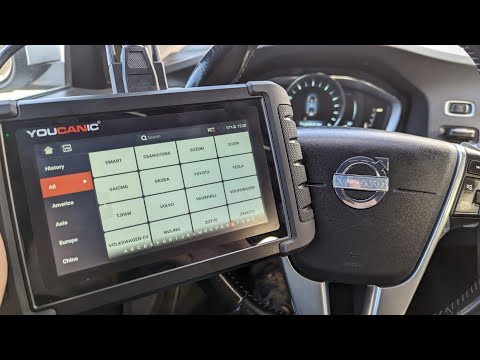
The best way to diagnose and correct the issue is the trouble codes stored in the ABS and Anti-skid control modules. This will indicate the problem, and the mechanic can proceed with the repair accordingly.
What does Volvo ABS Anti Skid Service Required Mean?
Volvo warning message ABS Anti-skid service required displays on the instrument cluster when the ABS malfunctions. Volvo anti-lock brake system (ABS) light will come on when the ABS module detects a problem with the ABS pump, ABS wheel speed sensors, steering angle sensor, or the ABS control module. Wheels may lock up during braking and lose tractive contact with the road. The vehicle may skid and require a longer distance to stop during hard braking situations.
If your Volvo has traction or stability control, those systems may cause the car to go into limp mode or even stall while driving.
Symptoms
In addition to the ABS light, you may experience one or more symptoms.
- ABS Service Required
- Brake light on
- Anti-skid disabled
- Traction light on, STC light on
- Traction Off
- Check engine light
- Car shuts off unexpectedly
- Odometer shows
------mileage - The cruise control stops working
- Transmission shift light
- Brake failure, stop asap
- Speedometer works intermittently
- Sluggish acceleration
- Anti Skid Temporarily Off
Many of these symptoms are intermittent. You may experience these problems more frequently if the weather is extremely hot or humid or if you drive on a bumpy road. They often disappear when the car is restarted. A defective Central Electronic Module causes some of these symptoms.
Common Causes
Some common causes that trigger Volvo ABS anti-skid service required message include:
- Faulty wheel speed sensors: These sensors monitor the rotation of each wheel and send information to the ABS control module. If a sensor is malfunctioning or damaged, the ABS may not be able to properly monitor the wheel speed, which can lead to the service required message.
- Worn brake pads or rotors: If the brake pads or rotors are worn or damaged, it can affect the ABS’s ability to control the brake pressure properly.
- Failed brake control module: The brake control module is responsible for processing information from the wheel speed sensors and controlling the brake pressure. It can result in the ABS anti-skid service required message if it fails.
- Failed yaw rate sensor: The anti-skid system uses the yaw rate sensor to measure the vehicle’s rotation and compare it to the driver’s intended direction. It can result in the ABS anti-skid service required message if it fails.
- Failed control module: The control module is the central processor of the ABS and anti-skid systems. It can result in the ABS anti-skid service required message if it fails.
- Corroded or damaged wiring: Corroded or damaged wiring can cause communication errors between the ABS control module and other components, resulting in the ABS anti-skid service required message.
- Wiring short
- Central Electronic Module (CEM) defective
- Low battery voltage
It’s important to note that other issues can also cause the ABS anti-skid service to require a message. The most accurate diagnosis can only be obtained by connecting the vehicle to a diagnostic scanner and reading the trouble codes stored in the ABS and Anti-skid control modules.
Soft Reset Volvo ABS

Park the car in a safe spot. Turn off the ignition. Wait for fifteen seconds and restart the car. In many cases, a soft reset will turn off the Volvo ABS light. If the ABS light comes back on, diagnose your Volvo, as the problem will eventually return.
Read Volvo ABS Codes
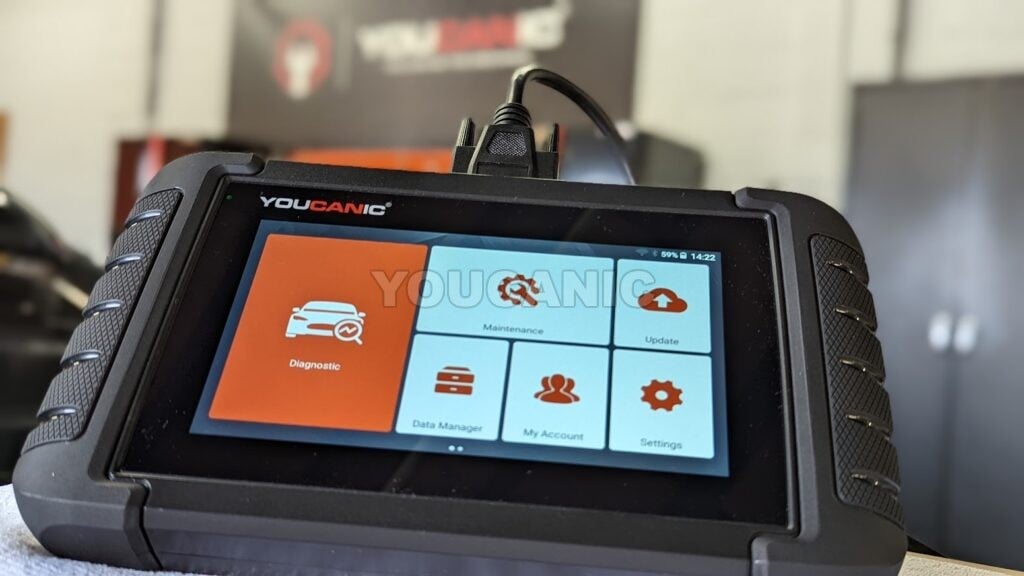
The next step is to use a scanner such as the YOUCANIC UCAN-II Pro scanner to read Volvo ABS module fault codes. Generic OBD2 scanners cannot read Volvo ABS codes. Use a Volvo-specific scanner. The YOUCANIC UCAN-II Pro can read and clear fault codes in the engine and other control modules on supported vehicles.
Troubleshooting Volvo ABS Malfunctions
The Volvo ABS warning light on the instrument cluster should go out after starting the engine, indicating that the system is okay. If the light stays on after starting the engine, it indicates a malfunction.
ABS Module

Volvo ABS units have a very high failure rate due to faulty solder joints. The traction control light may come on when the ABS module and the ABS light fail. Once the ABS module fails due to broken joints, it loses communication with the ABS pump, wheel speed sensors, and other modules. A fault code in the ABS module describes what triggered the ABS error. You can use the scanner to diagnose the Volvo ABS module.
Remember that you can’t use a generic OBD2 scanner to diagnose Volvo ABS problems. You can use any Volvo scanner that can read ABS module fault codes. ABS module failure on Volvo vehicles such as XC70, V70, S60, S40, V40, V50, XC60, XC90, S60, S70, S80, C30, and XC90 is quite common.
If you get a fault code for the high-pressure ABS pump or a defective wheel speed sensor, the issue may be the ABS module, not those components.
Common Volvo ABS Fault Codes
- ECM-A02B Communication, the control module for ABS-faulty signal
- CEM-1A5F Communication with ABS control module Signal missing
- ABS-0070 Pump motor faulty signal
- ABS-0080 Control Module faulty signal
- ABS: 0115 Communication between control modules
Quite often, mechanics who do not have experience working on Volvo vehicles may misdiagnose the problem.
For example, they replace the ABS wheel speed sensor because the fault says it’s a bad sensor. However, replacing the ABS wheel speed sensor may not fix the problem because the issue is with the ABS module’s connections.
Check Fuses

The first step is to check the fuses for the ABS module. You don’t need any special tools for this. Locate the fuse panel on the engine bay and dashboard side. Look at the chart for the ABS fuse. If the fuse is blown, replace it.
Replace ABS Relay

Inspect the ABS relay, which is typically located in the fuse box in the engine bay. It isn’t easy to visually verify if the relay is working properly. Replace it with a working one.
Wheel Speed Sensor

When you read the ABS codes with a Volvo scanner, you may get a fault code for a faulty wheel sensor signal circuit fault. The first step would be to remove one wheel and check your wheel speed sensors for dirt or debris.
Next, you will need to replace the ABS sensor. If the ABS light stays on after replacing the wheel ABS sensor, clear the fault codes from the ABS module. If you cannot clear the ABS fault codes, the most likely issue is a defective ABS module.
Check the Brake Fluid Level

A low brake fluid level will trigger the brake light to come on and a warning message. Check the brake fluid level as soon as possible. Have your car diagnosed ASAP if you keep loose brake fluid. Your car should not lose any brake fluid. If you are losing brake fluid, you have an issue that needs to be addressed immediately.
How to fix a Volvo ABS module?

There are a couple of ways to fix Volvo ABS module problems.
- You can have the Volvo dealer replace the ABS module, which costs $1000+. The dealer’s average Volvo ABS module repair cost ranges between $1500 and $2000.
- A cheaper alternative is to remove the module yourself and send it to a specialist offering a Volvo ABS module repair service, such as Module Medics. The specialist disassembles the unit and repairs the broken solder connections. Because the module coming back is the same one already matched to your car, this route also avoids the coding step that a replacement unit requires.
Replacing the module with a used unit works on older models. Used modules no longer work on newer Volvo models because the VIN must be coded into the module and match the car.
What does it mean when my Volvo says anti-skid temporarily off?
When your Volvo displays the message “Anti-skid temporarily off,” it generally means that the vehicle’s electronic stability control (ESC) system has detected a problem and been deactivated. The ESC system, also known as the anti-skid system, is designed to help the driver maintain vehicle control by automatically applying the brakes to individual wheels and reducing engine power if necessary.
If the battery supplying power to the ABS/DSTC system is low, the system may behave abnormally, and as a safety measure, it will be temporarily disabled. This message may occasionally appear, particularly if the ignition has been on for an extended period. To avoid any potential issues, it’s recommended to have the battery checked by a qualified Volvo technician who can use a diagnostic scanner. Your Volvo dealer may even offer a free battery check. It’s best to address this issue as soon as possible to ensure the proper functioning of the ABS/DSTC system and avoid potential safety hazards.
Rule out the cheap causes before the module
Given the cost of an ABS module, work through the inexpensive possibilities first, and the article above lists most of them. Two are worth emphasising because they are so commonly missed.
The first is battery voltage. The ABS and stability modules are sensitive to supply voltage, and a tired battery produces exactly these warnings while the car still starts and drives normally. If several unrelated lights appeared on the same day, or the message comes and goes on cold mornings, have the battery load tested properly before anything else.
The second is the encoder ring rather than the sensor. On many modern vehicles the wheel speed sensor reads a magnetic encoder molded into the wheel bearing seal rather than a separate toothed ring. When that encoder is damaged by rust or by a bearing fitted the wrong way round during an earlier repair, the sensor tests perfectly while still producing no usable signal. The symptom is a signal that works at low speed and drops out as the car gains pace, and the fix is the wheel bearing rather than the sensor.
As the article notes, the codes live in the ABS module and a generic OBD-II reader cannot see them at all, which is why owners so often report that their code reader finds nothing while two warning lights sit on the dashboard. A full system scanner that supports Volvo chassis modules will read those codes and show the live wheel speed values, which tells you in seconds whether one corner is reporting zero while the others are reading correctly.
What This Repair Costs
| Repair | Typical total cost |
|---|---|
| Battery replacement | $250 to $450 |
| Brake light switch | $80 to $180 |
| Wheel speed sensor | $170 to $350 installed |
| ABS module rebuild using your original unit | $300 to $700 |
| New ABS module with programming | $1,100 to $2,400 |
Rough US estimates for planning, not quotes. Prices vary widely by model, parts brand and region, so get a written quote before committing.
The rebuild route matters on Volvo ABS modules specifically. The common failure is in the module circuitry rather than the hydraulics, so repairing the original unit keeps your programming and avoids most of the dealer bill.
When to Stop and Hand It Over
- All four wheel speed signals drop out, which points at the module or its supply.
- The fault returns immediately after clearing with a good battery.
- Programming is needed after module replacement.
Finding the Cause Instead of Guessing
A generic OBD2 reader shows a clean scan on every cause listed above, because none of them are emissions faults. That is why the anti skid light is one of the most commonly misdiagnosed warnings on these cars.
The scanner reads Volvo ABS and anti skid codes, shows live wheel speed from all four sensors and system voltage, and clears the faults after the repair. If one wheel reads zero while the other three track together, you have your answer and it is a cheap one. If all four look right and voltage is low, the battery is the answer and it is cheaper still.
Where the module is confirmed, a rebuild through a specialist such as Module Medics is usually a fraction of the dealer price for a new programmed unit.
Frequently Asked Questions
Can I continue to drive my Volvo if the ABS light is on?
When the anti-lock brake system fails, the brakes will still operate normally but without ABS. If you slam on the brakes during an emergency stop, the wheels may lock up. If your Volvo has traction control, that system will also be disabled. You can continue to drive with extra caution. Get your Volvo diagnosed as soon as possible.
Where is the Volvo ABS module located?
The ABS module is located on the left side of the engine compartment under the ABS pump. It has Torx bolts but can also be removed with a 4mm socket.
Can I drive my car with no ABS module?
Yes, most models. We do not recommend it. The ABS module can be removed, and the pump can be left in place, allowing the vehicle to be driven with normal brakes but no ABS.
Does Volvo make its own ABS module?
Volvo does not make its own ABS Control Module. They are, in most cases, made by Bosch or ATE.
Is it safe to drive with the ABS light on?
Your ordinary brakes are unaffected and will stop the car normally, because the hydraulic braking system works independently of the ABS. What you lose is everything layered on top of it: anti lock braking in an emergency stop, the anti skid stability control, traction control, and on many Volvo models the hill start assist and any adaptive cruise function as well.
That is a real loss in the wet, in snow and in any situation where you have to brake hard and steer at the same time, which is precisely when you would most want it. Short local journeys in good conditions are reasonable while you arrange a repair. Driving through a winter on it is not, and a car with ABS and stability lights illuminated will fail inspection in most jurisdictions.


Have a similar problem with my 2005 XC90. Warning lights are as stated above, plus the ABS sometimes tries to work with one pulse per wheel revolution (hence jerky braking). This problem can usually be fixed by re-applying the brakes. If I remove both ABS fuses, the brakes work fine except no ABS and the warning lights are still illuminated. Strangely under these conditions the odometer no longer works!
I wonder if your water incident affected the sensors, not the ABS module, which most analysts seem to suspect? One (of two) mechanics I consulted, suspected degradation of the wheel “cogs” which provide the wheel motion information – still an expensive replacement.
Every “real” fix seems to cost $1,000+ so I’m with you on accepting no ABS. It would be nice to disable the warning lights and get the other display functions back though. Any other tips will be welcomed.
Had both (abs and anti-skid) lights/warnings come on my 2005 XC90 2,5t awd after driving through standing water. Caused hesitation at 20 mph…only a minor annoyance for a while, then began taking longer and longer for throttle to “kick in”, until I found myself cruising around a parking lot for almost 10 minutes. Disconnected battery, checked fuses. In engine compartment, numbers 14 and 19 control abs. Removed 19 and warning went to brake failure stop immediately along with red lights. Then removed 14 and still got both warning messages, but anti skid icon went off (abs still on yellow) but no hesitation! Have been driving for a few hundred miles now with no obvious bad effect. I know that abs system is compromised, but car still brakes fine, though I haven’t had emergency situation. I THINK I am content with this “new normal” as opposed to paying thousands of dollars to fix the module.