

Kia ABS Module Pump ESC Control Unit Replacement
Reviewed/Verified by:

The ABS module on a Kia, which Kia calls the HECU (hydraulic and electronic control unit) or ESC module, controls anti lock braking and stability control. When it fails you get ABS and ESC warning lights, and on many models there is a second, more serious issue: Kia has recalled millions of these modules because brake fluid can leak inside them and cause an electrical short and an engine compartment fire. This guide starts with that, then covers diagnosis, replacement, bleeding, coding and cost.
Read This First: Fire Risk Recalls
If you smell burning or melting plastic, see smoke from the engine bay, or the ABS light comes on suddenly with a check engine light, stop driving, park outside away from buildings, and have the car towed to a Kia dealer. That is Kia’s own instruction for the affected cars.
Kia has issued a series of recalls on the ABS/ESC module for engine compartment fire risk. The largest, 23V-652, covers about 1.73 million vehicles on its own. Until each recall was repaired, Kia advised owners to park outside and away from structures. The repairs are free.

🔧 Find out what is actually wrong before you pay someone to guess
Dealer level diagnostics at home with the YOUCANIC UCAN-II Pro.
- ✔ Covers most makes and models, including many luxury brands. Send us your VIN and we will confirm your car before you order
- ✔ Reads every module, not just the engine, so you find the faults a basic reader says are not there
- ✔ Commands the car: test a fan or pump, bleed ABS, retract an electronic parking brake, register a battery
- ✔ No subscriptions. Free lifetime updates, so the price you pay is the whole price
- ✔ Backed by real mechanics in the USA you can email before and after you buy
Featured in The Wall Street Journal
| Recall | Models and years | Remedy |
|---|---|---|
| 23V-652 | Borrego 2010 to 2019 (US territories), Cadenza 2014 to 2016, Forte and Forte Koup 2010 to 2013, K900 2015 to 2018, Optima 2011 to 2015, Optima Hybrid 2011 to 2013, Rio 2012 to 2017, Rondo 2010 to 2011, Sorento 2011 to 2014, Soul 2011 to 2013, Sportage 2010 to 2013 | Replace the ABS fuse |
| 22V-051 | Sportage 2014 to 2016, K900 2016 to 2018 | Replace the ABS fuses with lower rated ones |
| 21V-137 | Sportage 2017 to 2021, Cadenza 2017 to 2019 | Replace junction box fuses; software update on cars with electric parking brake |
| 20V-519, then 21V-331 | Optima 2013 to 2015, Sorento 2014 to 2015 | New fuse, plus inspect the module and replace it if it fails the test |
| 20V-518 | Stinger 2018 to 2021 | New fuse kit |
| 16V-815, then 22V-800 | Sportage 2008 to 2009 | Inspect the module and harness; replace the module, harness and fuses as needed |
Sources: the NHTSA records for each campaign, for example 23V-652, 22V-051, 21V-137, 21V-331, 20V-518 and 22V-800. Check your own VIN at nhtsa.gov/recalls or in the owners section of kia.com.
What the Fuse Remedy Does and Does Not Do
Most of these recalls replace a fuse with a lower rated one. They do not replace the module. The lower rated fuse is designed to blow if the module shorts, cutting power before it can overheat. That protects against fire, but it means that if the module later shorts, the fuse blows and you lose ABS and stability control, with the warning lights on.
So if your ABS and ESC lights come on after the recall fuse was fitted, the module may well be the cause, and you should go back to the dealer. Recall 21V-331 on the 2013 to 2015 Optima and 2014 to 2015 Sorento is one of the few where Kia’s remedy includes testing and replacing the module itself for free.
A class action settlement (Zakikhani v. Hyundai Motor Co.) added a warranty extension on ABS modules repaired or replaced under these recalls. The claim deadlines for reimbursement passed in 2023, but the extension itself is described as applying without a claim form. Details are at kiahecusettlement.com. How it applies to your specific car is a question for the dealer.
Not a Recall, but Related: Campaign SC252
Kia service campaign SC252 covers the 2022 Sorento, 2022 Telluride and 2022 to 2023 K5. The module may leak brake fluid internally. Symptoms include electric parking brake, ABS, ESC, Auto Hold or forward collision warning lights, with those systems disabled. The remedy is to inspect the module and replace it if it is leaking. Campaign bulletin.
At a Glance
- Check for recalls first. A free dealer repair beats any price on this page.
- Symptoms of a failing module: ABS and ESC lights, sometimes with the electric parking brake, Auto Hold and forward collision warning disabled.
- Cheaper causes to rule out first: a steering angle sensor that needs resetting, a brake light switch, a wheel speed sensor, and low battery voltage.
- Kia’s own test for a leaking module: a tiny parasitic current draw at the ABS fuse position with the ignition off. Above 70 microamps means replace the module.
- After replacement: the system must be bled using a scan tool, and on newer models the module also needs variant coding and sensor calibration.
- Cost: about $1,100 to $2,000 for a new genuine module (sale price), about $170 to $280 to repair yours by mail, and 1.8 to 2.2 hours of dealer labor per Kia’s own bulletins.
Symptoms and Fault Codes
- ABS and ESC warning lights, often together.
- On newer models, electric parking brake, Auto Hold and forward collision warning lights, with those features disabled.
- A pull to one side under braking or a soft pedal, from an internal hydraulic fault in the module.
- A burning or melting smell, or smoke. Stop and tow, see the recall section above.
Kia lists these codes as module related in its recall bulletin for the Sportage:
| Code | Meaning |
|---|---|
| C2380 | ABS/TCS/ESP valve error |
| C2402 | Motor electrical |
| C2112 | Valve relay error |
| C1503 | TCS/ESP switch error |
| C1604 | ECU hardware error |
Codes C1259, C1260 and C1261 relate to the steering angle sensor, and Kia’s bulletin CHA084 says to reset the steering angle sensor calibration before replacing anything. We have not listed wheel speed sensor code numbers because we could not confirm Kia’s numbering across models.
Rule Out the Cheaper Causes First
- Recall check. Free, and on some cars it includes the module.
- Steering angle sensor. If you see C1259 to C1261, or the car had an alignment or steering work, reset the calibration first.
- Brake light switch. A failing switch can turn on the ESC light. Kia recalled the switch on the 2007 to 2010 Rondo and Sportage, 2007 to 2011 Sorento, 2007 Sedona, 2010 to 2011 Soul and 2011 Optima (recall 13V-114). Other signs are brake lights that do not work, cruise control that will not cancel, and a shifter stuck in Park.
- Wheel speed sensors. On the 2021 and later K5 the active sensor output should switch between about 0.59 to 0.84 volts and 1.18 to 1.68 volts, tested through a 100 ohm resistor. Live wheel speed on a scan tool is the quicker check.
- Battery and charging voltage. Low voltage can disable stability systems.
Kia’s Test for a Leaking Module
This comes from Kia’s own recall procedure for the 2013 to 2015 Optima and 2014 to 2015 Sorento, and it is the most useful test on this page. With the ignition off, remove the ABS multi fuse and measure the current flowing across the empty fuse position. A module with brake fluid leaking inside it creates a small current path. Above 70 microamps (0.07 milliamps), Kia replaces the module. Also inspect the module connector for melting or burn marks. You need a meter that reads in microamps. Kia bulletin SC212.
What you will need
- New Kia ABS Pump
- 3/8 Ratchet
- Metric Socket Set
- Screwdriver
- Syringe
- Container
- Brake Fluid
Procedure
- Disconnect battery. Open the hood of your vehicle and disconnect the battery.
- Locate the ABS Module / ESC Control Module. On a Kia Optima, it is located in the engine bay, on the passenger side, near the firewall. Regardless of the Kia model, the ABS pump can be found in the engine bay.

- Unplug the connector. Press the red locking tab and release that first. Next, pull up the grey connector to unplug the wire harness.
- Use a syringe to remove the brake fluid from the master cylinder. Don’t let dirt or particles fall inside the brake fluid reservoir.
- Do not allow brake fluid to fall on your car’s exterior paint, as it causes damage to your car.
- Disconnect the brake lines from the ABS unit using an 11 mm wrench. The brake lines are held in place with flare nuts. On the 2016 Optima shown here there are four outlet lines to the wheels; other Kias have more, including two inlet lines from the master cylinder (six in total on the 2021 and later K5), so count and label every line before you remove any.

- Remove the ABS module. Remove the bolts that hold the brake module in place. Two 10 mm bolts need to be removed. Now, you should be able to remove the ABS brake module/pump.
- Install the new ABS module in reverse order. Do not let the new module’s ports stay open longer than necessary, and keep dirt out of the lines.
- Add brake fluid to the reservoir. The brake fluid level will go down as you bleed the air out of the system. Check the brake fluid level as you bleed the air, and add fluid if needed.
- Then bleed the system as described in the bleeding section below. A pedal bleed at the calipers on its own does not purge air trapped inside the new module.


Torque Specifications (2016 Optima)
These are the figures from the 2016 Optima in this guide. On the 2021 and later K5, Kia specifies 13.7 to 16.7 Nm and 18.6 to 22.6 Nm for the brake tube nuts and 19.6 to 29.4 Nm for the mounting nut. On the 2008 to 2009 Sportage, the lines are 12.7 to 16.7 Nm. Use the figures for your model.
- Brake Line Bolts (M10): 11 lb-ft
- Brake Line to Reservoir (M12): 16 lb-ft
- Bracket to frame bolts: 21 lb-ft
Bleeding and Coding After Replacement
This is the part the old version of this page got wrong, and it is the most common reason a DIY module swap ends with a soft pedal.
On the 2021 and later K5, Kia’s sequence after fitting the module is:
- A conventional pedal bleed at each wheel.
- ESC air bleeding with a diagnostic tool connected, which runs the module’s pump and valves to push trapped air out.
- A second conventional pedal bleed.
- Variant coding of the new module.
- Automatic sensor calibration, then longitudinal G sensor calibration, then an assembly check.
Fluid is DOT 4, about 414 cc, and bleeder screws are 6.8 to 12.7 Nm. Source.
On older models such as the 2008 to 2009 Sportage, Kia’s bulletins use the scan tool’s HCU air bleeding mode, bleeding in the order rear right, front left, rear left, front right, and warn not to run the ABS motor for more than 60 seconds at a time.
For Kias built roughly 2011 to 2020 we could not find a Kia document saying whether variant coding is required, so check with the module supplier before you buy. Specialists who repair your original module report that it goes back in without reprogramming, because it is the same unit.
Stepping on the brake pedal a few times is not enough to bleed a new module, whatever you may read elsewhere.
Part Numbers and Prices
New genuine modules from kiapartsnow.com in October 2026. Kia uses several numbers per model depending on options such as the electric parking brake, so confirm against your VIN.
| Model | Part numbers | Sale price (new) |
|---|---|---|
| 2016 Optima | 58920D5010, D5050, D5060, D5080 | $1,334 to $1,461 |
| 2013 Optima | 589202T550, 589204C550 | $1,309 to $1,349 |
| 2014 Soul | 58920B2506, B2586, B2720, B2760 | $1,098 to $1,374 |
| 2012 Sorento | 589101U860, 589101U960 | $1,558 to $1,612 |
| 2012 Forte | 589201M510, 1M640, 1M720 | $1,869 to $2,007 |
List prices (MSRP) run about $1,600 to $2,960. Used modules sell for as little as about $50, but a used unit carries the same leak risk as the one you are removing and, on newer models, still needs coding.
What It Costs
| Route | Typical cost |
|---|---|
| Recall repair, if your car is covered | No cost |
| Mail in repair of your module (UpFix, Sportage and Sorento) | $169.99 to $279.99 |
| New genuine module, part only | About $1,100 to $2,000 |
For labor, Kia’s own bulletins allow 1.8 to 2.2 hours to replace the module, and 7.4 to 8.0 hours if the wiring harness connector is damaged too. Mail in repairs of the electronics do not fix an internal brake fluid leak. If the module failed the leak test above, it needs replacing, not repairing. Module Medics, a YOUCANIC sister company, also repairs modules by mail; the same limit applies.
Where a Scan Tool Fits In
Three things on this page need a tool that talks to the ABS module: reading the ABS and ESC codes, running the ESC air bleed after a module is fitted, and resetting the steering angle sensor. A generic OBD2 code reader can do none of them.
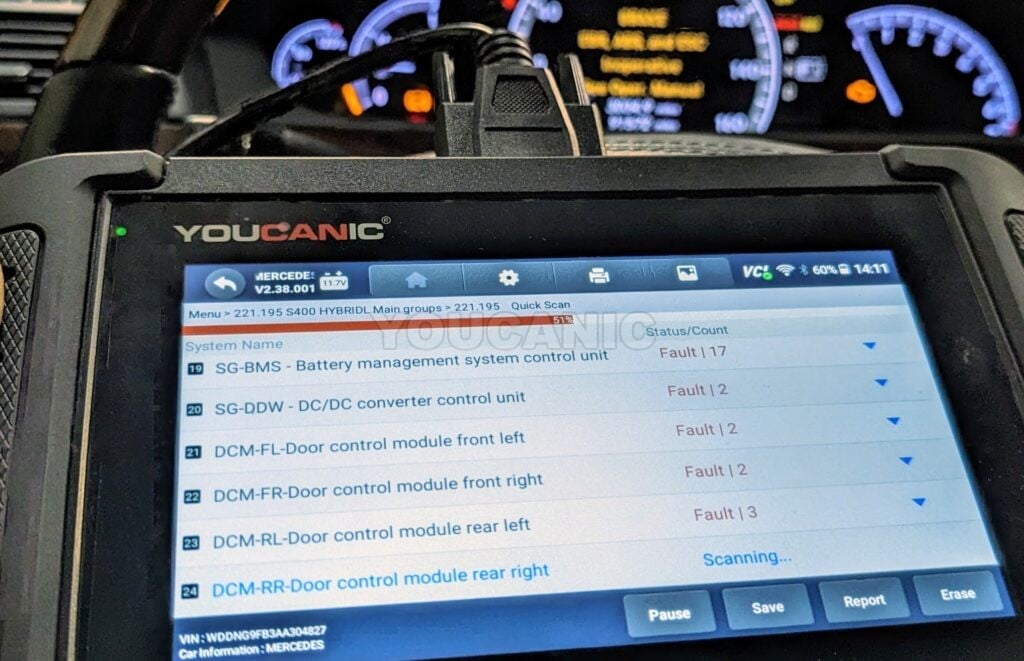
The YOUCANIC UCAN-II Pro reads Kia ABS and ESC codes and shows live wheel speeds. For the ESC bleed, variant coding and sensor calibration, check the scanner’s coverage list for your exact model and year before you start, because those functions vary by model.
When to Hand It Over
- Any sign of burning, melting or smoke. Tow it, do not drive it.
- Your car is under a recall. The dealer repair is free.
- You cannot run a scan tool ESC bleed. Without it, air trapped in the module can leave you with a soft or long pedal.
- The module needs variant coding and calibration and you do not have a tool that performs them.
- The connector or harness is melted. That is a much bigger repair.
Before you buy a module, or a tool
An ABS module and pump is one of the most expensive parts on this car, and it is replaced unnecessarily more often than almost anything else. A wheel speed sensor, a damaged sensor harness and a poor ground all set codes that look like a module fault from the dashboard. Those three are cheap, and the module should be your last conclusion rather than your first.
What you need to reach that conclusion honestly is the code and the live wheel speed values, which is a reading job rather than an ownership job. rent one for seven days if this is a single repair, or have a shop scan it once. Spending the price of a week long rental to avoid a wrong module purchase is the best value decision on this page.
Frequently Asked Questions
Can I drive my Kia with the ABS light on?
Normal braking usually still works, but ABS and stability control are off, so the wheels can lock in a hard stop. Drive gently and get it checked soon. If you smell burning or see smoke, park outside and away from buildings.
How do I know if my Kia is covered by a campaign?
Enter your VIN on the NHTSA recall site or the Kia owners site. Open campaigns for your exact car will show up there.
Why does the ABS module need coding after replacement?
A new module has to be set up for your car’s equipment, and the brakes usually need bleeding with a scan tool so air is purged from the pump.
Related guides: Troubleshooting Kia ABS light: Common Causes & Problems · Kia ABS Wheel Speed Sensor Replacement




The correct terms is called ‘bleeding’ the air from the ABS Module.
Bleeding or removing this air is very important. This is done by ‘bleeding the brakes’ Hence, simply step on the brake pedal a couple of times. As you keep on pressing on it, the air trapped inside will gradually be removed from the ABS module. Of course, you need to do this before you remove the whole module.
Please, how to remove air trapped in ABS module? Thanks
excellent breakdown in easy steps. very helpful
This article is very helpful. The ABS module in my Kia needs to be replaced but luckily the car is still under warranty. Nevertheless it was helpful to read about this issue. I am sure that other Kia owners will find it helpful as well.