Mercedes Anti-Theft Protection Activated: What It Means and How to Fix It
Reviewed/Verified by:

“Anti-theft protection activated” on a Mercedes COMAND or Audio 20 screen is the head unit locking itself, not the engine immobilizer. The car still starts and drives. Radio, navigation, phone and media go dark because the head unit did not receive the anti-theft data it expects from the engine control unit over the CAN bus. Mercedes’ own bulletin traces repeat cases to that communication link, and states that replacing or coding the head unit does not fix it.
At a Glance
- What it is: the head unit (COMAND or Audio 20) anti-theft lock. The engine immobilizer and the ATA alarm are separate systems.
- Can you drive? Yes. Only the head unit functions are disabled.
- Quick fix: switch the ignition off, lock the car, let it sleep, then restart. Mercedes lists an ignition cycle, a head unit reset and letting the bus go to sleep as temporary fixes.
- Real cause when it repeats: missing CAN data from the engine control unit, often a chafed or corroded harness, a glow plug output stage fault on OM651 diesels, or head unit software on some models.
- Do not buy first: a new head unit. Mercedes says replacing, updating or coding COMAND or Audio 20 does not cure the communication fault.
- Car will not start? That is a different problem (key, EIS or steering lock). Jump to If the car will not start.

What the Message Really Means

Mercedes technical bulletin LI82.85-P-058185 covers NTG4.5 and NTG5 head units in the 204 (C-Class and GLK), 207, 212 (E-Class), 218 (CLS), 166 (ML and GLE), 172, 117, 156, 176, 231, 246, 292 and 463. It describes the exact message, “Anti-theft protection activated. Please visit your Mercedes-Benz workshop,” and states the head unit cannot be used while the fault is active. The stored fault is 9561 or B156100: the PIN for the anti-theft protection is incorrect or missing. The cause is a CAN communication problem with the engine control unit (Mercedes TSB LI82.85-P-058185).
In plain terms, the head unit asks the engine computer for a security handshake every time it wakes up. If that answer arrives late, garbled or not at all, the head unit assumes it has been stolen and locks. That is why a fault in the engine wiring can kill your radio.

🔧 Find out what is actually wrong before you pay someone to guess
Dealer level diagnostics at home with the YOUCANIC UCAN-II Pro.
- ✔ Covers most makes and models, including many luxury brands. Send us your VIN and we will confirm your car before you order
- ✔ Reads every module, not just the engine, so you find the faults a basic reader says are not there
- ✔ Commands the car: test a fan or pump, bleed ABS, retract an electronic parking brake, register a battery
- ✔ No subscriptions. Free lifetime updates, so the price you pay is the whole price
- ✔ Backed by real mechanics in the USA you can email before and after you buy
Featured in The Wall Street Journal
Message Wording You May See
- Antitheft protection activated, switch ignition on, and restart the system
- Anti-theft protection is activated; please switch the ignition on and restart the system.
- Anti-theft protection activated. Service required.
- Anti-theft protection is activated please visit your Mercedes-Benz workshop.
The same bulletin lists related variants: “Enter security code,” “Service Required,” “Please enter activation code!” and “Antitheft protection active!”
Head Unit Lock vs Immobilizer vs Alarm
| System | What you see | Does it start? | First step |
|---|---|---|---|
| Head unit anti-theft | “Anti-theft protection activated” on COMAND or Audio 20; audio and navigation dead | Yes, drives normally | Ignition cycle and sleep, then scan for 9561 or B156100 |
| Drive authorization (immobilizer, DAS) | “Key not detected,” “Place key in marked space,” or crank and no start | No, or starts then stalls | Spare key, fob battery, emergency start position |
| ATA anti-theft alarm | Horn and hazard lights after unlocking or opening a door | Usually yes once disarmed | Unlock with the remote or insert the key; see the alarm section of your manual |
Mercedes owner manuals index the immobilizer and the ATA alarm as separate features, for example pages 72 and 73 in the 2014 C-Class operator manual. Treating the head unit message as an immobilizer failure is how owners end up paying for keys and ignition switches they did not need.
Quick Fix: Reset the Head Unit

- Park safely. The message does not affect braking, steering or the engine.
- Press and hold the head unit power button for about 10 seconds to force a restart.
- If that does not clear it, switch the ignition off, remove the key or open and close the driver door, and lock the car with the remote.
- Leave the car locked for at least 10 to 15 minutes so the CAN bus can go to sleep. Overnight is even better.
- Unlock, start the engine and only then switch on the head unit.
Mercedes lists an ignition cycle, a head unit reset and bus idle (sleep) as temporary remedies (TSB LI82.85-P-067191). If the message appeared once and never came back, the 2016 bulletin says to monitor only. If it returns, the communication fault is still there and needs a scan.
Why It Keeps Coming Back

1. Missing CAN data from the engine control unit
This is the root cause Mercedes documents. On cars covered by the 2016 bulletin, technicians are told to inspect circuit 30 and the chassis CAN pins at engine control unit connector F, front SAM connector 4I, and the harness routed under the wiper linkage for chafing and corrosion (TSB LI82.85-P-058185). Water under the cowl and rubbed through wiring are the usual findings.
2. Glow plug output stage on OM651 diesels
On four cylinder OM651 diesels, the same bulletin directs a test of the glow time output stage (N14/3) and notes the engine control unit may need replacement. A failing glow module can disturb the bus enough to trigger the head unit lock.
3. Head unit software on specific models
On the 218 CLS, Mercedes traced the message with fault B156000 (CAN data for anti-theft missing) to COMAND software and released a fix in head unit software 14/36.00 and later (TSB LI82.85-P-067191). For the 205 C-Class and 238 E-Class coupe and cabriolet, field measure 1805P54B33 updates Audio 20 and COMAND software through XENTRY, with a charger holding the battery above 12.5 V during the update (Mercedes field measure). Ask a dealer to check for open software campaigns by VIN; field measures are often done at no charge.
4. Low battery voltage
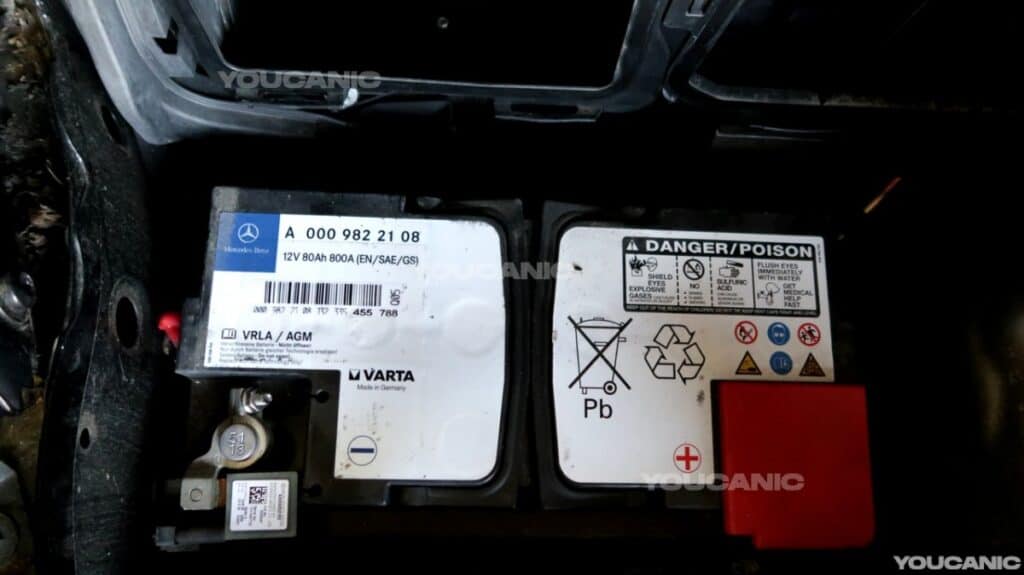
A weak 12 V battery does not appear in the bulletin as a direct cause, but voltage dips during cranking disrupt the same CAN messages, and Mercedes requires battery support above 12.5 V for any head unit work. A fully charged battery rests around 12.6 V; much below 12.4 V after the car sits overnight means it needs charging or testing. On models with an auxiliary battery, a failing auxiliary battery can add to the problem. See how to test a Mercedes battery, battery and alternator checks and Mercedes auxiliary battery malfunction.
5. Replaced or swapped modules
A used head unit, a replacement engine control unit or a new EIS that has not been correctly coded to the car can leave the anti-theft PIN missing. The fix is correct SCN coding or personalization at a dealer or a specialist with XENTRY access.
6. Brand new or recently delivered cars
On early 2014 production W205 C-Class cars with very low mileage, Mercedes found the head unit could stay dark because production or transport mode had not been switched off (TSB LI82.85-P-059362). That is a dealer delivery issue, not an anti-theft fault.
How to Diagnose It
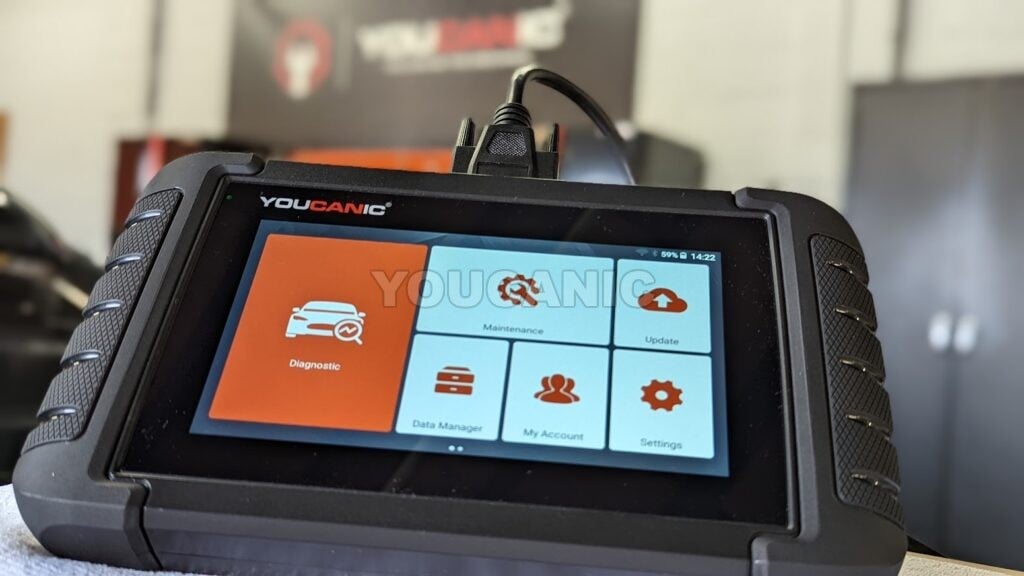
A generic OBD2 code reader only talks to the engine emissions system, so it cannot see the head unit or the CAN faults behind this message. You need a scanner that reads every Mercedes module. The YOUCANIC UCAN-II Pro runs a quick test of all modules, which is what you need here: the head unit code tells you what happened, and the engine control unit and SAM codes tell you why.
- Run a full quick test and save the report.
- Look for 9561, B156100 or B156000 in the head unit. These confirm the anti-theft lock.
- Check the engine control unit and front SAM for CAN communication or voltage faults. Those point to the wiring or module causing it.
- Clear all codes, drive, and scan again. Focus on the codes that return.
- Check battery voltage at rest and while cranking before condemning any module.
| Code | Meaning |
|---|---|
| 9561 / B156100 | PIN for the anti-theft protection is incorrect or missing |
| B156000 | CAN data for the anti-theft protection is missing |
| DA00 | Enabling the Audio or COMAND is not possible due to a CAN fault |
| DA01 | Anti-theft protection is activated, control unit disabled |
| A10A / A10D | Supply voltage too low |
| A10B / A10E | Supply voltage too high |
| C020 | Interior CAN bus off |
| A19C / A19D | Wake up line short to ground / short to positive |
| D016 / D017 | MOST fiber optic ring break |
| 0607 | Control unit malfunction |
Exact code numbers vary by head unit generation. The first two rows come from Mercedes bulletins; the rest are common COMAND and Audio fault texts seen alongside this message.
If the Car Will Not Start
If the car will not crank or start, you are not dealing with the head unit message. Messages such as “Key not detected” or “Place key in marked space” come from drive authorization: the key, the electronic ignition switch (EIS or EZS) and on some models the electronic steering lock (ESL or ELV). The Mercedes DAS anti-theft system guide covers that system in depth.
Key not detected or KEYLESS-GO fails
- Use the emergency position. Owner manuals for models such as the W205 and W213 say to hold the key in the marked space when the display asks; the car then starts, and the key must stay there for later starts on that trip (Mercedes owner manual).
- Replace the key battery. Mercedes keys use CR2025 cells; older chrome keys and plastic SmartKeys usually take two, newer chrome keys one (Mercedes dealer guide). Check the cell printed in your key, since newer key generations differ.
- Try the spare key. If the spare works, the problem is the first key, not the car.
- Press any key button. On 118, 167, 177 and 247 models, double pressing the lock button deactivates KEYLESS-GO until a key button is pressed, and the newest keys go to sleep after a period without movement (TSB LI80.61-P-069912).
A scan of this condition often shows P0513 (unauthorized key). A good scan tool should show start enable yes, immobilizer not activated, and valid key detected when the key is accepted (StarTuned, Mercedes technical magazine). If you are buying a key, read whether a used Mercedes key can be programmed first.
Key will not turn or no crank
On many 204, 207, 212 and 218 era cars this points to the EIS or the electronic steering lock. Mercedes bulletin LI54.25-P-056472 describes an EZS assembly defect on 166, GLK, 212, 218 and 246 models where the key is not recognized and the car will not start; the remedy is EIS replacement after the guided drive authorization test (TSB LI54.25-P-056472). For 2011 ML and 2011 to 2012 GL and R-Class, service campaign 2013040001 replaced the EIS at no charge on about 11,067 vehicles (Mercedes campaign bulletin). Run your VIN through the NHTSA recall lookup and ask a dealer about open campaigns.
Electronic steering lock failures on C and E-Class are common enough that FCP Euro calls them “all too common,” with dealer replacement quotes of at least $1,500 (FCP Euro). Some EIS and ESL faults can be repaired at module level rather than replaced; a specialist such as Module Medics can advise whether yours is a repair candidate.
What This Repair Costs
| Repair | What to expect |
|---|---|
| Head unit reset or bus sleep | $0 |
| Battery test and charge | $0 to $50 |
| Battery replacement | $220 to $450 |
| Dealer software update (field measure) | Often no charge if a campaign is open; otherwise diagnostic time |
| Harness repair under the cowl | Varies with damage; diagnostic time is most of the cost |
| EIS part, dealer list price | About $740 to $1,080 before programming |
| Electronic steering lock, dealer | $1,200 to $1,500 reported |
EIS list prices are from a Mercedes dealer parts catalog for 2006 to 2018 C, E and S-Class switches (MB Parts Giant). Other figures are rough US estimates for planning, not quotes; get a written quote before committing. A new EIS must be personalized to the car by a dealer or a specialist with Mercedes access.
When to Hand It Over
- The message returns after every reset and the scan shows CAN or voltage faults in the engine control unit or SAM.
- You find water or green corrosion in the cowl or at module connectors.
- The car will not start with either key and a known good battery.
- Any module has to be replaced, coded or personalized.
Sources
- Mercedes TSB LI82.85-P-058185, anti-theft protection activated (2016)
- Mercedes TSB LI82.85-P-067191, model 218 COMAND software (2017)
- Mercedes field measure 1805P54B33, models 205 and 238
- Mercedes TSB LI82.85-P-059362, W205 transport mode
- Mercedes TSB LI80.61-P-069912, KEYLESS-GO
- Mercedes TSB LI54.25-P-056472, EZS key recognition
- Mercedes service campaign 2013040001, EIS
- Mercedes W205 owner manual, emergency start
Frequently Asked Questions
Can I drive with anti-theft protection activated?
Yes. The message locks the head unit only. The engine, brakes and steering work normally. Get it diagnosed if it keeps returning, because the underlying CAN or wiring fault can grow.
Will a new COMAND or Audio 20 head unit fix it?
No, in the cases Mercedes documents. The 2016 bulletin states that replacing, updating or SCN coding the head unit does not cure the communication fault. The exception is models with a specific software fix, such as the 218 CLS.
Does disconnecting the battery reset it?
It can clear it temporarily, the same way letting the car sleep does. It does not fix the cause, and on many Mercedes models disconnecting the battery means resetting windows, sunroof and steering angle afterward. Locking the car and letting it sleep is the gentler reset.
Is there a code I need to enter?
Not on these COMAND and Audio 20 systems. The “PIN” in fault 9561 is exchanged electronically between modules, not typed by the owner. If the screen asks for a code, the module pairing is broken and needs a scan.
Related guides: Servicing Mercedes-Benz DAS Anti-Theft Systems · Can You Program a Used Mercedes-Benz Key · Understanding the Central Gateway Control Unit in a Mercedes-Benz Vehicle · Mercedes-Benz Auxiliary Battery Malfunction How to Replace It · Mercedes-Benz Check / Test Battery Voltage with Multimeter